
School Indoor Court Marking: Compliance & Safety Guide 2026

A confusing network of faded sports hall line marking isn't just a frustration for PE teachers; it's a documented safety risk that can lead to student injuries and failed inspections. You likely understand the challenge of managing a high-traffic hall where the surface is in constant use. There's often a legitimate worry that maintenance might damage expensive timber or vinyl flooring, or that the updated 34.5m x 20m Sport England hall standards won't be met with the necessary precision.
We're here to show you how to achieve a compliant, durable, and safe multi-sport environment with professional marking tailored for UK schools. This guide details the technical process of court renewal, from surface preparation to the specific hierarchy of line colours. You'll learn how to coordinate these works alongside your annual safety inspections to ensure your facility remains a high-performance space that withstands heavy daily use whilst adhering to the latest governing body regulations for the 2026 season.
Table of Contents
The Role of Precision Court Marking in School Sport Safety
Professional indoor court marking functions as a technical safety system rather than a simple aesthetic choice. It consists of high-friction, compliant lines that regulate the movement of students across a shared space. When these lines are clear and accurate, they provide the spatial awareness necessary to prevent player collisions and reduce confusion during fast-paced activities. A faded sports hall line marking layout makes it difficult for students to judge boundaries, leading to late stops or accidental incursions into other playing zones, which frequently results in injury.
The psychological impact of a professional environment shouldn't be underestimated. A hall that features crisp, official markings encourages better student behaviour and higher levels of engagement. When a facility looks like a professional arena, students often treat the space with more respect and approach their PE sessions with a more disciplined mindset. Conversely, a neglected floor with peeling tape or barely visible lines can lead to a lack of focus and a disregard for the rules of the game.
Temporary fixes like adhesive court tape often create more problems than they solve. Tape is prone to lifting at the edges, which presents a significant trip hazard in a high-intensity environment. These DIY methods also fail standard safety audits because they don't provide the consistent slip-resistance required by Sport England. Additionally, the adhesives used in these tapes can chemically bond with or strip away expensive timber and vinyl floor seals, leading to costly structural repairs that far outweigh the initial savings of a temporary solution.
Beyond Aesthetics: Why Compliance Matters
Adhering to Sport England and National Governing Body (NGB) dimensions is essential for any school that hosts competitive play or inter-school tournaments. Properly applied basketball court markings ensure the key, three-point line, and boundaries are accurate to within millimetres, ensuring fair play and technical safety. Schools that allow their markings to deteriorate face significant liability risks if an accident is traced back to poor facility standards. In the context of school sports hall safety, compliance refers to the strict adherence to National Governing Body dimensions and slip-resistance standards to ensure a facility is legally and technically fit for purpose.
The Impact of Faded Lines on PE Delivery
Confusing or faded sports hall line marking hinders effective teaching. When a single hall must accommodate multiple classes or different sports simultaneously, clear colour-coding is the only way to manage the space efficiently. If the lines aren't distinct, PE teachers spend more time officiating boundary disputes than actually coaching. Maintaining these standards is most effective when integrated into a regular schedule of indoor inspection and maintenance, ensuring that the playing surface remains as reliable as the sports equipment used upon it.
Navigating Governing Body Standards and Multi-Sport Layouts
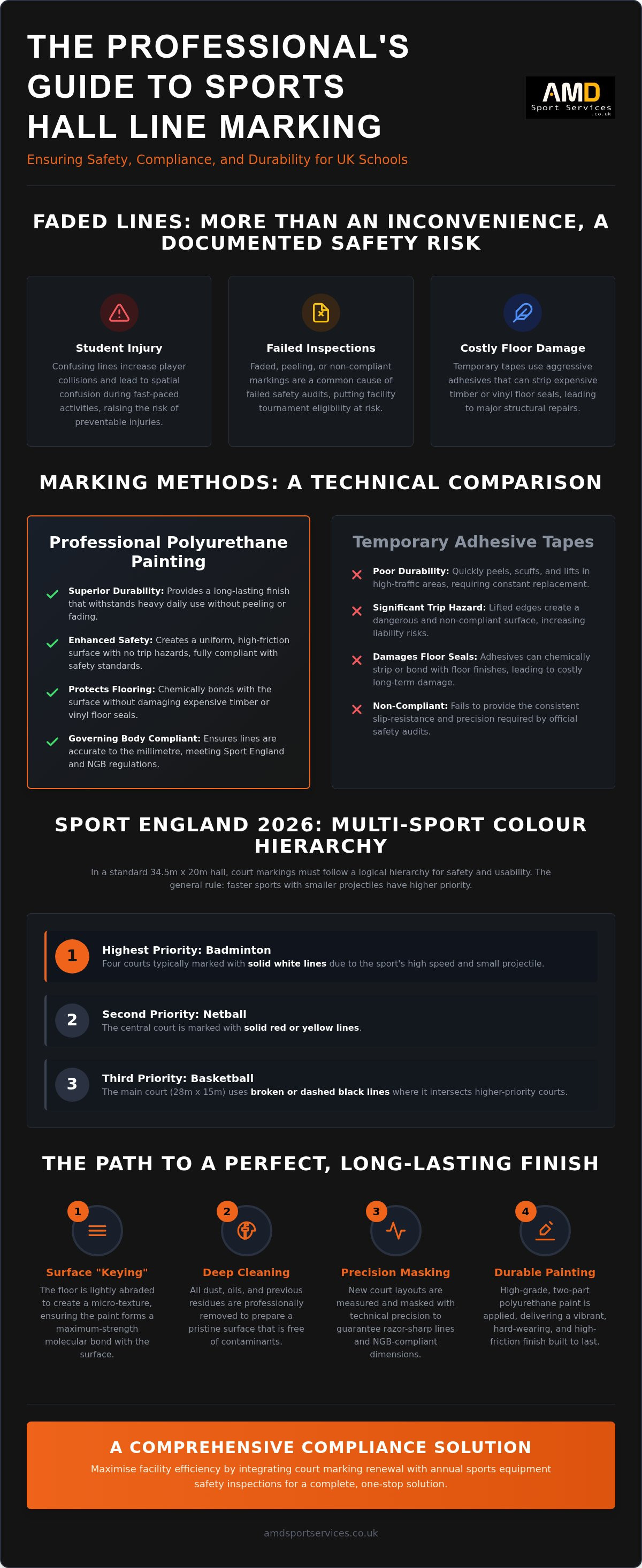
Managing a multi-use hall requires more than just painting lines; it demands a logical hierarchy. In a standard 34.5m x 20m four-court hall, the visual overlap can be overwhelming if not planned correctly. When dealing with faded sports hall line marking, the renewal process offers an opportunity to reorganise the layout according to Sport England 2026 standards. The general rule of thumb is that the faster the sport and the smaller the projectile, the higher the priority. Consequently, badminton lines often take precedence, appearing as solid lines whilst slower sports like basketball might feature "broken" lines where they intersect.
Safety margins, or "buffer zones", are non-negotiable. There must be adequate clearance between the court boundaries and the hall walls or stored equipment to prevent high-speed collisions. For example, a standard basketball court (28m x 15m) requires specific run-off areas to ensure players don't impact wall-mounted goals or division netting during play. Establishing these margins is a technical task that requires precise measurements to ensure the facility remains safe and compliant for both primary and secondary school use.
Common Multi-Sport Combinations for UK Schools
Most secondary schools require a combination of badminton, netball, and basketball. A standard layout prioritises four badminton courts, one central netball court, and a main basketball court. For primary schools, dimensions are often scaled down to accommodate younger players, but the need for clear zones remains identical. Integrating five-a-side football or volleyball requires careful planning to avoid visual clutter. Bespoke layouts allow us to fit these disciplines into irregularly shaped halls by adjusting the orientation of the courts whilst maintaining the necessary safety margins.
Governing Body Colour Coding
Adherence to specific colour palettes isn't just about tradition; it aids referees and players in making split-second decisions. For 2026, the standard hierarchy remains clear:
Basketball: White (28m x 15m)
Netball: Yellow (30.5m x 15.25m)
Badminton: White or Yellow (depending on primary hall use)
Volleyball: Red or Blue
Technical specifications usually dictate a 50mm line width, though futsal technically requires 8cm. In multi-sport environments, we often apply 50mm lines for all sports to maintain visual balance and prevent one court from dominating the space. The paint must offer consistent friction levels to meet ASTM F2772 safety standards for indoor sports surfaces. This ensures the floor remains safe for lateral movements, even over painted areas. If you're struggling with a confusing or faded sports hall line marking, you can view our maintenance services to see how we restore clarity to multi-use spaces.
Evaluating Marking Methods: Professional Line Painting vs. Temporary Solutions
Selecting the correct application method is a balance between immediate budget constraints and long-term facility health. For many schools, the sight of a faded sports hall line marking layout prompts a search for the quickest fix, often leading to the use of adhesive tapes or single-part floor paints. However, the technical differences between professional-grade two-part polyurethane (PU) paints and these temporary alternatives are vast. Water-based PU paints offer superior flexibility, allowing the lines to move with the natural expansion of a sprung floor without cracking. Unlike traditional solvent-based options, modern water-based PU is low-odour and quick-drying, making it ideal for the limited maintenance windows available in busy educational settings.
A professional marking renewal is designed to withstand at least five years of high-intensity use. When you consider the labour costs of frequent "patch-up" jobs, the professional route is almost always the more cost-effective choice. Temporary solutions often fail within a single term, requiring constant re-application that disrupts hall bookings. A single, correctly executed installation provides a stable, high-friction surface that meets safety standards throughout its lifespan.
Material Compatibility: Timber vs. Synthetic Floors
Different surfaces require bespoke bonding strategies. Whether your hall features Granwood blocks, blue vinyl, or traditional oak timber, the paint must be technically matched to the substrate. Poorly selected materials lead to "ghosting", where the shadow of the old faded sports hall line marking remains visible through the new finish. Achieving a permanent bond requires precise chemical synchronisation between the existing floor lacquer and the new line paint to prevent delamination. We identify the current floor seal before application to ensure the new markings don't peel or react with the surface.
The Pitfalls of Temporary Floor Tape
Adhesive floor tape is a significant liability in a school environment. Over time, the adhesive seeps into the floor pores, leaving a sticky residue that attracts dirt and drastically reduces slip-resistance. This can lead to a failure in TRL pendulum tests, which measure the surface friction required for safe play. Additionally, peeling tape creates trip hazards that are particularly dangerous during fast-paced sports like basketball or netball. While the hall is clear for marking renewal, it's also the optimal time to assess other safety infrastructure, such as your Professional Sports Hall Netting Systems, ensuring a fully compliant environment.
The Installation Process: Preparing School Facilities for Renewal
The renewal of faded sports hall line marking begins long before the first drop of paint is applied. A thorough initial assessment is the primary step in our workflow. We examine the integrity of the existing floor seal and identify any structural issues, such as loose timber blocks or deep gouges in vinyl, that could compromise the final finish. Once the surface is deemed sound, we perform a deep clean and "key" the surface. This involves a light mechanical abrasion of the top layer of floor lacquer, creating a microscopic profile that ensures maximum paint adhesion. Without this technical preparation, new lines are likely to flake or delaminate under the stress of high-friction sports.
Precision is achieved through laser-guided measurement tools and high-grade masking techniques. This ensures every court boundary aligns perfectly with the latest Sport England specifications. Site managers must plan for specific environmental conditions during this phase. Optimal paint curing requires a stable temperature and controlled humidity to prevent the paint from becoming brittle or tacky. Ventilation is also a key consideration; whilst modern water-based PU paints are low-odour, adequate airflow accelerates the drying process and ensures the hall is ready for use within the agreed timeframe.
Pre-Installation Checklist for Site Managers
To facilitate a smooth installation and ensure the longevity of the new markings, site managers should follow these steps:
Clear the hall of all portable equipment, including goal posts, gymnastic mats, and trampolines.
Disable underfloor heating 24 hours prior to the start of works to prevent the paint from drying too quickly and cracking.
Secure the area to prevent unauthorised access during the sensitive curing phase.
Integrating these works with your broader service and maintenance schedule ensures that the hall remains fully operational and compliant with the least amount of downtime.
The Professional Application Method
We employ a two-coat application process as standard for school environments. The first coat establishes the boundary, whilst the second provides the depth of colour and durability required for heavy daily use. Specialist line-marking machines are used to achieve razor-sharp edges, eliminating the paint bleed often seen with hand-painted DIY attempts. The process concludes with a final inspection, where we verify all dimensions against the original governing body specifications. If your facility currently suffers from faded sports hall line marking, you can book a professional court marking renewal to restore your hall to competition standards.
Integrating Court Marking with Comprehensive Facility Maintenance
Court marking renewal shouldn't be viewed as an isolated task. When a hall is cleared of equipment and the floor is prepared for work, it provides a unique window of opportunity to conduct a total facility compliance check. A faded sports hall line marking layout often signals that other safety infrastructure may also be overdue for an inspection. By coordinating the renewal of your playing surfaces with annual sports equipment safety inspections, you ensure that every component of the hall, from the floor to the ceiling-mounted apparatus, meets current UK safety standards.
AMD Sport Services operates as a seasoned practitioner in this environment. We understand that educational institutions face constant pressure to maintain high standards whilst managing tight schedules. Managing both surfacing and apparatus maintenance through a single contractor reduces administrative burden and ensures a consistent technical standard across the entire facility. This holistic approach prevents the common issue of overlapping maintenance visits, which can lead to unnecessary hall closures and increased labour costs.
The Holistic Safety Audit
Whilst the hall is empty for the marking process, our technicians perform a detailed assessment of all fixed and portable equipment. This includes:
Wall-Mounted Basketball Goals: Checking the integrity of the brackets, safety chains, and winch mechanisms to ensure they are secure and operational.
Netting Systems: Identifying frayed division netting or damaged tracking that could compromise the safety of multi-class PE sessions.
Floor Sockets: Inspecting floor-fixed sockets for volleyball or netball posts to ensure they are flush with the surface, preventing trip hazards for students.
Backboards and Hoops: Verifying that backboards are free from cracks and hoops are set at the correct height and tension.
If your facility requires updates beyond the indoor environment, we also specialise in external-sport-equipment-installation, providing the same level of technical precision to your outdoor courts and fields.
Planning Your Maintenance Cycle
Professionally painted lines using two-part polyurethane typically have a 5-7 year lifespan, depending on the intensity of use and the cleaning regime. We recommend that high-use secondary schools plan for a full faded sports hall line marking renewal every five years to maintain visual clarity and technical compliance. Budgeting for this as part of a multi-year maintenance cycle helps schools avoid large, unexpected capital outlays and ensures that safety inspections are never overlooked.
Taking a proactive approach to hall maintenance protects your investment in expensive flooring and equipment whilst providing a safe, professional environment for your students. To ensure your facility is fully prepared for the 2026 season, Contact AMD Sport Services for a comprehensive sports hall safety and marking assessment.
Securing Your Facility's Technical Compliance for 2026
Maintaining a high-performance sports hall requires moving beyond aesthetic fixes. Professional court marking acts as a critical safety infrastructure that protects students from spatial confusion and injury. By adhering to the latest Sport England 2026 standards and using durable, PU-based line systems, schools ensure their facilities remain competition-ready for years to come. Addressing a faded sports hall line marking layout is the first step toward a broader commitment to facility safety and technical excellence.
As a UK-wide specialist service, we provide governing body compliant dimensions that outlast temporary alternatives. Integrating these works with your annual equipment checks ensures a one-stop solution for total hall compliance. We invite you to Book a Professional Court Marking Assessment for Your School to identify necessary repairs and plan your maintenance cycle effectively. Taking these steps today guarantees a safe, professional playing environment that your students and staff can rely on.
Frequently Asked Questions
How long does it take to mark a school sports hall?
A standard four-court sports hall typically takes two to four days to complete from start to finish. This timeframe includes the technical preparation of the surface, precision measurement, and the application of two coats of professional-grade paint. Complex multi-sport layouts or halls requiring intensive deep cleaning may extend the process toward the four-day mark to ensure a compliant finish.
Can you paint new lines over old, faded markings?
You can paint new lines over existing markings provided the surface is correctly prepared through mechanical abrasion. We use a technical "keying" process to ensure the new paint bonds securely to the floor lacquer rather than simply sitting on top of faded sports hall line marking. This professional preparation prevents the new lines from peeling or delaminating during high-intensity PE sessions.
What are the standard colours for school sports hall lines?
Sport England 2026 guidelines dictate specific colours to maintain clarity in multi-use environments. The standard palette typically includes white for basketball, yellow for netball, and red or blue for volleyball. Adhering to these established colour hierarchies is essential for refereeing accuracy and ensures your facility meets the requirements for inter-school competitions and regional tournaments.
Do we need to sand the floor before new court markings are applied?
Full sanding is usually only required if the existing floor seal has completely failed or the surface is severely degraded. For most schools, a light mechanical "key" of the top lacquer layer is sufficient to achieve maximum paint adhesion. This method is less invasive than a full sand and seal, allowing for a faster turnaround whilst preserving the lifespan of your timber or vinyl floor.
Is it possible to add new sports markings, like Pickleball, to an existing hall?
Yes, adding new disciplines to an existing layout is a common request during a court marking renewal. We use laser-guided measurement tools to integrate new sports like Pickleball into your current hall hierarchy whilst maintaining necessary safety run-off zones. This allows your school to modernise its sports curriculum without the need for a full and costly floor replacement.
How soon can students use the hall after the lines are painted?
Students can generally return to the hall for light activities 24 to 48 hours after the final application. However, the paint requires a full seven days to cure completely before heavy sports equipment or trampolines should be moved across the surface. We provide a specific curing schedule as part of our handover to ensure the long-term durability of the new lines.
Will professional line paint damage our sprung timber floor?
Professional water-based polyurethane paint is specifically engineered to be safe for use on sprung timber and synthetic floors. These paints are technically matched to the floor's flexibility, allowing the lines to move with the natural expansion of the wood without cracking. They are low-odour and chemically compatible with most commercial floor lacquers, ensuring no structural damage occurs during or after application.
What governing body standards do school courts need to follow?
School courts must comply with the dimensions and safety margins set by Sport England and the relevant National Governing Bodies (NGBs), such as Basketball England and England Netball. These regulations define everything from the 50mm standard line width to the mandatory "buffer zones" between playing areas. Following these standards is a technical requirement for passing annual safety inspections and maintaining facility insurance.


Comments