
Sports Dividing Net Installation: UK Facilities Guide

A sports hall's ceiling is its most overlooked asset, yet it carries the literal weight of your facility's revenue potential and safety record. For many UK site managers, the challenge isn't just finding more space; it's making the existing square footage work harder without compromising on structural integrity. You likely recognise that a large, open hall is often an underutilised hall, but concerns over ceiling loads and confusing fire standards frequently stall necessary upgrades.
Professional sports dividing net installation provides a pragmatic solution to these pains. By integrating bespoke netting systems, you can transform a single-use area into a versatile, multi-sport environment that generates additional income through simultaneous bookings. This guide details how to achieve a fully compliant installation that adheres to BS 5867-2:2008 Type B flame retardancy and Sport England's latest design guidance. We will explore the technical workflows of manual versus motorised systems, the importance of structural load assessments, and the long-term benefits of expert maintenance for facility durability.
Table of Contents
Maximising Facility Utility with Sports Dividing Net Installation
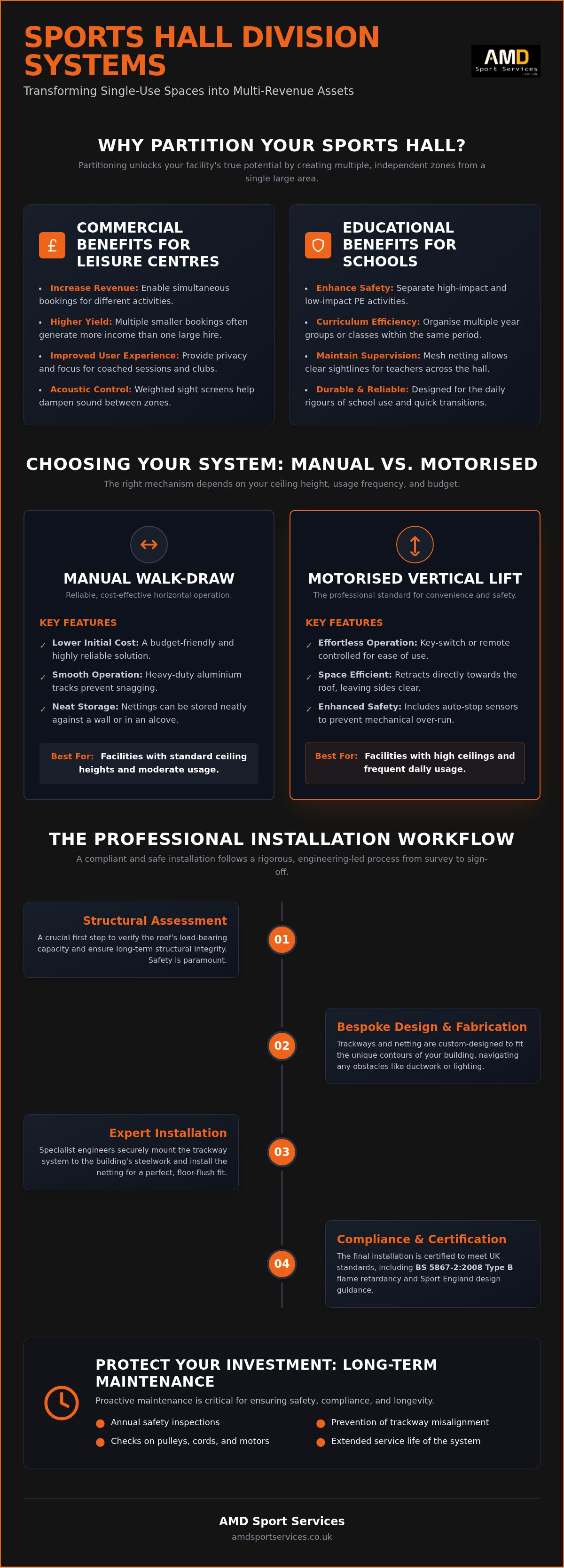
A sports hall is often the largest single asset in a school or leisure centre, but without logical partitioning, its utility remains limited. Effective sports dividing net installation serves as the primary tool for spatial management, allowing a single 34.5 x 20-metre hall to function as multiple independent zones. As a fundamental category of sports equipment, these netting systems provide the physical barrier necessary to host diverse activities simultaneously without compromising user safety.
The Commercial Case for Hall Partitioning
For leisure centre operators, the return on investment is driven by booking density. Partitioning allows for a 5-a-side football match to occur alongside a badminton session or a fitness class without the risk of stray balls. This separation is vital for improving the user experience for community clubs who require a degree of privacy and focus during coached sessions. According to Sport England's lifecycle cost guidance, maintaining high-utility spaces is essential for long-term financial sustainability. By splitting the hall, management can accept multiple smaller bookings that often command a higher cumulative hourly rate than a single whole-hall hire. Modern systems also address acoustic concerns, using weighted sight screens to help dampen the sound travel between different activity groups.
Educational Benefits for Schools
In the educational sector, hall division is a matter of safety and curriculum efficiency. Schools often need to organise multiple year groups within the same period, creating designated zones for high-impact sports whilst maintaining a safe area for low-impact activities like gymnastics. Because the mesh netting is transparent above the solid PVC sight screen, teacher supervision remains effective across the entire floor. This ensures that safeguarding standards are met even when the hall is partitioned into smaller segments. Our installations are designed to withstand the daily rigours of school use, ensuring that the transition between a full-hall assembly and divided PE lessons is quick and reliable.
Standard off-the-shelf solutions rarely suffice for older UK facilities with irregular roof pitches or obstructive ductwork. Bespoke design ensures that the trackway follows the specific contours of the building, maximising the available height. A tailored approach also accounts for local structural challenges, such as mounting to existing steelwork or navigating around light fittings, ensuring the netting sits flush with the floor to prevent ball escape during play.
Comparing Manual Walk-Draw and Motorised Dividers
Selecting the mechanical operation for your sports dividing net installation is a critical decision that impacts both daily logistics and long-term maintenance costs. The choice usually rests between manual walk-draw tracks and motorised vertical lift systems, each suited to different facility heights and usage patterns as outlined in the Sport England design guidance. Pragmatic planning at this stage prevents operational bottlenecks once the facility is in full use.
Manual Walk-Draw Netting Systems
Manual systems are often favoured for their reliability and lower initial capital outlay. We utilise heavy-duty aluminium tracks that provide a smooth, snag-free channel for the netting sliders. By incorporating bespoke junctions and curves into the track design, the netting can be stored neatly against a wall or in a designated alcove. This ensures the floor area remains entirely unobstructed when the nets aren't in use. Whilst these systems are simple, they do require periodic maintenance of the pulley and cord components to prevent fraying and ensure the tension remains consistent across the span.
Motorised and Electric Solutions
For facilities with high ceilings, motorised systems are the professional standard. Vertical lift curtains are particularly effective because they retract directly towards the roof steelwork, eliminating the need for side-storage bundles that can interfere with court run-offs. These systems include auto-stop safety sensors to prevent mechanical over-run and can be integrated into your building's management system for centralised control. If your current manual equipment is becoming difficult for staff to operate, our team can inspect your existing setup to determine if a motorised upgrade or repair is the most pragmatic way forward.
Beyond the mechanism, the choice of mesh size is vital for durability. Standard multi-sport halls typically require a 50mm mesh to stop smaller balls, whereas 100mm apertures are sufficient for basketball or netball zones. Crucially, every sports dividing net installation must adhere to BS 5867-2:2008 Type B performance for flame retardancy. This isn't just a recommendation; it's a core requirement for institutional safety compliance in the UK. We ensure every system meets these rigorous fire standards to protect both the users and the building's insurance standing.
Structural Engineering and Trackway Requirements for Indoor Netting
A successful sports dividing net installation relies entirely on the structural integrity of the host building. It's not enough to simply hang a net; the primary roof steelwork or concrete eaves must be evaluated to ensure they can safely support the static and dynamic loads of the trackway and fabric. This assessment is particularly vital for motorised systems, which introduce additional weight through motors and winch mechanisms. Adhering to Sport England's design and cost guidance ensures that these structural considerations are met before any physical work begins.
Roof and Eave Mounting Strategies
Every facility presents unique structural challenges. In modern steel-frame buildings, we typically fix directly to the portal frames using heavy-duty clamps. In older brick or concrete halls, bespoke bracketry is often required to bridge gaps or bypass existing ductwork. Telescopic roof brackets are an essential tool in our kit, allowing us to maintain a perfectly level trackway even when the ceiling height varies across the span. If you're concerned about the stability of your current setup, an indoor inspection and maintenance audit can identify potential points of failure in your mounting hardware.
Trackway Design and Layout
The efficiency of your hall division depends on the trackway layout. Crossover junctions are used to enable complex "T" or "L" shaped divisions, allowing you to create varied court configurations on the fly. We also incorporate curved track units to navigate around permanent obstructions like cricket net storage or wall-mounted basketball goals. Precise alignment during the installation phase is critical. Even a minor misalignment in the track segments can lead to increased friction, causing the sliders to snag and accelerating the wear and tear on the aluminium channel.
Structural planning must also account for the hall's mechanical services. We ensure all netting maintain strict clearance from high-intensity discharge lighting and radiant heaters. This prevents heat damage to the fire-retardant mesh and ensures that fire sprinkler coverage remains unobstructed. By using high-tensile tensioning systems, we keep the netting taut and clear of these services, ensuring the system remains both functional and safe for long-term institutional use.
The Installation Process: From Site Survey to Safety Certification
A successful sports dividing net installation is an engineering project that demands technical precision from the first site visit. We don't rely on generic hall dimensions because every building settles differently and structural steelwork is rarely perfectly uniform. Our process follows a logical, methodical sequence designed to eliminate operational risks before the equipment is even delivered to your facility.
The Importance of the Initial Site Survey
The survey is the most critical phase of the project. We identify potential obstructions amongst existing equipment, such as radiant heaters, lighting rigs, and basketball goals, that could interfere with the trackway path. Measuring exact dimensions is vital for preventing netting from sagging or leaving floor gaps that allow balls to escape during play. This technical assessment also determines the fixing methods required for your specific roof type, whether it involves concrete eaves or steel portal frames. View our previous installations to see how we've solved complex structural challenges in varied hall layouts.
Once the survey is complete, we move into the procurement and bespoke fabrication phase. Netting is cut to size and finished with weighted bands or PVC sight screens as per your specification. Trackways are pre-cut and curved in our workshop to ensure a perfect fit on-site. Managing an installation in an active school or leisure centre requires careful logistical planning. We coordinate our work to minimise disruption to your booking schedule, often working in phases to keep parts of the hall operational whilst the new system is being secured and tensioned.
Commissioning and Handover
The final stage is the formal commissioning of the system. For motorised installations, we test the travel limits and auto-stop sensors to ensure consistent alignment and safe operation. For manual systems, we verify that the pulley and cord mechanisms pull the netting tight without snagging the track. Our handover process includes several key steps:
Functional testing of all moving parts under tension.
Staff training on correct storage techniques to prevent mesh damage.
Verification of fire retardancy compliance for the facility records.
Issuing a formal safety certificate for your compliance file.
This certification is essential for institutional insurance and demonstrates that your facility meets current UK safety standards. If you are planning a facility upgrade, you can book a technical site survey to begin the assessment of your structural requirements.
Ensuring Long-Term Compliance: Maintenance and Repair of Division Systems
The completion of a sports dividing net installation marks the beginning of its operational lifecycle, not the end of your safety obligations. Institutional requirements in the UK dictate that all sports equipment must undergo a formal safety audit at least once every twelve months to remain compliant with insurance and health and safety standards. Proactive maintenance prevents minor mechanical issues from escalating into structural failures that could render your hall unusable.
What a Safety Inspection Covers
Our technical team conducts professional sports equipment safety inspections that go beyond a visual check. We focus on the high-stress points of the system, specifically examining the roof fixings and wall brackets for signs of structural movement or fatigue. In motorised systems, we inspect the wire ropes and pulleys for fraying, corrosion, or flat spots that indicate a pulley is seized. For manual systems, we check the tensioning of the lead cords and the integrity of the aluminium trackway sliders. This methodical approach ensures that every component is capable of withstanding the dynamic loads experienced during daily use.
Trackway misalignment is a common byproduct of building movement or heavy usage. If the track segments shift even slightly, the netting sliders will snag, causing staff to apply excessive force that can tear the mesh or bend the track. DIY repairs on high-tension systems or motorised winch units are hazardous and often void the manufacturer's warranty. It's far more pragmatic to engage a seasoned practitioner who understands the torque settings and limit switches required to keep the system balanced and safe.
Responsive Repairs and Refurbishment
Not every mechanical issue requires a full system replacement. We specialise in the responsive repair of netting sections, allowing us to replace only the damaged mesh whilst retaining the existing trackway and sight screens. This is a cost-effective way to maintain facility standards without the capital outlay of a new sports dividing net installation. We also offer motorisation upgrades for older manual systems, integrating modern safety sensors and remote controls into your current setup. For a deeper look at the technical specifications of these systems, you can read our Professional Sports Hall Netting Systems: The Ultimate UK Facility Guide 2026.
Regular servicing of motor control boxes and winch mechanisms is essential to prevent operational failure during peak booking times. By cleaning the tracks and lubricating the moving parts annually, you extend the service life of the equipment and ensure the hall remains a versatile, revenue-generating space. Our goal is to provide technical honesty; if a system is beyond safe repair, we'll provide a clear assessment and a bespoke plan for a compliant replacement that meets the latest BS EN standards.
Optimising Your Hall for Multi-Sport Performance
Implementing a professional sports dividing net installation is a pragmatic investment that fundamentally changes how your hall operates. By partitioning your space, you move away from the limitations of a single-use layout and open up new revenue streams through simultaneous bookings. The success of these systems relies on technical precision; from the initial structural load-bearing assessment to the final safety certification under current BS EN standards.
Our UK-wide specialist installation team brings over 20 years of technical expertise to every project, solving complex structural challenges that standard equipment cannot accommodate. Ensuring your facility remains safe and compliant requires a commitment to professional standards and regular maintenance. By prioritising quality at the installation stage, you secure a durable, easy-to-use environment for your staff and users alike.
Take the first step toward a more versatile facility today. Request a professional site survey for your facility to ensure your hall is safe, compliant, and performing at its full potential. We look forward to partnering with you on your next upgrade.
Frequently Asked Questions
How long does a sports dividing net installation typically take?
A standard sports dividing net installation usually takes between two and four days on-site, depending on the trackway complexity and ceiling height. This timeframe excludes the initial site survey and the bespoke fabrication period, which typically requires several weeks. We coordinate the on-site phase to minimise disruption, often working during school holidays or off-peak hours in leisure centres to ensure facility continuity.
Are sports hall division nets fire retardant?
Yes, all indoor division nets must comply with British Standard BS 5867-2:2008 Type B for flame retardancy. This is a non-negotiable safety requirement for UK institutional facilities. We ensure every mesh and PVC sight screen we install meets these performance standards, providing the necessary certification for your building's fire safety compliance file and insurance records to prove adherence to regulations.
Can you motorise an existing manual walk-draw net system?
We can often motorise existing manual walk-draw systems, provided the current trackway and structural fixings are in good condition. This process involves installing a winch motor and replacing manual pull-cords with high-tensile wire ropes. It's a pragmatic way to upgrade facility efficiency without the cost of a full sports dividing net installation, though a structural assessment of your roof steelwork is always required first.
What is the standard mesh size for multi-sport hall netting?
The standard mesh size for multi-sport halls is 50mm, which is small enough to stop most balls used in school and community sports. If the hall is primarily used for larger balls like basketballs or netballs, a 100mm mesh may be used to reduce the overall system weight. We assess your primary sports activities during the survey to recommend the most durable mesh aperture.
Do I need a structural survey before installing a new net trackway?
A technical assessment of the roof steelwork or concrete eaves is essential before any new trackway is installed. This ensures the building can safely carry the additional static load and the dynamic forces generated when nets are moved. We conduct this survey as part of our initial process to identify the correct fixing methods and bespoke bracketry required for a secure, long-term installation.
How often should sports hall dividing nets be inspected for safety?
Sports hall dividing nets should be inspected by a professional at least once every twelve months. This annual audit is a requirement for most UK institutional insurance policies and local authority safety standards. Regular inspections identify issues like trackway misalignment, frayed wire ropes, or loose fixings before they become hazardous, ensuring the system remains fully compliant and operational for all users.
Can you repair a torn sports net or does it need full replacement?
Netting tears can often be repaired by replacing specific sections or patching the mesh, which avoids the cost of a full replacement. However, if the damage is widespread or the fire-retardant coating has degraded, a new net is the only safe option. We provide a technical assessment of the damage to determine if a responsive repair or a full refurbishment is the most cost-effective path for your facility.
What is the difference between a division net and a protection net?
A division net is designed to split a hall into separate activity zones, often featuring a solid PVC sight screen at the bottom for visual privacy. A protection net is typically used to shield spectators, windows, or equipment from high-impact ball strikes. Whilst both use similar materials, their mounting structures and tensioning requirements differ based on their primary safety function and the specific structural challenges of the hall.


Comments