
Strength Equipment Reupholstery: The UK Facility Manager's Guide

A cracked vinyl pad on a resistance machine is never merely an eyesore; it is an unhygienic biomechanical hazard and a compliance breach waiting to happen. When faced with split seams that expose core foam to sweat and bacteria, facility managers often wonder whether they should track down costly OEM replacements, retire otherwise sound machines, or invest in professional strength equipment reupholstery.
You already know that equipment downtime frustrates gym members, disrupts scheduled athletic programmes, and risks failing health inspections. Sourcing discontinued factory parts rarely solves the issue quickly, whilst wholesale machine replacements rapidly drain capital budgets. Discover how commercial strength equipment reupholstery restores biomechanical safety, ensures complete hygiene and UK fire regulation compliance, and significantly extends apparatus service life. Below, we examine the essential safety standards, heavy-duty material specifications, and proactive maintenance strategies every facility manager needs to keep their gym floor safe, compliant, and operational.
Table of Contents
Why Strength Equipment Reupholstery Is Critical for Commercial Facilities
Commercial gym pads undergo punishing treatment. Every day, heavy resistance equipment endures continuous dynamic loading, abrasive friction from coarse sportswear, and saturation from acidic sweat. While many operators view torn vinyl as an unavoidable aesthetic flaw, treating pad restoration as purely cosmetic is a critical mistake. In commercial fitness environments, strength equipment reupholstery serves as a fundamental safety intervention that protects both user biomechanics and the structural integrity of expensive apparatus.
Biomechanical Stability and Hygiene Risks of Degraded Pads
When resistance pad foam breaks down, it stops distributing weight evenly. During a heavy chest press or hip thrust, compressed or uneven foam forces the user's spine, shoulders, and pelvis into asymmetrical angles. This instability diminishes joint control precisely when lifters require maximum structural support. At the same time, split vinyl exposes open-cell polyurethane foam to body fluids. Because porous foam cannot be sanitised with surface wipes, it becomes an active reservoir for sweat, odour-causing bacteria, and dermatological pathogens. During local authority environmental health audits, these unsealed tears represent immediate hygiene liabilities that project an impression of neglect.
Traditional upholstery materials and methods designed for domestic furniture collapse quickly under this combination of dynamic force and constant sanitisation. Commercial fitness pads require purpose-built construction engineered to withstand high shear stress without deforming.
Financial Asset Protection and Frame Preservation
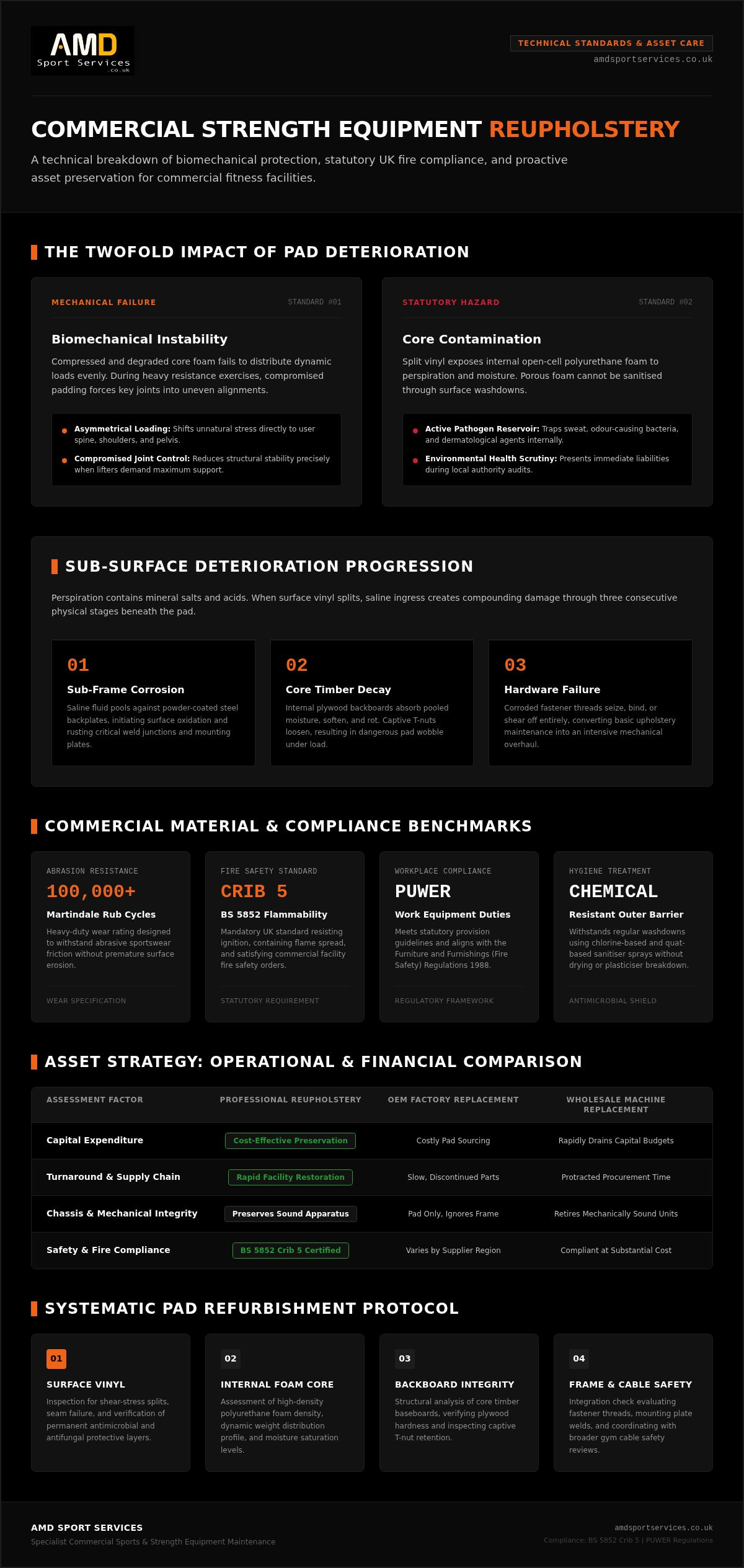
Moisture ingress causes invisible, compounding damage beneath the surface. Perspiration contains mineral salts and acids that migrate straight through cracked vinyl into the underlying substrate:
Sub-frame corrosion: Saline fluid pools against powder-coated steel backplates, rusting structural mounting plates and weld points.
Core timber decay: Plywood backboards soften and rot, loosening captive T-nuts and causing pads to wobble dangerously under load.
Hardware failure: Corroded fastener threads seize or shear off, turning a straightforward pad refurbishment into an intensive mechanical repair.
Addressing damaged pads through planned strength equipment reupholstery preserves the apparatus chassis before moisture compromises the steel frame. Incorporating upholstery care into your broader service and maintenance schedule protects capital budgets, extends apparatus working life, and maintains the rigorous performance standards your members expect.
Commercial Gym Upholstery Standards: Materials and Specifications
Domestic vinyl and standard commercial fabrics quickly disintegrate under institutional gym usage. Constant friction at specific contact points, paired with daily exposure to sanitising chemicals, strips low-grade vinyl of its plasticisers within months. Professional strength equipment reupholstery relies on technical textiles and reinforced sub-structures designed specifically to maintain load-bearing integrity under severe, continuous stress.
Heavy-Duty Vinyl Grades, Crib 5, and Wear Ratings
Contract-grade upholstery vinyl for fitness facilities must demonstrate extreme abrasion resistance. Material longevity is measured via the Martindale rub test, where commercial fitness environments require ratings of 100,000 cycles or higher to prevent premature surface breakdown. The outer barrier must also feature permanent antimicrobial and antifungal treatments that inhibit bacterial penetration beneath the skin.
Fire safety compliance is an unavoidable statutory duty for UK facility operators. Under the Furniture and Furnishings (Fire Safety) Regulations 1988 and the Regulatory Reform (Fire Safety) Order 2005, all commercial gym upholstery must achieve the Crib 5 (BS 5852) flammability standard. Ensuring equipment meets these benchmarks also keeps apparatus aligned with general workplace safety duties under PUWER regulations. The material must actively resist ignition, contain flame spread, and withstand regular washdowns using quat-based or chlorine-based sanitiser sprays without drying or cracking.
Core Foam Density and Structural Baseboard Requirements
Surface vinyl represents only half the equation; the load-bearing core dictates user protection. Low-density open-cell foams bottom out during heavy lifts, driving the lifter's joints directly into the unyielding timber beneath. Commercial specifications require high-density reconstituted composite foam, typically Combustion Modified High Resilience (CMHR) chip foam.
Indentation load deflection: High-density reconstituted cores resist dynamic deformation, supporting lifters during heavy presses without shifting off-axis.
Substrate construction: Structural backboards require 18mm exterior-grade birch plywood rather than brittle chipboard or MDF, which split under lateral load.
Fastener retention: Steel blind T-nuts must be mechanised securely into the baseboard to eliminate thread stripping and pad movement.
Specifying these high-performance materials prevents premature equipment wear and shields capital budgets from repeated repair cycles. If your facility needs an appraisal of worn apparatus pads or worn resistance mechanisms, explore AMD Sport Services' comprehensive indoor inspection and maintenance services to secure long-term durability across every station.
Reupholstery vs OEM Pad Replacement vs Machine Replacement
When resistance pads fail, facility managers face three options: decommission and replace the entire machine, order replacement pads from the Original Equipment Manufacturer (OEM), or commission professional strength equipment reupholstery. Heavy commercial frames, guide rods, and weight stacks frequently outlast their surface coverings by decades. Scrapping sound structural steel because of worn vinyl wastes capital budgets, which narrows the choice down to OEM replacement versus refurbishment.
Evaluating Lead Times, Costs, and Operational Downtime
Sourcing direct factory pads from overseas manufacturers often creates substantial operational hurdles. International freight delays, customs clearance, and high component markups leave stations marked "out of order" for weeks or months. Every day a key selectorised station sits cordoned off, member frustration mounts and athletic programming suffers.
Contracting a professional refurbishment partner eliminates these extended supply chains. Experienced specialists rebuild pads using materials tested against Furniture Industry Research Association standards, returning equipment to service quickly without incurring costly overseas shipping fees. By directing capital towards restorative servicing rather than redundant hardware replacements, facilities preserve budget flexibility for broader upgrades whilst maintaining peak operational capacity.
Overcoming Machine Obsolescence and Custom Pad Contours
Product catalogues evolve rapidly, leaving legacy plate-loaded and selectorised machines unsupported. When manufacturers discontinue a line, replacement pads disappear from stock entirely, forcing operators towards generic off-the-shelf alternatives. Universal bolt-on pads rarely fit properly. Their generic mounting holes misalign with chassis brackets, creating dangerous play that destabilises the lifter.
Bespoke strength equipment reupholstery solves obsolescence through direct replication:
Precision contouring: Bespoke patterning recreates complex anatomical curves on preacher curl benches, seated leg extensions, and prone leg curls.
High-wear reinforcement: High-abrasion zones, such as the foot plates on leg presses or head rests on flat benches, can be reinforced with double-stitched wear patches.
Custom bracket alignment: New timber backboards are measured directly from the frame, ensuring captive T-nuts match factory chassis mountings perfectly.
Custom refurbishment restores older, reliable machinery to original factory tolerances. Rather than replacing well-designed apparatus simply because its fabric has torn, skilled re-covering renews the station's durability and keeps heavy-use equipment fully productive.
The Strength Equipment Reupholstery Process: What Managers Must Check
A durable refurbishment requires an engineered overhaul rather than a rapid cosmetic cover-up. Rushing through pad recovery without inspecting the underlying core guarantees early failure under heavy training loads. When overseeing strength equipment reupholstery across your facility, ensure your servicing team follows a strict, step-by-step restoration workflow.
Step 1 & 2: Comprehensive Pad Audit and Core Deconstruction
Every refurbishment starts with a hands-on audit. Technicians examine the assembly on the machine, noting off-centre wear patterns, crushed edges, and fastener play before unbolting the pad from the carriage.
Once removed, the old material is stripped back completely:
Substrate testing: The exposed timber is assessed for soft spots, sweat saturation, and delamination. Compromised bases are remanufactured using exterior-grade birch ply.
Insert replacement: Rusted or cross-threaded blind T-nuts are extracted. New zinc-plated inserts are seated and reinforced to prevent spin-out under torque.
Core clearance: Contaminated foam layers are discarded, clearing away bacterial build-up before fresh materials are applied.
Step 3 & 4: Precision Foam Profiling and Commercial Tailoring
Rebuilding the core requires stable, multi-density lamination. High-resilience base foam is bonded to the timber foundation using industrial contact adhesives that tolerate broad temperature swings without softening. An upper comfort layer is then profiled over the top, softening edge transitions to protect users during dynamic movements.
Pattern pieces are cut along the vinyl grain to prevent stretching or bunching. Seams are joined using bonded polyester thread resistant to chlorine and perspiration. Technicians use reinforced twin-needle stitching on perimeter joints, adding high-density wear guards across heavy-contact zones like leg-curl foot rollers and bench shoulders.
Step 5: Safe Installation and Hardware Verification
Proper reassembly ensures complete structural safety. Restored pads are bolted back onto the equipment chassis using high-tensile fasteners torqued to manufacturer specifications. Alignment is checked under static load to ensure the pad sits square against moving linkages.
A competent engineer will not walk away once the bolts are tightened. They will inspect the surrounding mechanical components, checking guide rods, pivot bearings, and load cables for fraying or uneven resistance. Integrating these structural checks into your regular service and maintenance programme keeps the entire station safe, reliable, and compliant.
To audit your gym floor and restore worn apparatus to heavy-duty commercial standards, contact AMD Sport Services to arrange a nationwide on-site inspection.
Selecting a Professional Sports Equipment Maintenance Partner
Institutional facilities cannot rely on domestic furniture restorers or automotive trimmers for gym pad repairs. General upholsterers understand fabric finishes, but they rarely comprehend the dynamic shear forces, structural mounting stresses, or British statutory safety standards governing commercial fitness apparatus. Managing safety liabilities across public leisure facilities and educational settings requires a specialist contractor experienced in heavy-duty sports engineering.
Comprehensive Servicing: Combining Upholstery with Cable Inspections
Pad failures rarely happen in isolation. When high-volume footfall splits bench vinyl, the surrounding mechanical components usually carry similar levels of fatigue. Operating split pads alongside frayed wire ropes, worn pulleys, or loose guide rods creates serious user hazards. Addressing pads while ignoring mechanical wear simply defers inevitable apparatus downtime.
Contracting a dedicated sports maintenance engineer solves both mechanical and surface issues in a single visit:
Synchronised safety checks: Combining complete fitness equipment upholstery with routine replacements for fatigued gym cables resolves cosmetic and mechanical risks simultaneously.
Structural auditing: Specialists inspect carriage weldments, pivot bearings, and selector pins alongside pad baseboards to verify total mechanical integrity.
Operational efficiency: Coordinating servicing through comprehensive indoor inspection and maintenance programmes cuts contractor travel fees and limits multiple gym floor disruptions.
Streamlining Procurement for Schools, Leisure Trusts, and Councils
Public-sector facilities face rigorous procurement thresholds. Working with an ad-hoc local tradesperson often introduces compliance headaches regarding insurance coverage, DBS clearance, and formal risk assessments. Institutional managers need certified contractors capable of providing full method statements, robust public liability provisions, and clear audit documentation for environmental health inspectors.
Partnering with an established national contractor ensures consistent material specifications across multi-site estates. Whether you run a single community sports trust or oversee secondary school fitness suites nationwide, uniform Crib 5 vinyl grades and standardised high-density foam cores keep every station compliant with UK regulations. Scheduled batch refurbishments during scheduled holiday closures or off-peak maintenance shutdowns eliminate reactive emergency call-outs. With over 20 years of hands-on technical expertise, AMD Sport Services delivers nationwide gym refurbishment and equipment testing, providing estate managers with dependable compliance across their complete strength inventory.
Protect Your Facility Assets with Engineered Equipment Restoration
Treating pad wear as a structural maintenance priority rather than a cosmetic nuisance protects lifters from biomechanical strain and shields your premises from hygiene and fire safety breaches. Professional strength equipment reupholstery rebuilds compromised apparatus from the baseboard up, eliminating the prolonged delivery delays and excessive expenses associated with overseas OEM replacements.
With over 20 years of technical expertise maintaining sports facilities across the United Kingdom, AMD Sport Services operates as a fully insured national contractor trusted by schools, local councils, and leisure trusts. Our engineers resolve compound fatigue across your entire gym floor, seamlessly pairing fitness equipment upholstery with replacement gym cables to verify complete statutory compliance. Take control of your apparatus lifecycle today: schedule a strength equipment maintenance assessment with AMD Sport Services to keep your fitness suites resilient, safe, and fully operational.
Frequently Asked Questions
How do I know when strength equipment pads need replacing rather than just recovering?
Pads require full replacement when internal timber backboards delaminate or captive T-nuts strip out completely. If the internal plywood remains structurally sound and fastener threads hold firm torque, professional strength equipment reupholstery resolves damaged surfaces. When deep compression hollows remain permanent or baseboards wobble under load, a complete rebuild of the internal timber core and high-density foam composite is necessary.
Can commercial gym equipment pads be reupholstered on site to prevent machine downtime?
Yes, many commercial pad repairs can be carried out directly on site to avoid extended machine downtime. Engineers strip worn materials and fit freshly tailored commercial covers inside mobile workshops, completing individual pads in 20 to 30 minutes. For complex contours or extensive facility refurbishments, pads can be removed in batches during off-peak hours and returned ahead of peak trading periods.
What fire safety standards apply to gym equipment upholstery in UK commercial premises?
Commercial gym upholstery must meet the Crib 5 (BS 5852) flammability standard under the Furniture and Furnishings (Fire Safety) Regulations 1988 and the Regulatory Reform (Fire Safety) Order 2005. Compliance demands the use of Combustion Modified High Resilience (CMHR) foam paired with flame-retardant contract vinyl. Facility managers carry personal legal accountability for ensuring all upholstered apparatus on site satisfies these strict commercial flammability ratings.
Is it possible to reupholster strength machines if the original manufacturer has gone out of business?
Yes, specialist sports contractors can restore legacy machinery without original manufacturer support. Technicians fabricate bespoke timber bases, profile matching high-density foam, and hand-tailor commercial vinyl covers to fit obsolete frames perfectly. Bespoke patterns eliminate reliance on discontinued factory spare parts, extending the operational life of heavy structural steel apparatus indefinitely.
How long does commercial grade gym equipment vinyl typically last under heavy use?
Heavy-duty commercial vinyl typically lasts between three and five years under intensive institutional footfall. Longevity depends directly on selecting materials rated for at least 100,000 Martindale rubs and enforcing non-abrasive cleaning routines. Using domestic-grade materials or aggressive solvent-based sprays will cause premature cracking and shorten fabric life to mere months.
Can custom colours or embroidered facility logos be incorporated during pad reupholstery?
Yes, facilities can incorporate custom corporate colours, contrasting twin-needle stitching, and bespoke embroidered logos during the tailoring phase. High-tensile thread and dedicated embroidery backings protect fabric integrity, preventing moisture from penetrating stitch holes. Customising pads reinforces club branding across selectorised lines whilst maintaining strict commercial durability and flame retardancy standards.
What causes gym upholstery to crack and split prematurely in fitness facilities?
Premature vinyl splitting is primarily driven by harsh chemical cleaners, body sebum, and acidic sweat accumulation. Solvent cleaners leach vital plasticisers from synthetic leather, leaving the skin brittle, stiff, and vulnerable to shear fatigue. Using pH-neutral, antibacterial sanitising sprays and conditioning vinyl regularly prevents early surface embrittlement and extends fabric suppleness.
Should replacement gym cables be fitted at the same time as pad reupholstery?
Scheduling replacement gym cables alongside strength equipment reupholstery creates significant operational and financial efficiencies. Cable fatigue develops concurrently with pad abrasion on high-use selectorised machines. Addressing mechanical wire rope wear alongside upholstery restores total equipment safety in a single contractor visit, eliminating repeat travel expenses and multiple floor disruptions.


Comments