
Tennis Court Post Socket Installation: A Professional UK Guide to Technical Standards

A tennis post that leans or shifts under net tension usually points to a problem below the court surface. Getting tennis court post socket installation right is structural work, not a finishing detail. Poor groundworks can lead to unstable posts, failed net tension and costly surface damage if corrections are needed later.
For schools, leisure centres and other facilities, the aim is a permanent, level post system that is safe to use and straightforward to maintain. This guide covers the technical requirements and installation sequence, including setting out, preparing foundations and accounting for the finished court surface. It also explains how the SAPCA Code of Practice for the Construction and Maintenance of Tennis Courts (5th Ed., January 2026) and EN 1510 inform construction and equipment inspection. Use it to check what needs confirming before work begins, how accurate positioning helps prevent post lean, and why professional inspection matters. AMD Sport Services works with facilities across the UK on tennis post installation and sports equipment safety inspections.
Table of Contents
The Critical Role of Correct Tennis Court Post Socket Installation
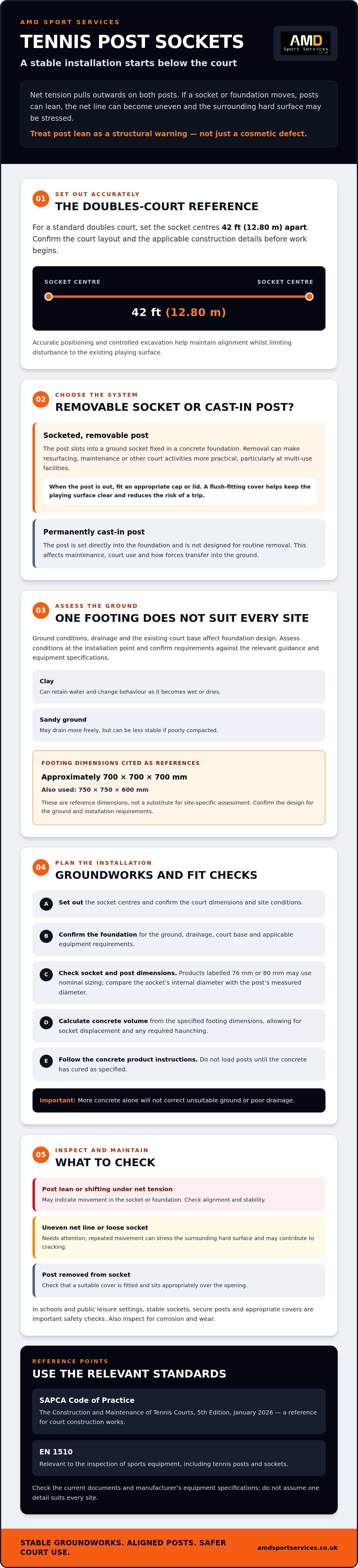
A tennis post system must resist the pull of a tensioned net without shifting, leaning or damaging the surrounding court. In a socketed system, each post slots into a ground socket fixed within a concrete foundation. A cast-in post, by contrast, is set directly into the foundation and is not designed for routine removal. This affects maintenance, court use and how forces transfer into the ground.
During tennis court post socket installation, the socket position, alignment and foundation must work together. For a standard doubles court, the socket centres are set 42 ft (12.80 m) apart. Check the court dimensions when planning the layout, then confirm the applicable construction details against the current SAPCA Code of Practice and the requirements for the equipment being installed.
Socketed vs. Permanent Posts: Why Sockets Win
Removable posts make it easier to clear the court for resurfacing, maintenance or other activities. This flexibility can help at multi-use facilities, including outdoor MUGAs, where posts may need to be removed when tennis is not being played. A socket keeps the post itself above ground rather than embedding it in the foundation, which can make removal and replacement more practical. It does not remove the need to choose suitable materials or inspect for corrosion and wear.
When posts are removed, a correctly fitted cap or lid helps cover the socket opening and reduce the risk of a trip. On courts used for different sports, a flush-fitting cover can also help keep the playing surface clear.
Safety and Compliance Standards in the UK
SAPCA’s current court construction code provides a reference for court works, whilst EN 1510 is relevant to the inspection of sports equipment, including tennis posts and sockets. Check the current documents and equipment specifications rather than assuming one detail suits every site. AMD Sport Services provides external sport equipment installation for facilities including schools and councils.
Net tension creates a sustained outward pull on both posts. If a socket or its foundation moves, the posts can lean, the net line can become uneven and the load may no longer be supported as intended. A loose or poorly aligned installation can also stress the hard surface around the foundation. Repeated movement may contribute to cracking. These are structural issues, not cosmetic defects, and should be assessed before they worsen.
Professional inspection is particularly relevant in schools and public leisure settings, where loose sockets or uncovered openings can create hazards. Check that posts sit securely, sockets remain stable and covers fit appropriately when posts are out. Sound groundworks and routine equipment checks help support safe use and reduce avoidable damage.
Technical Specifications: Planning Your Groundworks
Ground conditions affect how a post socket foundation should be designed. Clay can retain water and change behaviour as it becomes wet or dries, whilst sandy ground may drain more freely but can be less stable if poorly compacted. Neither soil type dictates one universal foundation size. Assess the ground at the installation point, including drainage and the condition of any existing court base, then confirm the design against the SAPCA Code of Practice and the equipment manufacturer’s requirements.
A concrete footing of approximately 700 mm × 700 mm × 700 mm is cited as a recommended minimum in some guidance, with 750 mm × 750 mm × 600 mm also used. Treat these as reference dimensions, not a substitute for site-specific assessment. The base must resist the lateral force created by net tension without shifting or compromising the surrounding surface.
Calculating Haunching and Concrete Requirements
Calculate concrete volume from the specified footing dimensions, allowing for the socket’s displacement and any required haunching. A robust base helps limit movement over time, but simply adding concrete will not correct unsuitable ground or poor drainage. Rapid-set concrete may suit projects where the installation programme is constrained; standard concrete may be selected where the work sequence allows. In either case, follow the product instructions and do not load the posts until the concrete has cured as specified.
Socket and post dimensions must match. Products described as 76 mm or 80 mm may refer to nominal sizes, so check the socket’s internal diameter and the post’s measured diameter before ordering or installing. A loose fit can allow movement, whilst a poor fit can make post removal difficult.
Drainage and Corrosion Prevention
Standing water inside a socket can contribute to corrosion and make posts harder to remove. Galvanised steel sockets have a protective coating, but the coating’s condition and the socket’s drainage design still matter. Gravel at the base should only be used where the ground and drainage arrangement allow water to disperse. It is not a substitute for a planned drainage route.
During tennis court post socket installation, set the socket to suit the finished surface level and protect it from concrete entering the opening. Keep the interior clear of grit and debris, check for retained water, and inspect for coating damage during routine maintenance. For schools and leisure facilities planning a new installation, AMD Sport Services provides external sport equipment installation across the UK.
Step-by-Step Installation Process for Tennis Post Sockets
Accurate setting out comes first. A small positioning error can leave the net off-centre or put a socket too close to a court line, creating problems that are difficult to correct once the foundation has set. Confirm the court layout and post positions against the LTA recommended dimensions. For a standard doubles court, socket centres should be 42 ft (12.80 m) apart. Check the specified distance from the doubles sidelines too, rather than measuring from a convenient but potentially inaccurate surface feature.
Preparation and Marking Out
Establish the net line across the court and check that it is square to the court’s long axis. A string line between the marked socket centres helps reveal alignment errors before excavation. Measure both positions from fixed court references and recheck the line from more than one point. AMD Sport Services offers external sport equipment installation for facilities planning professional work.
Excavation and Setting the Socket
Protect the playing surface before cutting or breaking through it. Keep the excavation as controlled as the ground conditions and foundation design allow, removing only the material needed to form a stable base. A bell-shaped hole is not automatically right for every court. The excavation profile and dimensions should suit the site and specified footing.
Position the socket so its top will sit flush with the finished playing surface. Allow for any surfacing layer that will be added later. Secure the socket against movement before placing concrete, then check its position and the net line again. Do not assume it should be perfectly vertical: follow the equipment specification, which may call for a slight lean away from the net to account for tension.
Surface Integration and Finishing
Finish the concrete neatly below the level required for the final surface, keeping the socket opening clean. Protect the work area whilst the concrete cures, and follow the concrete manufacturer’s instructions before loading the foundation. There is no universal curing time that suits every mix and site condition.
Once the foundation is ready, fit the post and check that it seats properly without excessive movement. Operate the tensioning mechanism and inspect the post alignment under tension. Finally, fit the socket cap when the post is removed, and confirm it sits securely without creating a raised obstruction. These checks complete tennis court post socket installation and help identify faults before the court returns to use.
Common Pitfalls and Safety Inspection Requirements
A post that no longer stands true may indicate movement below the surface, not simply a loose fitting. Common causes include an undersized or poorly supported foundation, ground movement, water ingress and wear within the socket. Do not assume that tightening the net or adjusting the post will correct the underlying fault. If a post moves noticeably in its socket or the surrounding surface is damaged, restrict use until the equipment has been assessed.
Identifying Structural Fatigue
Inspect the visible court surface around each socket for cracks, sinking or separation. These can indicate movement in the concrete haunching below, although the cause needs proper assessment. Check the socket for looseness, corrosion, debris and retained water. Where the design allows, look for obstruction or damage around drainage openings. A post that is difficult to insert or remove may also point to a damaged or contaminated socket interior.
Keep a record of inspection findings and changes over time. Routine checks can help identify deterioration before it becomes a more serious equipment or surface issue. AMD Sport Services provides sports equipment service and maintenance for facilities that need support with ongoing equipment care.
The Risks of Incorrect Tensioning
Net tension applies a sustained pull to the posts. Over-tensioning can place additional force on a socket or foundation that is already loose, increasing movement rather than restoring a straight net line. Check net height and post stability together: an uneven net may result from incorrect adjustment, post lean or a shifted socket. Follow the equipment instructions and avoid using tension to compensate for poor alignment.
For schools and public leisure facilities, loose sockets create a practical safety concern, particularly if posts rock during use or socket openings are left uncovered. A cap should sit securely when a post is removed, without presenting a raised obstruction. Record and act on visible defects rather than waiting for a post to fail.
DIY work can miss issues such as an unsuitable foundation, poor alignment or inadequate consideration of site conditions. There is no reliable basis for saying that every DIY installation will fail within a particular number of seasons. Lifespan depends on the installation, materials, ground and maintenance. Inspect the completed work and check it regularly rather than assuming it remains safe because it looks intact.
For a facility-wide approach, arrange appropriate sports equipment safety inspections and keep clear records of defects and follow-up work. Review the installation and maintenance support available through AMD Sport Services’ maintenance services.
Why Professional Installation is Essential for UK Facilities
A tennis court post socket is part of the court’s supporting structure. If its position, level or foundation is wrong, correcting the fault later may mean disturbing the playing surface as well as the concrete below it. Professional installation can help identify site constraints before work starts and provides a methodical check of the finished system.
Precision matters. Suitable levelling equipment, including a laser level where appropriate, can help installers establish consistent heights and alignment across both sockets. This is particularly useful where surface levels vary or a project involves an existing court. Tools do not replace sound setting out or an assessment of the ground, but they help verify measurements before the foundation is poured.
Expertise in Institutional Environments
Schools, councils and leisure centres need clear information about the planned work, how the area will be managed and what checks will be completed before the court returns to use. Installation records can support facility management and future inspections. Do not assume that an installation automatically provides a safety certificate or meets an insurer’s specific conditions. Confirm the required documentation with the contractor, responsible facility team and insurer before work begins.
AMD Sport Services provides sports equipment installation and safety inspections across the UK, with over 20 years of industry experience. Its services include sports equipment installation for schools and councils. You can review its sports equipment installation work to understand the range of projects undertaken.
Bespoke Solutions for Unique Courts
Existing courts are not always straightforward. An older macadam surface may need a different approach to excavation and reinstatement than a synthetic surface, and the condition of the underlying base can affect the work. A professional assessment helps establish how to limit disruption and what details need resolving before installation, rather than relying on a standard method for every site.
For high-use public facilities, the post and socket arrangement should suit the court’s intended use, maintenance plan and equipment specification. Clear records of the installation and any inspections also help teams track defects and plan follow-up work.
Professional installation can reduce the risk of avoidable remedial groundworks, although no method can remove every site risk. Before appointing a contractor, ask how they will assess the surface and ground, check alignment and confirm the finished socket position. For insurance or health and safety audits, verify which standards and documents apply to your facility rather than assuming one certificate covers every requirement.
Build a Stable Tennis Post System for the Long Term
Reliable tennis court post socket installation depends on sound groundworks, accurate positioning and checks that confirm the posts and sockets remain secure. The foundation must suit the site, whilst careful alignment and attention to the finished surface help prevent post movement and avoidable damage.
For schools, councils and leisure facilities, suitable installation and regular sports equipment safety inspections support safer, more durable courts. AMD Sport Services provides sports equipment installation for institutional environments. Agree inspection requirements separately to suit your facility and equipment.
To discuss a suitable approach for your court, contact AMD Sport Services about tennis post installation. Careful planning and installation help create a stable court that is ready for play.
Frequently Asked Questions
How deep should a tennis court post socket be installed?
There is no single socket depth that suits every court and ground condition. The required depth depends on the socket and post specifications, the foundation design and the site’s soil. A concrete footing of approximately 700 mm × 700 mm × 700 mm is cited as a recommended minimum in some guidance, but this is not a universal specification. Check current SAPCA guidance and equipment requirements before deciding on the foundation depth.
Can I install tennis post sockets on an existing court surface?
Yes, sockets can be installed on an existing court, but the work involves cutting or excavating through the surface and may require reinstatement around the foundation. Before starting, assess the surface type, its condition and the underlying base. Mark positions accurately, control the excavation and set the socket top to suit the finished surface level. Professional tennis court post socket installation can help limit disturbance and avoid misalignment.
Why is my tennis post leaning towards the net?
A post leaning towards the net may indicate movement in the socket or foundation, incorrect alignment, deteriorating groundworks or a post that does not fit securely. Net tension can make an existing weakness more apparent, but adjusting tension alone may not address the cause. Check for movement at the socket and cracks or sinking around the foundation. If the post feels loose or the court surface is damaged, restrict use until it is assessed.
Do tennis post sockets need regular maintenance?
Yes. Check that sockets remain secure, posts fit correctly and socket caps sit safely when posts are removed. Look for corrosion, debris, standing water, cracks or movement around the foundation. Set inspection frequency according to the facility’s use and the equipment’s condition. Keep a record of findings and arrange a professional assessment if you notice a defect.
What concrete mix is best for sports equipment groundworks?
There is no single concrete mix that is best for every post socket foundation. Selection depends on the specified footing, ground conditions, installation method and product requirements. Follow the current project specification and concrete manufacturer’s instructions, including guidance on mixing and curing. Rapid-set concrete may suit some work programmes, but it should not be chosen solely to speed up reopening. The foundation must be suitable for the loads the installed equipment will experience.
How long does it take for a tennis post socket installation to cure?
Curing time depends on the concrete product, site conditions and the manufacturer’s instructions, so there is no reliable universal duration. Do not fit and tension posts until the foundation has cured as specified. Protect the area from disturbance during this period and ensure the work is not loaded prematurely. For institutional facilities, confirm the expected curing period with the installer before planning when the court can return to use.
Is a socketed system safer than a permanently fixed post?
Not automatically. A socketed system allows posts to be removed, which can help with maintenance or multi-use courts, but safety depends on correct installation, secure posts and regular checks. Fit a suitable cap or lid when posts are out, and ensure it does not create a raised obstruction. Permanently fixed posts also require sound groundworks and inspection. Choose a system that suits the court’s use and follow its equipment specifications.
What is the standard distance between tennis post sockets?
For a standard doubles court, the socket centres should be 42 ft (12.80 m) apart. Measure from the centre of each socket, and check the court layout before excavation rather than relying on existing marks alone. Accurate positioning helps keep the net line correctly placed and the posts aligned. Confirm dimensions against the relevant court guidance and equipment specification, particularly if the court is non-standard or serves more than one sport.


Comments