
The Essential School Playground Inspection Checklist for 2026

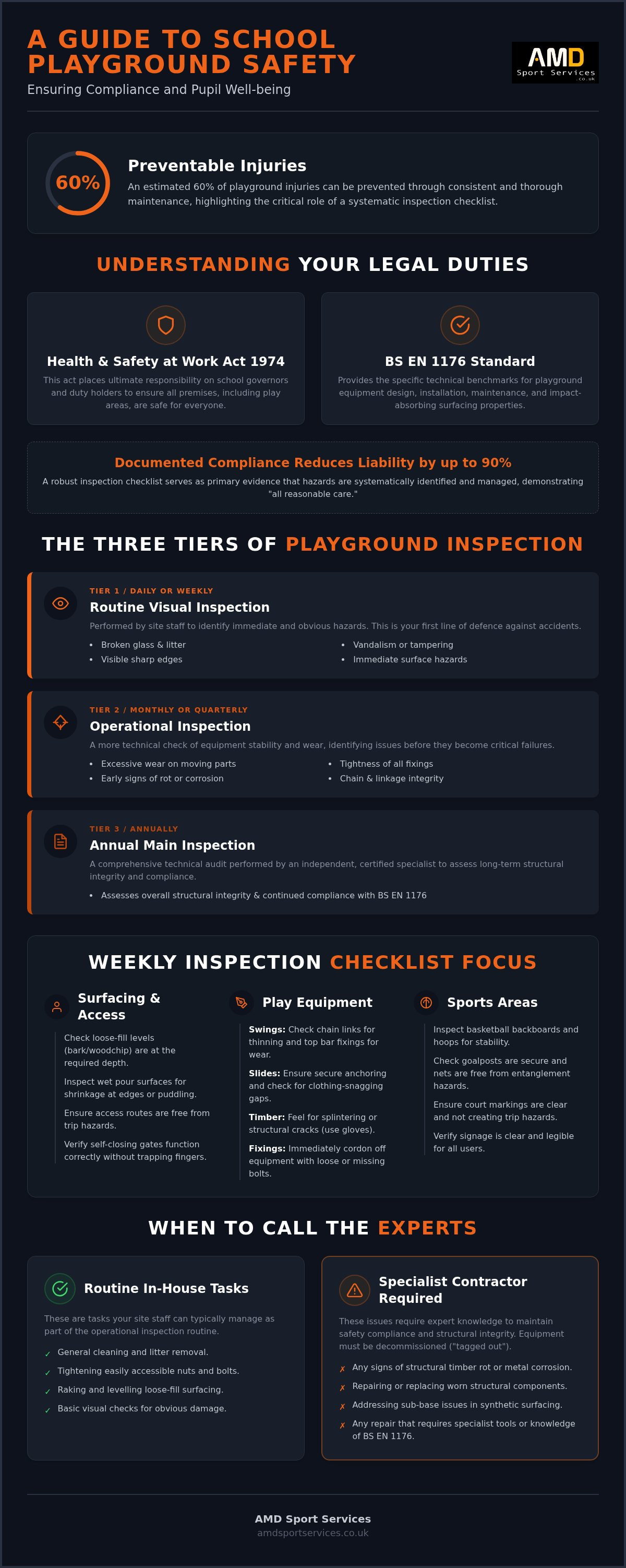
An estimated 60% of playground injuries are preventable through consistent maintenance, but keeping a school playground inspection checklist up to date is often a significant challenge for busy staff. Managing an outdoor play area feels like a constant balancing act between encouraging active physical activity and mitigating serious legal risks. You're likely navigating the confusion of daily visual checks versus formal audits, all whilst trying to make a tightening repair budget stretch across the academic year.
Our guide is designed to remove that uncertainty, ensuring your pupils stay safe and your institution remains fully compliant with current safety standards. By following these steps, you'll gain a clear understanding of the BS EN 1176 requirements and learn exactly how to document your safety efforts to protect against liability. We'll outline the essential daily, weekly, and annual tasks required to maintain your equipment and explain precisely when it's time to call in a professional contractor for technical repairs.
Table of Contents
Understanding Your Legal Duties: BS EN 1176 and School Safety
The Health and Safety at Work etc. Act 1974 dictates that school governors and duty holders carry the ultimate responsibility for the safety of everyone on their premises. This legal obligation requires you to ensure that play equipment is maintained in a condition that is safe for use. Whilst the Act provides the broad legal framework, the specific technical benchmarks are found in Playground safety standards, primarily BS EN 1176. This standard covers everything from equipment design to the impact-attenuating properties of the ground surface.
Adherence to these standards is not merely a box-ticking exercise; it is a critical component of your risk management. In the event of a pupil injury, insurers and legal bodies will examine your maintenance records to determine if you exercised "all reasonable care." Research indicates that documented compliance with safety standards can reduce liability by as much as 90%. A robust school playground inspection checklist serves as your primary evidence that hazards were identified and managed systematically.
The Three Tiers of Playground Inspection
Safety compliance is built on a three-tiered inspection regime. Failing to distinguish between these levels is a common mistake that leaves schools vulnerable to both accidents and litigation.
Routine Visual Inspection (Daily/Weekly): These are basic checks performed by site staff or caretakers. The focus is on immediate, obvious hazards such as broken glass, litter, vandalism, or equipment that has been clearly tampered with.
Operational Inspection (Monthly/Quarterly): This is a more technical look at the equipment's stability and wear. It involves checking moving parts for excessive play, ensuring fixings are tight, and identifying early signs of corrosion or rot.
Annual Main Inspection: This must be performed by an independent, certified specialist. It is a comprehensive technical audit that assesses the long-term structural integrity of the equipment and its continued compliance with BS EN 1176.
Risk Assessments for Play and Sport
Effective safety management involves balancing the "benefit" of play against the "risk" of injury. It is neither possible nor desirable to eliminate all risk; children need challenges to develop physical and cognitive skills. The goal of your school playground inspection checklist is to identify "unacceptable" risks, such as structural failure or entrapment points, which provide no play value and only pose a danger.
When a hazard is identified, it must be recorded with a clear priority level. Minor issues can be scheduled for routine upkeep, but high-risk defects require immediate isolation of the equipment. Integrating professional service and maintenance into your strategy ensures that technical repairs are handled by experts who understand the specific requirements of school environments, preventing small faults from becoming major liabilities.
The Weekly School Playground Inspection Checklist
A weekly school playground inspection checklist isn't just about appearance; it's a structural health check. It bridges the gap between daily visual sweeps and the technical annual audit. Staff should examine access routes for trip hazards and ensure that fencing and gates are functional. Self-closing gates must be checked to ensure they don't slam or trap fingers, whilst signage should remain clear and legible for all users to see.
Surfacing integrity is often overlooked during routine checks. For loose-fill areas like bark or woodchip, levels must be maintained to the specified depth to ensure impact attenuation. For synthetic surfaces, look for "wet pour" shrinkage at the edges or "puddling" which indicates sub-base issues. Consulting the CPSC Public Playground Safety Checklist provides a solid baseline for these environmental safety markers, helping you spot issues before they escalate.
Equipment-Specific Checks
Swings require a close look at the top bar fixings and chain links for signs of thinning or excessive wear. Slides should be checked for secure anchoring and any gaps between the slide bed and the platform that could snag clothing. For timber climbing frames, run a gloved hand along accessible areas to feel for splintering or structural cracks. If you find bolts that are loose or missing, the equipment must be cordoned off immediately to prevent use.
Sports Equipment on the Playground
Playgrounds often serve double duty as sports courts, yet items like basketball goals are frequently omitted from standard safety checks. Inspect backboards for cracks and ensure the hoops are securely bolted to the frame. Rusted rims or damaged nets can lead to finger entrapment or facial injuries. Netting systems, such as those used for cricket or football, must be checked for fraying or large holes that could cause a child to become entangled whilst playing.
For schools installing new facilities, following a professional guide for external sport equipment installation ensures that these items meet safety standards from day one. If your weekly checks reveal recurring structural issues or damage that requires technical expertise, it may be time to consult AMD Sport Services for a professional repair assessment.
Surfacing and Surroundings: Identifying Hidden Risks
The ground beneath a child's feet is as critical to safety as the equipment itself. Impact Absorbing Surfacing (IAS) is designed to mitigate the severity of head injuries, but its effectiveness depends entirely on the "critical fall height" of the specific equipment it protects. If a climbing frame has a fall height of 2.0 metres, the surfacing must be tested and maintained to provide protection at that exact level. Your school playground inspection checklist should include a review of surface depth, especially in high-traffic areas like the base of slides or under swings where "hollowing out" frequently occurs.
Synthetic surfaces like wet pour and rubber mulch are durable, yet they are not maintenance-free. Over time, these materials can suffer from edge shrinkage, creating significant trip hazards where the rubber meets the concrete kerb. Puddling is another indicator of failure; standing water often suggests that the sub-base has subsided or the porous layers have become blocked with silt. These structural issues require more than a patch repair; they often signal that the underlying drainage needs professional attention to prevent further degradation.
Maintaining Safety Surfacing
Environmental factors can quickly compromise the safety of even the highest-quality installations. Moss and algae growth on tartan tracks or rubberised surfaces create a slippery film that is lethal in damp conditions. Regular pressure washing or chemical treatments are necessary to maintain grip levels. Beyond the physical texture, visual clarity is vital for safe play. Faded lines on multi-use games areas lead to pupil collisions during fast-paced sports. Investing in court marking renewal ensures that boundaries remain visible, reducing the risk of accidental contact whilst improving the overall utility of the space.
Environmental and Seasonal Precautions
A comprehensive school playground inspection checklist must adapt to the British climate. During autumn, wet leaves accumulate on rubberised surfaces, creating a slick layer that hides cracks or debris. Winter brings the risk of ice on metal rungs and walkways; these areas should be assessed daily before pupils are granted access. Summer presents a different challenge: UV degradation. Prolonged sun exposure can make plastic components and netting systems brittle, leading to sudden structural failure. Checking for "chalking" on plastics or fraying on sports netting during the warmer months allows you to identify components that are reaching the end of their safe operational life.
Boundary safety completes the perimeter check. Fencing should be free from protrusions or gaps where a child could become trapped. Self-closing gates are a specific priority; they must close at a controlled speed to ensure they don't slam or create finger-trap hazards. If a gate fails to latch or closes too quickly, it represents a breach of your duty of care that must be rectified immediately.
Common Playground Hazards: A Hazard vs. Indicator Guide
A school playground inspection checklist is only effective if the person conducting the walk-around understands the difference between a cosmetic indicator and a genuine safety hazard. Ageing equipment will naturally show signs of use, but your goal is to identify points of failure before they result in an accident. This requires a methodical approach to evaluating structural integrity and recognizing the specific ways that different materials degrade over time.
Vandalism and intentional tampering present immediate risks that often occur outside of school hours. Arson damage to rubberised surfacing or the intentional loosening of bolts can turn a compliant play area into a high-risk zone overnight. Inspecting for these signs of interference should be the first task of any Monday morning sweep. Identifying these issues early allows you to isolate the equipment and prevent injuries that standard wear and tear wouldn't typically cause.
Spotting Structural Weakness
Rust is the most frequent cause of failure for metal playground components, particularly at ground level where moisture sits against the post. Whilst surface oxidation might only require a fresh coat of paint, deep pitting or "flaking" metal at the base indicates that the post is no longer structurally sound. For timber installations, you must distinguish between natural "shakes" (cracks that follow the grain and don't compromise strength) and structural splits that expose sharp edges or allow fixings to wobble. Entrapment is defined as any gap between 8mm and 25mm that could catch a child's finger or larger openings that could snare a head or neck, presenting a risk of serious injury or strangulation.
Sports Equipment Hazards
Sports equipment often endures higher physical stresses than standard play frames, leading to unique failure points. Basketball goals are prone to vibration-induced bolt failure; the constant impact of the ball can loosen the backboard fixings over a single term. Inspect these regularly to ensure the unit remains rigid. Long jump runways and athletics tracks can develop "lips" or ridges where the synthetic material meets the sandpit or grass, which are common causes of ankle injuries during PE lessons.
Netting systems also require specific attention, as holes or fraying can quickly lead to entanglement. For facilities with indoor areas, maintaining sports hall netting systems is vital to ensure that balls and equipment don't strike pupils or spectators in adjacent zones. If your inspection reveals structural corrosion or equipment that has become unstable, contact AMD Sport Services to arrange a professional repair assessment and restore your site to full safety compliance.
Professional Maintenance: When to Call the Experts
Whilst your internal school playground inspection checklist is the first line of defence, there are clear limits to what site staff should attempt to resolve. Caretakers and site managers are essential for identifying faults and "tagging out" dangerous equipment, but they should rarely perform technical structural repairs. Specialist equipment requires specific knowledge that general builders often lack. Attempting a DIY fix on a climbing frame or a basketball goal can inadvertently create new hazards, such as non-compliant entrapment points or weakened structural joints that fail under load.
Investing in a professional indoor and outdoor inspection provides a level of scrutiny that goes beyond basic visual checks. These experts evaluate the internal integrity of metal posts, the elasticity of safety surfacing, and the security of high-level fixings. AMD Sport Services brings over 20 years of industry experience to every site, ensuring that your facilities don't just look safe but are technically compliant with BS EN 1176 standards.
The Annual Main Inspection Process
This technical audit is an independent assessment of your entire play and sports area. The resulting report categorises findings into "Low", "Medium", and "High" risk ratings. A "High" risk rating requires immediate action, whilst "Low" risks can be monitored or scheduled for future maintenance. Understanding these tiers allows governors to allocate limited budgets effectively. By integrating these professional findings into your ongoing school playground inspection checklist, you create a seamless safety record. Pro-active maintenance is always more cost-effective than emergency decommissioning; catching timber rot or metal fatigue early can save thousands in replacement costs.
Bespoke Repair Solutions
Choosing to refurbish existing equipment is often a more sustainable and budget-friendly alternative to complete replacement. Specialist contractors can replace specific components, such as worn chains, damaged nets, or frayed cables, whilst ensuring the unit still meets its original design specifications. You can see examples of how we have restored school facilities on our projects page. Every repair we undertake is designed to stand up to the rigours of daily school use, providing a durable result that protects both your pupils and your institution's reputation.
AMD Sport Services operates as your national partner for playground and sports facility repairs. We specialise in solving unique structural challenges that standard off-the-shelf products cannot address. Whether you need a court marking renewal or a complex equipment refurbishment, our goal is to provide a pragmatic, high-quality solution that keeps your school compliant and your pupils active.
Securing Your School’s Play and Sport Legacy
Maintaining a safe environment for your pupils requires more than a casual glance at the equipment; it demands a structured approach to risk management. By implementing a tiered inspection regime and training staff to recognise technical hazards like entrapment points or structural rot, you protect both the children and the school's legal standing. Consistently applying a school playground inspection checklist is the most effective way to uphold your duty of care whilst managing maintenance budgets effectively.
When technical issues arise or the annual audit is due, partnering with a specialist ensures that repairs meet the rigorous requirements of BS EN 1176. AMD Sport Services provides specialist repairs for outdoor play and sports equipment alongside comprehensive compliance audits. Our national UK coverage and focus on technical proficiency allow us to solve complex structural or mechanical challenges that standard site maintenance teams cannot address alone.
Book your professional playground safety inspection with AMD Sport Services today to ensure your site remains a safe, compliant, and engaging space for every pupil.
Frequently Asked Questions
How often should a school playground be inspected by law?
There is no single statute that specifies a frequency, but the Health and Safety at Work etc. Act 1974 requires schools to take all reasonable care to ensure equipment is safe. To meet this duty and satisfy insurance requirements, you should follow a three-tier regime. This includes daily or weekly visual checks, monthly or quarterly operational inspections, and one annual main inspection conducted by an independent specialist.
Who is qualified to carry out a weekly playground safety check?
A competent staff member, such as a school caretaker or site manager, is qualified to perform weekly checks. They don't require external certification for this level of auditing, but they must be familiar with the site's specific equipment. Using a formal school playground inspection checklist ensures they look for consistent indicators of danger, such as sharp edges, entrapment points, or surfacing degradation, without missing technical details.
What is the difference between BS EN 1176 and BS EN 1177?
BS EN 1176 is the primary standard for the design and manufacture of playground equipment, ensuring structural integrity and safety. BS EN 1177 focuses exclusively on impact-attenuating surfacing. It sets the requirements for how well a surface, like wet pour or rubber mulch, absorbs the force of a fall. Both standards work together to minimise the risk of serious head injuries in school environments.
Do we need a separate checklist for sports equipment like basketball hoops?
It is highly recommended to include sports-specific items in your auditing process. Basketball goals, outdoor netting, and long jump pits have different failure modes than slides or swings. For instance, basketball backboards can vibrate loose over time, and sports netting can develop entrapment-sized holes. Integrating these into your school playground inspection checklist ensures that every piece of external equipment is assessed for structural safety and pupil protection.
What should I do if I find a 'High Risk' hazard on the playground?
You must immediately isolate the equipment and prevent pupil access. Use physical barriers or safety tape to cordon off the area and place a clear "Out of Use" sign on the item. Once the hazard is contained, record the finding in your logbook and contact a specialist repair contractor. Don't allow pupils back onto the equipment until a competent person has certified the repair as safe and compliant.
Is impact-absorbing surfacing mandatory for all play equipment?
Impact-absorbing surfacing is required by BS EN 1176 for any equipment with a free fall height exceeding 600mm. For equipment with a fall height below this threshold, surfacing is still recommended but the technical requirements of BS EN 1177 are less stringent. Well-maintained topsoil and turf can sometimes be sufficient for very low heights, though synthetic surfaces are often preferred for their durability and consistent performance.
How long should we keep our playground inspection records?
You should retain all safety records for at least 21 years. This is because a child can technically bring a personal injury claim against a school once they reach adulthood. Keeping a comprehensive archive of every school playground inspection checklist, along with evidence of any remedial works performed by contractors, provides the necessary documentation to prove that the school met its legal duty of care throughout the child's tenure.
Can our school caretaker perform the Annual Main Inspection?
No, the Annual Main Inspection must be carried out by an independent, certified playground safety inspector. Whilst caretakers are excellent for spotting obvious wear and tear, the annual audit requires technical probes and testing equipment to check for hidden structural failures and compliance with BS EN 1176. Using an external professional also provides an unbiased safety record that is essential for insurance purposes and long-term liability protection.


Comments