
Throwing Cage Netting: Repair & Replacement Guide

For facility managers at schools, universities, and athletics clubs across the UK, the throwing cage is a cornerstone of track and field provision. Yet, its netting is more than just a backdrop; it is a critical safety system engineered to absorb immense kinetic energy from a hammer or discus. Deciding between athletic throwing cage netting repairs and replacement is a significant responsibility, balancing budget constraints with an uncompromising duty of care. A frayed or degraded net is not merely a maintenance issue—it is a serious liability risk.
This guide provides a professional framework for assessing the condition of your throwing cage system. We will explore the technical factors behind net degradation, outline a comprehensive inspection process, and offer a clear decision-making model for when to repair versus when a full replacement is the only safe option. Our focus is strictly on the standards and environmental conditions relevant to UK facilities, ensuring every piece of advice aligns with UK Athletics (UKA) and World Athletics compliance.
Table of Contents
The Critical Role of Athletics Throwing Cage Netting Safety
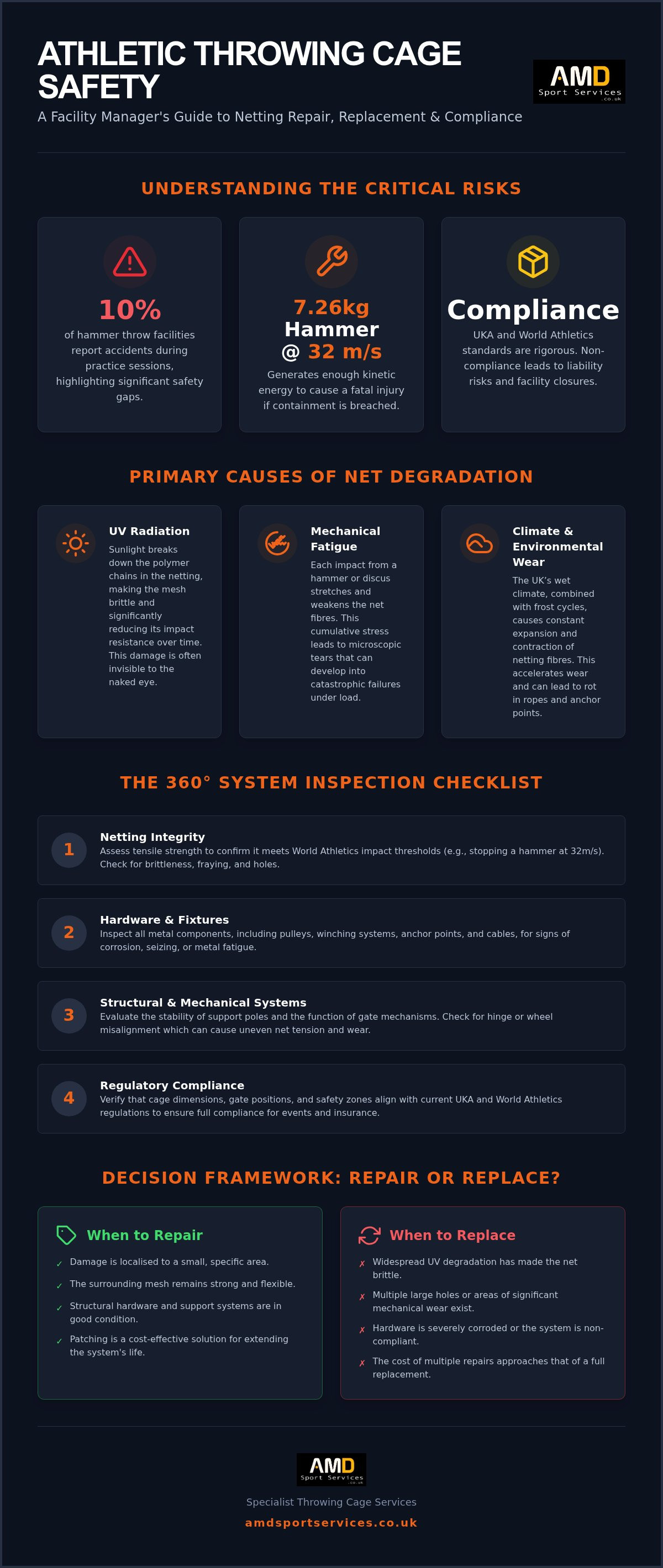
A throwing cage net must reliably stop a 7.26kg hammer or a 2kg discus travelling at high velocity. The physics involved are demanding, requiring a netting system that can dissipate massive, focused energy in fractions of a second. Failure is not an option. Understanding the regulatory landscape and the real-world consequences of degradation is the first step in responsible facility management.
The physics of impact: High-Density Polyethylene (HDPE) netting is designed to stretch and deform upon impact, converting kinetic energy into heat. Over time, this repeated stress, combined with environmental factors, degrades the material's structural integrity.
Regulatory landscape: In the United Kingdom, throwing cage safety is governed by standards set by UK Athletics (UKA) and World Athletics. These regulations dictate cage height, gate configuration, and netting specifications to create a safe zone for athletes, officials, and spectators.
Liability and duty of care: Schools, councils, and clubs have a legal and moral duty of care to provide a safe environment. A documented, proactive approach to cage maintenance is essential for demonstrating due diligence and satisfying insurance requirements.
The financial logic of proactive maintenance: The cost of an emergency net replacement after a failure—factoring in facility downtime and potential liability—far exceeds the planned cost of regular inspections and timely repairs.
Understanding Net Degradation Factors
Athletics throwing cage netting operates in a harsh environment. In the UK, a combination of mechanical and environmental stressors work continuously to weaken the material from the moment it is installed. Recognising these factors is key to predicting its lifespan.
UV radiation: The most significant factor is ultraviolet radiation from sunlight. UV rays break down the long polymer chains in synthetic netting, causing the material to become brittle, lose tensile strength, and ultimately fail under impact.
Mechanical fatigue: Each impact from a hammer or discus stretches the net's fibres. This cumulative effect, known as mechanical fatigue, gradually weakens the mesh, particularly in high-impact zones directly in line with the throwing circle.
Environmental stressors: The UK’s climate presents unique challenges. Wind loading places constant strain on the net and its fixings. Moisture from rain and frost can penetrate the fibres, and the freeze-thaw cycle can accelerate material breakdown.
Safety Standards and Compliance Audits
Adherence to safety standards is not a "tick-box" exercise; it is a fundamental requirement for operating a throwing facility. A compliant system is one where the netting, structure, and hardware all work in harmony to ensure safety. For a detailed overview of the compliance process, our guide on professional throwing cage safety inspection offers further reading.
Key indicators of a compliant throwing cage system: This includes correct net height (e.g., 7m rising to 10m at the front for hammer cages), properly functioning gates, secure ground sockets, and netting free from significant damage or degradation.
The role of annual safety inspections: A formal, annual inspection by a competent specialist is the minimum standard for maintaining facility insurance and proving compliance. This inspection should provide a detailed report on the condition of the entire system.
Why 'visual checks' are often insufficient: Whilst daily visual checks by ground staff are important for spotting obvious tears, they cannot identify internal fibre brittleness caused by UV exposure or hidden structural corrosion. A professional assessment uses technical methods to uncover these less visible dangers.
Conducting a Comprehensive Throwing Cage Inspection
A thorough inspection goes far beyond a quick look at the mesh. At AMD Sport Services, our approach is a systematic, 360-degree evaluation of the entire throwing cage structure. This methodical process identifies not only current issues but also patterns of wear that help predict future maintenance needs, allowing for proactive budgeting and scheduling.
The AMD Sport Services approach: We assess every component, from the base of the ground sockets to the top of the pulley systems, understanding that a weakness in one area compromises the entire structure.
Identifying 'hidden' failure points: We focus on areas often overlooked during routine checks, such as corrosion inside uprights, fraying on hoisting ropes, and stress fractures around hinge mechanisms.
Documenting wear patterns: By mapping impact zones and areas of abrasion, we can anticipate where the net is likely to fail next and recommend targeted reinforcement or plan for timely replacement.
The importance of professional assessment: A specialist brings the experience and equipment necessary to perform a truly comprehensive evaluation. Our sports equipment safety inspections provide facility managers with the detailed, actionable report needed to maintain a safe and compliant venue.
Beyond the Net: Hardware and Structural Integrity
The netting is only as strong as the structure supporting it. A comprehensive inspection must place equal emphasis on the cage's mechanical and structural components, as their failure can lead to catastrophic net collapse or unsafe tensioning.
Pulley systems: We check for seized bearings, corrosion, and frayed hoisting ropes. A stiff or failing pulley system makes it difficult to lower the net for storage, increasing its exposure to wind damage and vandalism.
Gate mechanics: Hinges and wheels must operate smoothly to ensure the gates can be correctly positioned during use without placing undue stress on the net. Seized gates can compromise the cage's certified safety zone.
Ground sockets: The stability of the entire structure depends on the ground sockets. We assess them for corrosion, cracking, and movement, ensuring the uprights are held securely and vertically.
Netting Specific Assessment Criteria
When evaluating the net itself, a specialist looks for subtle signs of degradation that indicate it is approaching the end of its safe operational life. These technical assessments provide a much clearer picture of the net's health than a simple visual check for holes.
Mesh 'creep' and distortion: Over time, netting can permanently stretch or 'creep', resulting in excessive sag. This reduces its ability to absorb impact correctly and can mean it no longer meets the required height regulations.
Abrasion points: We meticulously identify areas where the net rubs against the cage frame, gate edges, or hoisting components. These friction points wear away the fibres, creating localised weak spots prone to tearing.
Fibre brittleness tests: A key part of our technical assessment involves testing the health of the polymer fibres. By taking a small sample, we can physically assess its pliability. A healthy net's fibres are supple, whilst a UV-damaged net's fibres will be brittle and snap easily when flexed.
Netting Repairs vs. Full Replacement: A Decision Framework
The primary question for any facility manager facing a damaged net is whether to repair or replace. This decision should be driven by safety, compliance, and long-term value, not just short-term cost. A structured approach ensures the right choice is made.
Cost-benefit analysis: A professional repair can extend the life of a relatively new net with minor, localised damage. However, investing in multiple patches on an older, generally degraded net is often a false economy.
The '20% Rule': A useful guideline is to consider full replacement if the total area of damage (or the area requiring reinforcement) exceeds 20% of a single net panel, or if the net is already beyond 75% of its expected lifespan.
Safety thresholds: Certain types of damage are too high-risk to be patched. This includes extensive UV degradation (brittleness), major tears in primary impact zones, and damage near the top hanging line, which bears significant structural load.
Compatibility: When patching, it is crucial that the new netting section has the same material properties and tensile strength as the original. Mismatching materials can create a dangerous 'weak link' in the system.
Professional Patching and Mending Techniques
When a repair is deemed a safe and viable option, it must be carried out to a professional standard. DIY repair kits using cable ties or basic rope are wholly unsuitable for the forces involved in athletics and can create more dangerous failure points.
Bespoke netting repairs: Our technicians expertly weave in new sections of bespoke, high-tensile HDPE netting. The new patch is seamlessly integrated into the existing mesh, ensuring consistent strength across the repaired area.
Reinforcing high-impact zones: For nets showing early signs of wear in predictable impact areas, we can proactively reinforce these zones with an additional layer of netting, effectively doubling the energy absorption capacity where it is needed most.
The limitations of DIY repair kits: Off-the-shelf kits are designed for low-impact applications like garden sports. They lack the certified strength and durability required for a hammer cage and will not satisfy UKA compliance or insurance standards.
When to Opt for Full Netting Replacement
There comes a point in every net's life when patching is no longer a safe or economical solution. Recognising this point is a critical aspect of responsible facility management. For a more focused discussion, our guide to hammer cage netting replacement provides essential details.
Life expectancy of HDPE netting in the UK: Depending on the level of use and sun exposure, a professional-grade HDPE throwing cage net typically has a safe operational lifespan of 5 to 10 years in the UK climate. Beyond this, UV degradation becomes a significant and unavoidable safety risk.
Upgrading to knotless netting: A full replacement offers the opportunity to upgrade. Modern knotless netting provides superior energy absorption as the force is dissipated more evenly across the fibres. It also offers better visibility for officials and spectators and has fewer abrasion points.
The process of removing and disposing of old, non-compliant netting: Our service includes the complete removal and responsible disposal of the old netting, ensuring the facility is left clean and ready for the installation of the new, compliant system.
Extending the Lifespan of Athletics Netting Systems
Proactive maintenance is the most effective way to maximise the lifespan of your throwing cage netting and ensure it remains safe for as long as possible. A simple, consistent maintenance programme can significantly delay the need for costly repairs or a full replacement.
Developing a routine maintenance schedule: We work with ground staff and facility managers to create a simple checklist for regular inspections, covering everything from net tension to hardware lubrication.
The impact of correct net tensioning: A net that is too slack will not absorb impact correctly, whilst a net that is too tight is under constant strain. Ensuring correct tension is a simple way to improve both safety and durability.
Vandalism prevention: In public-access areas, lowering the netting when not in use is the single most effective way to prevent casual vandalism, such as cutting or climbing.
Managing installation for longevity: The quality of the initial installation has a lasting impact. Professional external sport equipment installation ensures that all components are correctly aligned and secured, preventing premature wear on the system.
Off-Season Care and Winterisation
The harsh UK winter is particularly damaging to throwing cage nets. A proper winterisation protocol is a non-negotiable part of any long-term maintenance plan, protecting the asset from the worst of the wind, rain, and frost.
The 'Lower and Store' protocol: Whenever the cage is not in use for an extended period, particularly during the off-season, the netting should be lowered, detached, and stored. This protects it from winter gales which can cause catastrophic tearing.
Correct storage techniques: The net should be stored in a dry, secure location, loosely folded or rolled rather than tightly packed. This prevents moisture from being trapped, which can lead to mould, and avoids creating hard creases that can weaken the fibres. Ensure it is protected from rodent damage.
Spring re-commissioning: Before re-hoisting the net for the new season, it should be fully inspected for any damage that may have occurred in storage. All hardware and pulleys should also be checked and lubricated before the first use.
Hardware Maintenance for Facility Managers
Simple, regular hardware checks can prevent major mechanical failures and extend the life of the entire cage system. These are tasks that can be easily integrated into a facility's existing maintenance programme.
Lubrication of pulleys and hinges: A regular application of a suitable lubricant to all moving parts, such as pulleys, gate hinges, and wheels, will prevent them from seizing and ensure smooth operation.
Clearing ground sockets of debris: Ground sockets should be regularly cleared of soil, leaves, and other debris. This ensures the uprights can be seated correctly and allows for proper water drainage, reducing the risk of corrosion at the base.
For routine cleaning, a mild solution of non-abrasive soap and water is the ideal choice for HDPE netting, as harsh chemical cleaners can accelerate polymer degradation.
Specialist Throwing Cage Services from AMD Sport Services
At AMD Sport Services, we approach throwing cage maintenance not as a product sale, but as the management of a critical safety asset. Our 'Seasoned Practitioner' ethos means we apply deep technical knowledge to every inspection and repair, delivering long-term value and peace of mind for facility managers.
Why our approach delivers better value: We focus on providing the most appropriate solution, whether that's a targeted repair or a full replacement. Our goal is to ensure safety and compliance in the most cost-effective way possible.
Bespoke repair solutions for all cage makes and models: We have the expertise to service and repair all types of throwing cages, including older, discontinued, and legacy systems for which off-the-shelf parts are no longer available.
Our commitment to UK-wide service: We provide a national service for schools, councils, universities, and athletics clubs across the United Kingdom, bringing specialist expertise to every corner of the country.
Integrating cage maintenance: We understand that outdoor athletics facilities are part of a broader estate. We can integrate cage maintenance with other services, such as the upkeep of sports hall netting systems, to provide a comprehensive maintenance programme.
The AMD Repair Process: From Assessment to Result
We believe in a transparent and methodical process that keeps our clients informed at every stage. Our workflow is designed for efficiency and clarity, ensuring a smooth journey from the initial query to the final sign-off.
Initial technical consultation: We often begin with a photo-based assessment, allowing clients to send us images of the damage. This allows our technicians to make a preliminary diagnosis and determine the likely scope of work.
Site visits for complex repairs: For more complex structural issues or full replacements, a site visit is essential. This allows us to conduct a thorough physical inspection and provide a precise, detailed quotation.
Final compliance certification: Upon completion of any repair or replacement, we provide a full safety report and compliance certification, giving you the official documentation needed for your health and safety records.
Why Choose a Specialist Contractor?
Throwing cage netting is a highly specialised field where technical knowledge is paramount. Choosing a general contractor or attempting an in-house repair can lead to non-compliant work and a false sense of security. A specialist provides assurance that the work is done correctly.
Deep technical knowledge: We have an expert understanding of high-velocity impact physics, material science, and the specific requirements of UKA and World Athletics regulations.
National reach with a local partnership feel: Whilst we operate nationwide, we pride ourselves on building long-term relationships with the facilities we serve, acting as a trusted partner in their safety and maintenance strategy.
Proven track record: Our portfolio of successful projects with schools, leisure centres, and athletics clubs across the country stands as a testament to the quality and reliability of our work.
Frequently Asked Questions (FAQs)
How often should athletic throwing cage netting be inspected for safety?We recommend a formal, detailed inspection by a qualified specialist at least once a year. This should be supplemented by frequent (e.g., weekly or pre-competition) visual checks by trained ground staff to identify any new or obvious damage.
Can we patch a hammer cage net ourselves using standard sports netting?We strongly advise against this. Standard sports netting, such as that used for football or cricket, does not have the required tensile strength to stop a hammer or discus. A professional repair uses certified, high-impact HDPE netting and specialist weaving techniques to ensure the patch is as strong as the original net.
What is the typical lifespan of a professional throwing cage net in the UK?In the UK climate, a high-quality HDPE net typically has a safe and effective lifespan of 5-10 years. This can vary depending on the intensity of use, the level of UV exposure at the site, and how well it is maintained, particularly regarding off-season storage.
Are there specific UK Athletics (UKA) rules for net mesh size and thickness?Yes, UKA and World Athletics specify rules for throwing cage construction, including netting. Typically, a mesh size of no more than 45-50mm square is required to safely contain the implements. The twine must be of a specified thickness and material (usually HDPE) to provide the necessary strength. Always consult the latest UKA rulebook for the most current specifications.
What should we do if our cage gates are difficult to operate or seized?Seized or stiff gates are a serious safety concern. They can prevent the cage from being configured correctly, potentially compromising the designated safe throwing sector. This is a structural issue that affects net tension and requires urgent assessment by a professional contractor.
How long does a full netting replacement typically take to complete?A full netting replacement for a standard hammer or discus cage, carried out by an experienced team, can usually be completed within 1 to 2 days. This includes the removal of the old net, a full inspection of the hardware, and the installation and tensioning of the new netting.
Does AMD Sport Services provide replacement netting for older, discontinued cage models?Yes. We specialise in providing bespoke solutions. We can manufacture and install custom netting panels to fit any cage, regardless of its age, make, or model. We assess the existing structure and create a netting solution that integrates perfectly and brings it up to current safety standards.
What are the benefits of knotless netting compared to traditional knotted mesh?Knotless netting offers several advantages. The knots in traditional netting can be a point of weakness and abrasion. Knotless netting distributes impact forces more evenly across the fibres, increasing its durability and energy absorption. It is also lighter and often provides better visibility through the mesh for coaches and officials.


Comments