
A Professional Guide to Wall Mounted Basketball Goals for UK Facilities

A basketball goal is only as safe as the wall it is attached to and the maintenance regime that follows. For facility managers and school governors, the pressure to provide high-quality equipment often clashes with legitimate concerns about load-bearing capacities and long-term durability. Selecting the correct wall mounted basketball goals is not just about the game; it is a technical decision that impacts the structural integrity of your sports hall and the safety of your students.
You already know that equipment in a high-use environment takes a beating, and you cannot afford to overlook compliance or structural stability. This guide provides the technical clarity you need to select, install, and maintain systems that meet the BS EN 1270:2005 safety standard. We will break down the essential structural requirements for installation, explain how to identify durable components, and outline the inspection routines required to ensure your equipment remains fit for purpose for years to come.
Table of Contents
Understanding the Types of Wall Mounted Basketball Goals for UK Facilities
Selecting the right configuration for wall mounted basketball goals depends entirely on how your facility functions on a daily basis. A dedicated basketball centre has different requirements than a primary school hall used for assemblies, lunch, and PE. To ensure your investment provides long-term value, you must match the equipment type to your hall's specific operational demands.
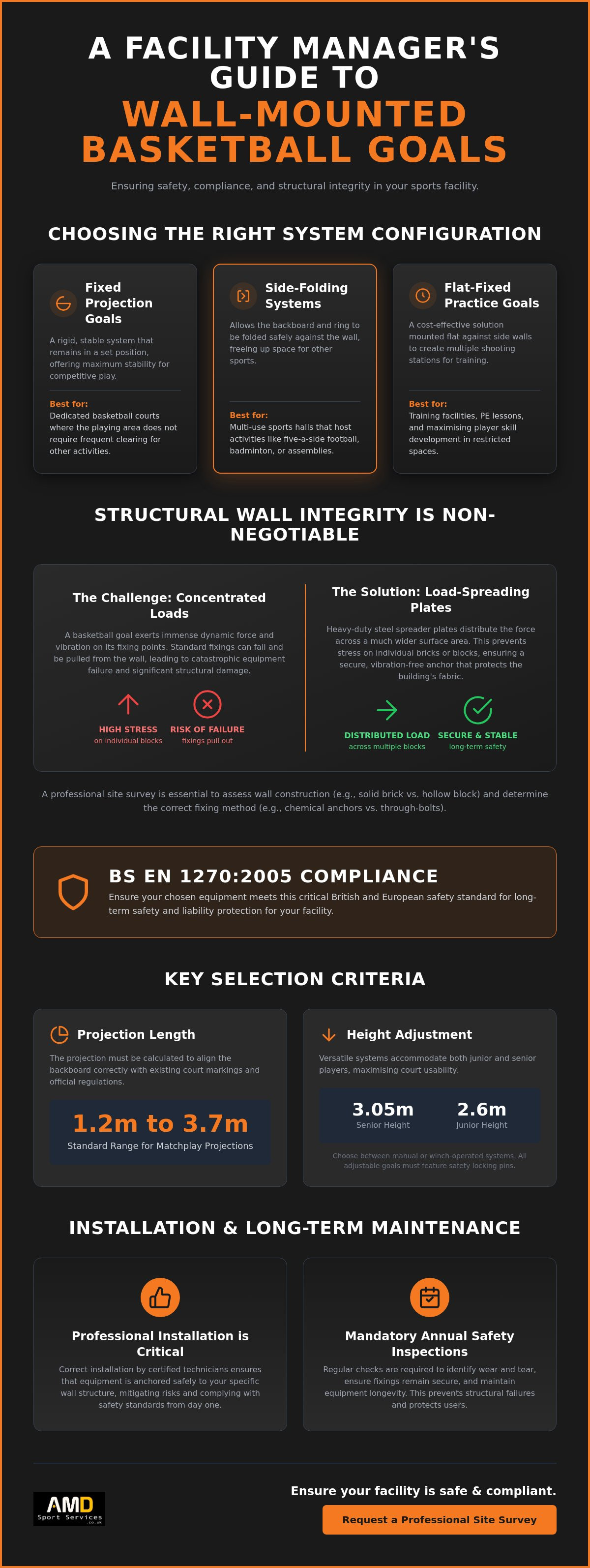
Fixed projection goals are the standard choice for dedicated courts. These systems provide a rigid, stable platform that doesn't require adjustment between sessions. Because they remain in a set position, they offer the highest level of stability for competitive play. However, they're only suitable where the projection doesn't interfere with other activities or safety zones.
Side-folding systems are the practical solution for multi-use sports halls. These systems allow the Basketball backboard to be tucked away against the wall when the space is needed for other sports. This is particularly important in halls where five-a-side football or badminton takes place; folding the goals prevents damage to the equipment and ensures player safety.
For facilities focused on training or PE, flat-fixed practice goals provide a cost-effective alternative. These are often mounted on side walls to create multiple shooting stations. Whilst they don't offer the projection required for official matchplay, they're excellent for developing skills in a restricted space.
Fixed vs. Folding: Which suits your sports hall?
Deciding between a fixed or folding system requires an honest assessment of your hall's changeover frequency. If your staff needs to clear the floor quickly for different activities, a side-folding mechanism is essential. You must also consider the projection length required to align with your court markings. A standard matchplay projection often ranges from 1.2m to 3.7m; a folding system ensures this significant structure doesn't obstruct the clearance needed for division nets or other floor-based equipment.
The role of height-adjustment mechanisms
To accommodate both junior and senior players on a single court, height-adjustable units are a versatile addition. These mechanisms allow the rim to be lowered from the standard senior height of 3.05m to the junior height of 2.6m. You can choose between manual or winch-operated systems. Manual systems are often sufficient for occasional changes, but winch-operated versions are safer and more efficient for staff who need to adjust heights daily. Every adjustable system must include safety locking pins to ensure the goal remains stable and secure during high-impact play.
Structural and Wall Requirements for Secure Installation
The physical integrity of your sports hall relies on the secure anchoring of your equipment. When players hang on a rim or a heavy backboard vibrates after a high-impact shot, the wall must absorb significant kinetic energy. Standard residential fixings are entirely insufficient for the heavy-duty demands of wall mounted basketball goals in a school or leisure centre. Without proper reinforcement, the vibration and constant weight can pull fixings directly out of the substrate, leading to catastrophic failure.
To mitigate this risk, we utilise heavy-duty load-bearing spreader plates. These plates distribute the force across a much wider surface area, preventing concentrated stress points on individual bricks or blocks. This approach ensures your installation adheres to FIBA safety and compliance standards, which mandate that support structures remain vibration-free and rigid during play. It's not just about holding the dead weight; it's about managing the dynamic live loads generated during active games.
Failure to account for wall density is a common oversight in facility management. A brick wall may appear solid, but its internal condition and the mortar's age significantly affect its load-bearing capacity. By spreading the load, we protect the building's fabric whilst providing a stable platform for the athletes.
Assessing Masonry and Blockwork Suitability
Not all walls are created equal. Solid brick offers excellent pull-out resistance, but many modern UK facilities use lightweight thermal blocks or hollow concrete units. These materials lack the density to hold traditional expansion bolts securely. Instead, we often use chemical anchors or through-bolts with backplates to create a mechanical bond that won't loosen over time. A professional site survey is the only way to guarantee wall suitability.
Bespoke Steelwork Support Systems
Sometimes, the wall itself cannot support the load directly, particularly in halls with non-structural partitions or timber frames. In these instances, we design and install bespoke steel frames that bridge the gap between structural pillars or steel stanchions. These frames are custom-engineered to ensure they don't interfere with existing indoor sports hall lighting or ventilation systems. Powder-coated to match your hall's colour scheme, these frames provide a professional finish whilst meeting the most stringent safety requirements. If you're planning an upgrade, seeking a professional structural assessment is the most reliable first step.
Safety Standards and BS EN 1270 Compliance
Every institutional facility in the UK must prioritise compliance with BS EN 1270:2005. This European standard specifies the functional and safety requirements for basketball equipment, ensuring that every component from the rim to the mounting bracket is fit for purpose. When you install wall mounted basketball goals, you aren't just buying sports gear; you're investing in a structural assembly that must withstand immense physical pressure. Without this certification, there's no guarantee the system can handle the dynamic loads generated during competitive play.
Compliance involves rigorous load testing. The equipment is tested to ensure the rim and backboard can withstand the forces of a player hanging or dunking without collapsing. In high-use environments like schools and leisure centres, this isn't a luxury. It's a fundamental safety requirement. Non-compliant retail systems often lack the reinforced steelwork necessary to pass these tests, making them dangerous choices for public facilities where equipment is used daily by hundreds of students and players.
The legal implications of non-compliance are severe for any facility using wall mounted basketball goals. Local authorities and educational trusts have a clear duty of care to provide safe environments for the public. If an accident occurs involving equipment that doesn't meet BS EN 1270 standards, the facility could face significant liability and insurance complications. Ensuring your equipment is compliant is a matter of institutional accountability and long-term risk management.
Load-bearing Capacities and Rim Safety
Breakaway rims are designed to flex when a specific load is reached, typically 105kg, to protect both the player and the backboard. This mechanism reduces the risk of wrist injuries and prevents backboard failure. For safety, the rim must be bolted directly to the metal support structure, ensuring the force bypasses the backboard material entirely. BS EN 1270 is the mandatory benchmark for UK sports hall basketball goals.
Backboard Materials and Safety Performance
Backboard choice impacts both durability and safety. Common options for institutional facilities include:
Cast Resin: Highly durable and suitable for heavy use in schools.
Acrylic: Provides professional rebound properties and transparency.
Safety Glass: The gold standard for competition, requiring toughened glass and protective film.
High-impact play also requires FIBA-compliant padding on the bottom and sides of the backboard to protect players during layups. Regular maintenance of the fixings is also necessary to prevent the vibration and noise that can signal loose or failing components.
Key Criteria for Selecting Your Basketball Goal System
Selecting a system requires balancing high-level performance with daily practicalities. Institutional wall mounted basketball goals must endure the rigours of school PE lessons and evening club sessions without loosening or warping. Choosing heavy-duty steel components over lightweight retail alternatives is the only way to ensure the system survives this high-impact environment. Retail units often use thin-walled tubing that cannot withstand the vibration of constant play; professional-grade frames utilise thick-gauge box sections that remain rigid over years of use.
Corrosion resistance is another factor often overlooked when selecting wall mounted basketball goals. For indoor halls, a high-quality powder-coated finish provides a durable, professional appearance that resists chipping and scratching. If you're installing equipment in an outdoor or semi-covered area, hot-dipped galvanised steel is a necessity to prevent rust from compromising the structural integrity of the mounting brackets and frame. A rusted bracket isn't just an aesthetic issue; it's a structural liability that can eventually lead to equipment failure.
Projection Lengths and Court Standards
The distance between the wall and the backboard, known as the projection length, must align precisely with your court markings. Standard projections typically range from 1.2m to 3.7m. This distance is critical for maintaining a safe "run-off" area behind the baseline, preventing players from colliding with the wall during high-speed layups. In smaller halls, you must balance these safety standards with the physical constraints of the building. Consulting a specialist on Indoor Basketball Goal Fitting ensures your layout remains compliant whilst maximising the available floor space.
Operational Efficiency for Staff
A goal system is only effective if your staff can operate it without risk of injury. Height-adjustable units should ideally feature gas-strut assistance to take the weight of the backboard during adjustment. This feature makes it much easier for a single person to transition between junior and senior heights safely.
Staff Training: Ensure all personnel are trained on the safe use of pull-cords and winch handles.
Manual Handling: Reducing the physical strain of equipment setup helps prevent workplace injuries.
Locking Mechanisms: Always verify that safety pins are engaged before play begins.
Using efficient, well-maintained equipment reduces the time needed for hall changeovers, keeping your facility running on schedule. For a safe and compliant setup, you can arrange a professional basketball goal installation to ensure every mechanism is fitted correctly and every safety standard is met.
Professional Installation and Long-term Maintenance
The final stage of securing high-quality wall mounted basketball goals is ensuring they're fitted by experts and maintained with technical precision. You shouldn't treat an institutional installation like a DIY project. Specialist installation is a non-negotiable requirement for insurance purposes and general safety compliance. If equipment fails due to poor fitting, the liability falls squarely on the facility manager. Professional installers understand the structural nuances of masonry and steelwork, ensuring that every load-bearing plate and chemical anchor is deployed correctly to handle the physical stresses of a competitive match.
Maintenance is the only way to protect your initial investment. Over time, even the most robust systems show signs of use. We frequently encounter frayed nets, loose bolts caused by vibration, and hydraulic or winch leaks in height-adjustable systems. In high-use environments, nets often require replacement every 12 to 18 months, whilst mechanical winches should be lubricated annually to prevent seizing. Catching these issues early prevents minor repairs from turning into expensive structural failures. A proactive approach ensures the equipment remains safe for students and club players whilst extending its operational lifespan by several years.
The Importance of Annual Safety Inspections
Regular sports equipment safety inspections are a cornerstone of facility management in the UK. A professional inspector goes beyond a simple visual check; they conduct structural integrity tests to ensure the mounting remains rigid and the safety mechanisms function under load. Inspectors specifically look for hairline fractures in backboards and check the tension in the springs of breakaway rims. They also verify that the wall spreader plates haven't shifted or caused cracking in the masonry. This process is vital for documenting compliance with UK health and safety regulations for schools, providing a clear audit trail for your records.
Choosing a Specialist Contractor
When selecting a partner for your facility, look for a seasoned practitioner who prioritises workmanship over polished sales pitches. Verify the contractor's experience by reviewing their previous indoor sports hall projects. A qualified specialist will understand the unique structural challenges of your building and provide bespoke solutions rather than off-the-shelf compromises. They should be able to explain the technical workflow from the initial assessment to the final result. Upon completion, ensure the contractor provides a full safety certificate, giving you the confidence that your wall mounted basketball goals are secure, compliant, and ready for years of intensive use.
Securing the Future of Your Sports Facility
Ensuring the safety and longevity of your equipment requires a technical approach that looks beyond the surface. From verifying BS EN 1270 compliance to assessing the specific load-bearing capacity of your masonry, every decision impacts the structural security of your wall mounted basketball goals. By prioritising professional installation and sticking to a methodical annual inspection regime, you protect both your facility's budget and the safety of your players.
With over 20 years of industry experience, we understand the unique structural challenges of UK institutional environments. We specialise in bespoke structural steelwork and provide comprehensive safety certification with every project, ensuring your facility remains fully compliant with current health and safety standards. Our pragmatic approach focuses on technical proficiency and long-term reliability rather than marketing flair.
Contact AMD Sport Services for professional basketball goal installation and safety inspections to discuss your specific hall requirements. Taking the right steps today ensures your equipment remains a safe, dependable asset for many years of intensive use.
Frequently Asked Questions
Do wall-mounted basketball goals require a specific type of wall?
Solid masonry such as brick or high-density concrete block is the ideal substrate for secure mounting. You can't safely attach these systems to partition walls or lightweight thermal blocks without significant internal reinforcement or spreader plates. If the building's fabric is unsuitable, we install bespoke steel frames to bridge structural pillars. This ensures the wall mounted basketball goals are anchored to the building's primary skeleton rather than just the surface material.
How often should wall-mounted basketball goals be inspected for safety?
Professional safety inspections should take place at least once every 12 months. In high-traffic leisure centres where the equipment is used daily, bi-annual checks are often recommended to manage wear and tear. These inspections identify structural fatigue, loose fixings, or frayed nets before they become a hazard. Documenting these regular checks is a critical requirement for meeting your facility's duty of care and insurance obligations.
Can I install a wall-mounted basketball goal myself in a school hall?
Professional installation is a non-negotiable requirement for school environments to ensure safety and compliance. Attempting a DIY installation risks structural failure and will likely void your facility's insurance policy. Specialist contractors have the technical equipment to test wall pull-out resistance and ensure the system meets BS EN 1270 standards. A certified installation provides a safety document that protects school governors and management in the event of an incident.
What is the standard height for a wall-mounted basketball rim?
The standard rim height for senior play is 3.05 metres, whilst junior play requires a height of 2.6 metres. This measurement is taken from the top edge of the rim vertically down to the finished floor surface. If your hall serves multiple age groups, height-adjustable wall mounted basketball goals are the most practical solution. They allow staff to transition between these two standard heights safely and efficiently using a manual or electric winch.
What is the difference between a fixed and a breakaway basketball rim?
Fixed rims are rigid steel hoops suitable for basic practice, whilst breakaway rims contain a calibrated spring-loaded mechanism. Breakaway rims are designed to flex when a specific downward force is applied, typically around 105kg. This feature is essential for preventing backboard shatter and reducing the risk of wrist injuries for players who dunk. In most competitive UK facilities, breakaway rims are the standard choice for player safety.
How much space is needed for a folding basketball goal system?
A side-folding goal system typically requires enough clear wall space to accommodate the width of the backboard, which is usually 1.8 metres. When in use, the projection can extend between 1.2 and 3.7 metres into the hall. When folded, the unit sits relatively flush against the wall. You must ensure that no other equipment, such as radiators or division nets, obstructs the folding path of the bracketry during changeovers.
Are wall-mounted goals better than portable basketball stands for schools?
Wall-mounted systems are generally superior for indoor halls because they don't occupy valuable floor space when stored. They offer much higher stability and consistent rebound performance compared to portable stands, which can shift or vibrate during play. These systems also eliminate the manual handling risks associated with moving heavy, weighted portable bases across the hall floor, making them a more efficient choice for school staff.
Is BS EN 1270 compliance mandatory for UK leisure centres?
BS EN 1270 is the essential benchmark for any public or institutional sports facility in the UK. Whilst it is a technical standard, it is used by insurance providers and health and safety auditors to determine if equipment is fit for purpose. Operating non-compliant equipment in a leisure centre significantly increases your legal liability if a player is injured. Adhering to this standard is the only way to guarantee the equipment's structural integrity.


Comments