
Acrylic Basketball Backboard Replacement: UK Guide

An acrylic basketball backboard replacement should start with an assessment of both the damage and the goal around it.
For schools, councils, leisure centres and sports clubs, it helps to know what needs attention before taking a court out of use. Cracks or broken edges may make replacement the practical option, but safe fitting also depends on the board’s connection to the existing goal.
This guide explains what to look for, how to compare replacement with repair, and what a professional replacement involves. AMD Sport Services carries out acrylic basketball backboard replacement and basketball goal repairs for facilities across the UK. The work considers the board, its mountings and the supporting assembly together.
Table of Contents
Acrylic Basketball Backboard Replacement: Signs the Board Needs Attention
Acrylic Backboard Replacement: Materials, Mountings and Compatibility
Replace the Acrylic Board, Repair the Goal or Renew the Assembly?
How Professional Acrylic Basketball Backboard Replacement Works
Acrylic Basketball Backboard Replacement by AMD Sport Services
Acrylic Basketball Backboard Replacement: Signs the Board Needs Attention
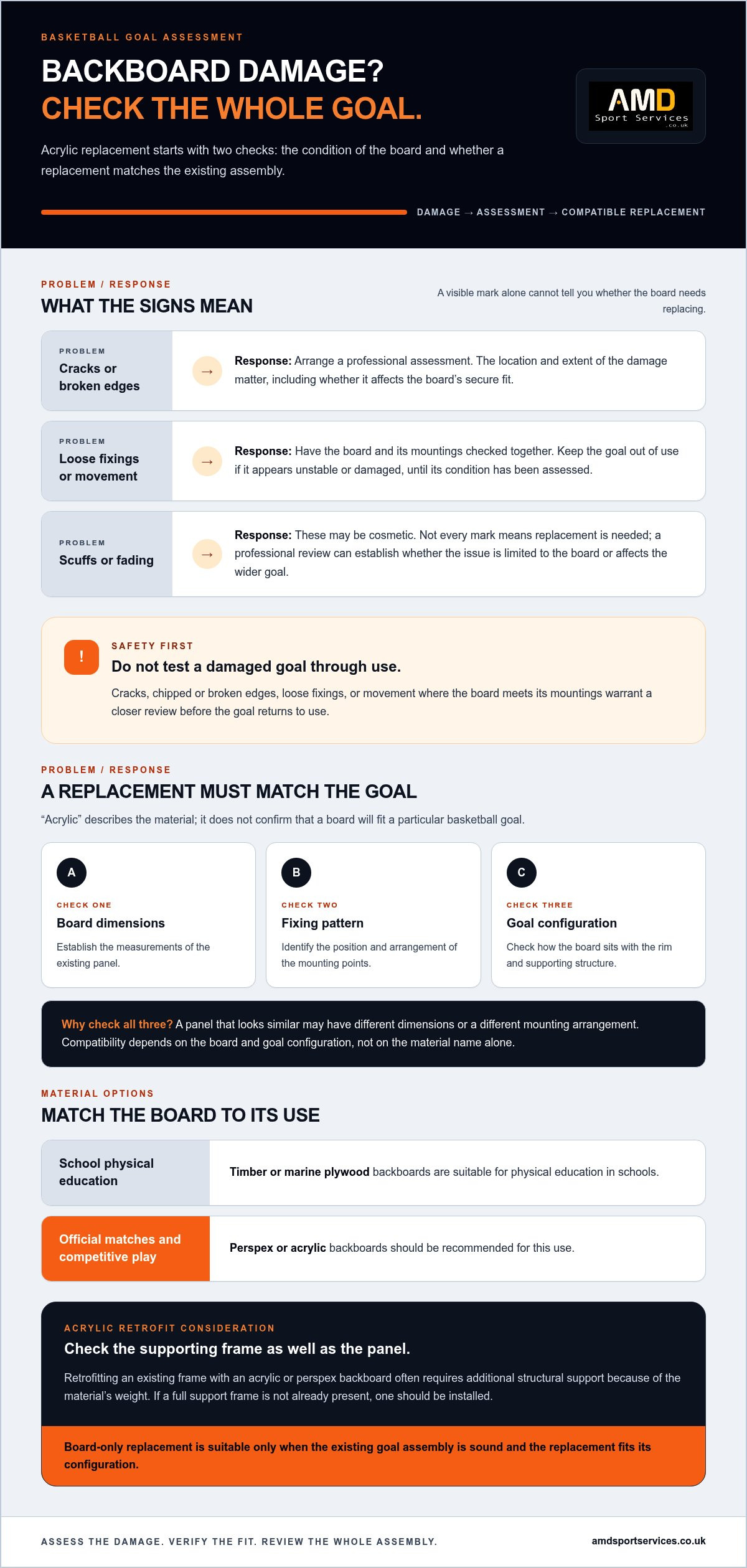
Cracks, broken edges, loose fixings or noticeable movement where the board meets its mountings are reasons to arrange a professional assessment. They are not a basis for a remote diagnosis. If the board appears unstable or damaged, keep the goal out of use until its condition has been assessed.
Not every mark means the board needs replacing. Scuffs or fading may be cosmetic, while a crack or damaged edge can raise a more serious concern. The location and extent of damage matter, as does whether it affects the board’s secure fit. Avoid using the goal to test how serious a concern is.
Which signs can indicate an acrylic backboard needs replacement?
Look for visible cracks, chipped or broken edges, fixings that appear loose, or movement between the board and its mountings. Significant surface deterioration also merits attention, particularly if it makes the board’s condition difficult to judge. These signs do not prove that replacement is the only option, but they do warrant a closer review before the goal returns to use.
Damage near a fixing point may need closer attention than a surface blemish elsewhere. A professional can assess whether the issue is limited to the board, can be addressed through repair, or involves other parts of the goal. Acrylic basketball backboard replacement should follow that assessment, rather than being decided by appearance alone.
Why the whole basketball goal assembly matters
The board connects to the goal through mountings, while the rim and supporting structure form part of the same assembly. A replacement must suit those components and sit correctly in relation to the rim. If nearby parts show damage or movement, replacing the panel alone may leave the wider concern unresolved.
For a general overview of basketball backboard materials and history, readers can refer to this background resource. It is not a substitute for assessing a particular goal. A practical assessment examines the board alongside its mountings, rim and support, rather than treating each part in isolation.
A board-only replacement changes the backboard while retaining a suitable goal assembly; wider goal repair addresses problems in the surrounding components as well. The right scope depends on the condition of those parts. If damage or movement raises doubts, record the visible concern and keep the goal out of use until it has been assessed. A professional review can then establish whether replacement, repair or wider work is appropriate.
Acrylic Backboard Replacement: Materials, Mountings and Compatibility
Acrylic describes the backboard material, but it does not establish whether a replacement will fit a particular goal. The board is one component in a complete assembly. Its dimensions and fixing points must suit the existing support, and it must align correctly with the rim and the rest of the goal.
A backboard can be replaced independently without replacing the entire basketball frame, provided the existing frame is sound and suitable. Timber or marine plywood backboards are suitable for physical education in schools, whereas perspex or acrylic backboards should be recommended for official matches and competitive play.
Establish compatibility before ordering or fitting a replacement. A panel that looks similar may have different dimensions or a different mounting arrangement. Visual resemblance is not a reliable way to select a board, because a mismatch can prevent it from fitting properly.
How the replacement board must match the existing goal
Start by establishing the board’s dimensions and how it attaches to the goal. The mounting points must correspond with the existing arrangement, and the board must sit correctly in relation to the rim and supporting structure. Check model-specific measurements and fitting instructions before fabrication or installation begins.
Equipment manufacturer documentation may include the goal or backboard model details. If records are unavailable, a professional assessment can help establish the existing configuration. The aim is to identify the actual fit requirements, not to assume that boards described by the same material or general type are interchangeable.
Board dimensions: establish the measurements of the existing panel.
Fixing pattern: identify the position and arrangement of its mounting points.
Goal configuration: consider how the board sits with the rim and supporting structure.
Structural support and mounting requirements for acrylic boards
Retrofitting an existing frame with an acrylic or perspex backboard often requires additional structural support because of the material's weight. If a full support frame is not already present, one should be installed.
Mounting requirements also differ from timber. A timber board on a hinge goal may use only two or three bolts on the sides, but an acrylic board requires full frame support bolted along the top, bottom and sides.
The support frame should include a ring support, so that the hoop bolts directly through the rim, the backboard and the steel frame structure. This reinforcement is essential to withstand the impact and weight when players dunk on a sprung hoop.
AMD Sport Services manufactures these goal frame supports, and carries out basketball goal repairs, and assessing the board as part of the wider equipment. Facilities arranging sports equipment maintenance can include backboard and goal compatibility in that assessment.
Replace the Acrylic Board, Repair the Goal or Renew the Assembly?
A damaged board does not automatically mean that the entire basketball goal needs replacing. The appropriate scope depends on the assessment: whether the damage is confined to the board, whether repair is suitable, and whether the rest of the goal remains serviceable. A comparison can help facility operators understand the options, but the decision should be based on the equipment’s condition, not appearance alone.
Goal configuration matters, too. A board that looks similar may not suit the existing mountings or support. This relationship is covered in more detail in the guide to professional basketball goal installation services.
When a board-only replacement may be suitable
A board-only replacement may be appropriate if an assessment finds that the damage is confined to the panel and the existing mountings and supporting structure remain serviceable. The replacement must still match the goal’s configuration, including its dimensions and fixing arrangement. If those details do not align, replacing the panel alone may not provide a suitable fit.
Repair may also be an option if the damage and equipment condition allow it. Repair and replacement are not interchangeable: the extent and location of damage, along with the board’s connection to the goal, determine what work is suitable. A professional assessment establishes whether repair or replacement is the practical course.
When the wider basketball goal needs attention
Movement, deterioration or other concerns affecting the mountings or support may indicate that the issue is not limited to the board. Basketball goal repair can address wider equipment problems alongside a damaged panel. The work needs to account for how the connected parts function as an assembly, rather than treating a new board as a complete solution.
Wider repair is different from installing a complete goal. Repair addresses identified issues in existing equipment; a new installation replaces or adds a goal system. For acrylic basketball backboard replacement, the assessment should establish what needs attention and whether the existing goal can remain in service. This keeps the work in proportion to the equipment’s condition.
How Professional Acrylic Basketball Backboard Replacement Works
A planned replacement follows a clear sequence: assess the goal, confirm the replacement board is compatible, prepare the work area, carry out the replacement, inspect the completed work and hand over the equipment. The goal is managed safely throughout. If its condition raises concerns, it remains out of use until the work and checks are complete.
For a school, council, leisure centre or sports club, planning also needs to account for access arrangements and the court timetable. Agreeing how the work area will be managed and when the court is available helps the facility operator plan around disruption. Arrangements depend on the equipment and site.
Assessment, compatibility checks and preparation
Before work begins, the existing board and goal configuration are assessed. This includes visible damage and the condition of relevant mountings and supporting components. The replacement is matched to the equipment using available manufacturer or model information and the observed fitting arrangement. If the assessment identifies issues beyond the board, the scope can include those as well.
Preparation includes agreeing access and court availability with the facility operator, then securing the work area so the goal is not in use during replacement. This helps staff understand which equipment is affected and when the area can be handed back. The time required depends on the job and site arrangements, so a fixed duration should not be assumed.
Fitting, inspection and return to use
Once the replacement and work plan are established, the existing board is removed and the compatible replacement is fitted using the appropriate method for that goal. The work is carried out with the assembly managed safely. Fitting methods depend on the equipment, so they should be determined by the people doing the work, not improvised from general guidance.
Before handover, the completed installation is inspected. This includes checking the fitted board, its fixings and related goal components, rather than relying on a visual check of the panel alone. The goal should return to use only when its condition has been assessed as suitable. If further work is needed, it remains unavailable until that work is addressed.
Handover gives the facility operator a clear point at which to resume normal court planning. Keeping a record of the work and any issues identified can also support future sports equipment maintenance and repair. This helps staff track the equipment’s condition without treating a single replacement as a substitute for ongoing attention.
For schools, councils, leisure centres and clubs, a well-managed acrylic basketball backboard replacement is about more than fitting a panel. It brings together compatibility checks, safe site planning and inspection before the goal returns to use. Arrange professional basketball goal repair with AMD Sport Services, with the backboard and supporting equipment assessed as part of the same job.
Acrylic Basketball Backboard Replacement by AMD Sport Services
A damaged backboard raises practical questions for a school, council, leisure centre or sports club: can the goal remain in use, what work is needed, and how can court disruption be managed? AMD Sport Services carries out acrylic basketball backboard replacement as part of its basketball goal repair work. The assessment considers the board in relation to its mountings, supporting goal and intended facility use.
AMD Sport Services supports facilities with sports equipment inspections, maintenance and repairs. With over 20 years of industry experience, the team takes a measured approach to basketball equipment: assess its condition, establish the appropriate scope, carry out the replacement or repair, and check the equipment before it returns to service.
A specialist approach for schools and sports facilities
Each goal needs to be considered as an assembly. A replacement board must suit the existing equipment, and the mountings and support need attention as part of the assessment. If the issue extends beyond the panel, the work may include basketball goal repair rather than a board-only replacement. This helps facility managers base decisions on the equipment’s condition, not just the visible damage.
Planning matters, too. Access arrangements and court use affect how replacement work fits around a facility’s activities. AMD works with the operator to account for these practical considerations and manage the affected goal and work area appropriately. Arrangements depend on the equipment and site, so no fixed project duration should be assumed.
Arrange basketball backboard replacement
AMD’s process connects assessment with the work required. The team considers the visible condition of the board, how it fits the goal and whether other components need attention. Once the scope is established, replacement or repair can be carried out, followed by checks before the goal is handed back. If the equipment needs further work before it is suitable for use, it remains out of service until that work is addressed.
This approach gives facility managers a clear basis for planning. It addresses the backboard without overlooking its connection to the wider goal or the court’s operation. It also distinguishes a board replacement from broader repair, so work can focus on the parts that need attention.
If a basketball goal at your facility has a damaged or deteriorating board, arrange acrylic backboard replacement and basketball goal repair with AMD Sport Services.
Plan the Next Step for Your Basketball Goal
A backboard issue is a useful prompt to review how the goal fits the facility’s ongoing plans. Before arranging work, gather any equipment records or previous repair details available, and consider how court access can be managed during the assessment. This gives the work a practical starting point and keeps the facility’s needs in view.
A professional assessment helps you decide whether acrylic basketball backboard replacement is appropriate and what work is needed before the goal returns to use. The scope should reflect the equipment’s condition and the way the court is used, rather than assuming every damaged panel calls for the same solution.
AMD Sport Services supports sports facilities with basketball goal installation and repair, alongside sports equipment inspection and maintenance. Discuss acrylic basketball backboard replacement with AMD Sport Services to plan the right work for your facility’s goal.
Frequently Asked Questions
How should an acrylic basketball backboard be cleaned?
Follow the equipment manufacturer’s cleaning instructions. For routine marks, use a soft, clean cloth and glass cleaner. Avoid abrasive pads or cleaners unless the manufacturer says they are suitable. Check the manufacturer’s guidance before using cleaning products, as the board’s material and finish affect what is appropriate. If dirt or surface changes remain after gentle cleaning, record the concern and arrange an assessment rather than scrubbing more aggressively.
How often should a basketball backboard be inspected?
These should be inspected annually as part of the facilities annual sport equipment safety inspection. Staff can also report visible changes as they arise, such as new marks, movement or damage after use. Assess reported concerns promptly, particularly if they could affect the board’s security or the goal’s continued use.
Can an acrylic basketball backboard be used outdoors?
An acrylic board can be used outdoors if it is specified for the particular goal and setting. The material name alone does not establish its suitability for outdoor use. Check the equipment manufacturer’s documentation for the board and goal, including any use and care guidance. If you are considering a replacement for an outdoor court, include the intended setting when assessing compatibility.
How long does acrylic basketball backboard replacement take?
Most replacements are carried out within a day. This would include if we had to install a new backboard support frame too. Obviously If the assessment identifies additional repair needs, the scope may change. Discuss access and court-use arrangements as part of planning the work.
Can an older basketball goal take a replacement acrylic backboard?
Usually, yes. However, if it is a roof mounted basketball goal that folds down via winch or motor control, we would need to assess whether the existing setup can safely handle the extra weight of a Perspex board and frame.
What should happen if a basketball backboard becomes loose?
Stop using the goal immediately and prevent access to it until it has been assessed. Do not try to steady the board during play or tighten fixings without the appropriate expertise, as the cause and condition of the mountings may not be clear. Tell the person responsible for the facility and arrange a professional inspection of the board and related goal components. Return the goal to use only when its condition has been assessed as suitable.
Comments