
Basketball Post Installation: Safety & Technical Guide

Table of Contents
Ensuring Safety and Compliance in Leisure Centre Basketball Post Installation
Selecting the Right System: Fixed, Folding, and Roof-Mounted Basketball Goals
Optimising Facility Efficiency with Motorised and Height-Adjustable Systems
The Technical Installation Process: Structural Integrity and Site Surveys
Long-Term Maintenance and Safety Inspections for Leisure Centres
Ensuring Safety and Compliance in Leisure Centre Basketball Post Installation
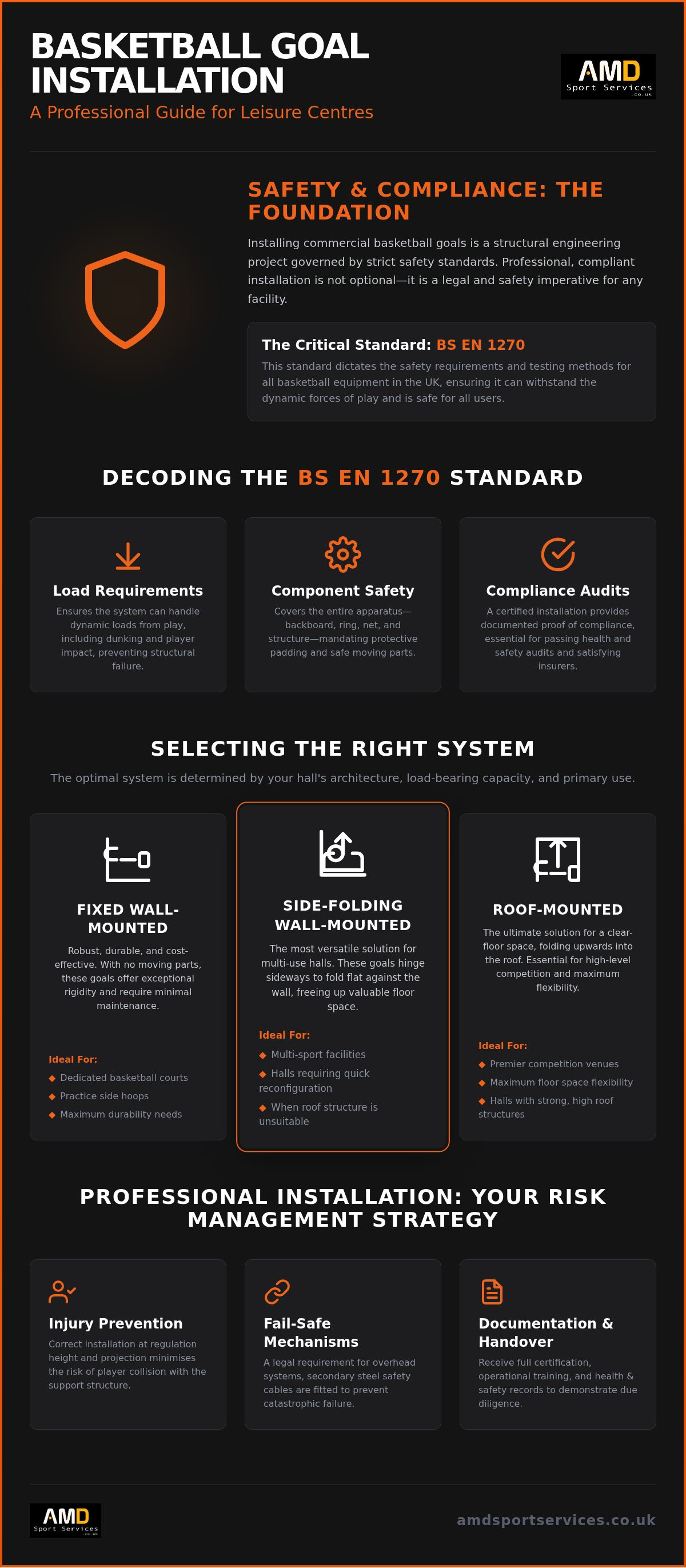
Installing basketball goals in a leisure centre is not a simple assembly task; it is a structural engineering project governed by strict safety standards. For facility managers and local authorities, understanding these regulations is the first step towards a safe and compliant sports hall. The primary standard in the UK is BS EN 1270, which dictates the safety requirements and testing methods for basketball equipment. Adherence is not optional—it is a fundamental part of your facility's health and safety obligations.
Professional installation is mandatory to ensure these standards are met. Unlike domestic hoops designed for garden use, commercial basketball systems are heavy, subject to immense dynamic forces, and must be anchored to a building’s primary structure. An incorrect or non-compliant installation can lead to catastrophic failure, posing a severe risk of injury to users and placing the facility in a position of significant legal liability. Furthermore, improper fitting can cause long-term, cumulative damage to walls and roof trusses, resulting in costly structural repairs that far exceed the initial cost of a professional survey and installation.
The BS EN 1270 Standard Explained
BS EN 1270 provides a detailed framework for the safety and performance of basketball equipment. It classifies goals based on their intended use and specifies the loads they must withstand. Key considerations for leisure centres include:
Load Requirements: The standard outlines different force-bearing capacities for various classes of equipment, from school-level practice goals to high-competition matchplay systems. A professional installer will ensure the chosen system can safely handle the dynamic loads generated during play, including dunking and player impact.
Component Safety: BS EN 1270 covers the entire apparatus, including the backboard, ring, net, and support structure. It specifies requirements for materials, dimensions, and the safe operation of moving parts, such as height adjusters or folding mechanisms. It also mandates the use of protective padding on the front, sides, and bottom edge of the backboard for specific goal types.
Compliance Audits: "Off-the-shelf" or improperly specified basketball goals frequently fail to meet the rigorous criteria required by local authorities and insurance providers. A certified installation provides documented proof of compliance, which is essential for passing health and safety audits.
Liability and Risk Management for Facility Managers
A professional installation is a critical component of a leisure centre's risk management strategy. By engaging a specialist contractor, you transfer the responsibility for structural calculations and compliant fitting to a team with the necessary expertise. This process mitigates risk in several key areas:
Injury Prevention: Correct installation ensures the goal is set at the regulation height and projection, minimising the risk of player collision with the support structure. This is particularly important for matchplay courts where the area behind the baseline must be clear.
Fail-Safe Mechanisms: For overhead systems, secondary safety devices are a legal requirement. Professional installers will fit steel safety cables alongside the primary winch system, ensuring that in the unlikely event of a primary mechanism failure, the goal will not fall.
Documentation and Handover: Upon completion, you should receive a full handover, including certification of compliance with BS EN 1270, operational training for staff, and documentation for your health and safety records. This paper trail is invaluable for demonstrating due diligence and ensuring ongoing safe management of the equipment.
Selecting the Right System: Fixed, Folding, and Roof-Mounted Basketball Goals
The architecture of a sports hall is the primary factor in determining the most suitable type of basketball system. A thorough site survey will assess the load-bearing capacity of the walls and roof, ceiling height, and the presence of other services like lighting, heating ducts, and division netting. This analysis informs the choice between the three main categories of permanently installed goals: fixed wall-mounted, folding wall-mounted, and roof-mounted.
Analysing hall architecture to determine the most stable mounting point
Choosing between wall-mounted systems: fixed-projection, side-folding, and their ideal applications
Roof-mounted goals: the ultimate solution for clear-floor, multi-sport facilities
Portable backstops: when to choose them over permanent installations
Whilst portable goals offer flexibility, they are often unsuitable for the high-intensity use of a busy leisure centre and can present their own manual handling and stability risks. For most institutional settings, a professionally fitted, permanent solution is the safest and most durable option.
Fixed Wall-Mounted Systems: The Practice Standard
For dedicated basketball courts or for practice hoops along the side walls of a multi-sport hall, fixed wall-mounted goals are an excellent choice. Their robust, simple design makes them exceptionally durable and cost-effective. Because they have no moving parts, they require less maintenance over their lifespan.
These systems can be mounted almost flat against the wall or, more commonly, projected outwards to create a clear playing area beneath the board. Common projection lengths range from 300mm to 1200mm, allowing facility managers to position the backboard correctly relative to the court's baseline. A single-stem steel design is a popular configuration, offering high rigidity for practice and general play.
Wall-Mounted Side-Folding Systems
Side-folding systems are the go-to solution for multi-use sports halls where floor space must be quickly reconfigured for other activities like badminton, netball, or events. These goals are mounted to a load-bearing wall and hinge sideways to fold flat when not in use. This design is ideal for halls where:
Roof structure is unsuitable: If the roof trusses cannot support the load of an overhead system, or if the ceiling is too low, a wall-mounted goal is the only viable option.
Projection needs to be managed: The projection from the wall can be specified to align perfectly with existing court markings for matchplay.
Space is shared: In halls with retractable division netting, side-folding goals can be stored neatly out of the way, allowing the space to be divided for different user groups simultaneously.
Roof-Mounted Matchplay Goals
For premier leisure centres, university sports hubs, and facilities hosting national league games, roof-mounted goals are the professional standard. By suspending the structure from the ceiling, they leave the floor and walls completely clear, eliminating any risk of player collision with support posts. This is the only system that truly guarantees a safe runoff area around the court perimeter.
These complex systems are typically motorised and can be specified to fold either forwards or rearwards into the roof space, depending on the hall’s architecture and any potential obstructions. Integrating them requires careful coordination with existing roof trusses, lighting rigs, and heating systems, making a detailed structural survey an absolute necessity. For more information, see our guide on motorising roof-mounted basketball goals.
Optimising Facility Efficiency with Motorised and Height-Adjustable Systems
Modern basketball installations offer significant operational benefits for busy leisure centres. Upgrading from manual to motorised systems and incorporating height adjustability not only enhances safety but also improves the efficiency and inclusivity of the sports programme.
The move away from manual hand winches to electric, key-switch-operated systems dramatically reduces the time required to set up and store basketball equipment. This allows for faster turnarounds between bookings, maximising the facility's revenue-generating potential. Crucially, it also eliminates the manual handling risks associated with staff operating heavy winch systems, often at height. For facilities catering to a wide range of users, from junior clubs to adult leagues, height-adjustable backboards are essential for creating an inclusive environment.
Electric Winch and Motorised Upgrades
Many older, manually operated basketball systems can be retrofitted with electric motors. This popular upgrade provides immediate benefits for leisure centre staff and management.
Converting existing frames: A specialist contractor can assess your current manual frames and install a compatible electric winch system, providing a cost-effective modernisation path without needing to replace the entire goal structure.
Enhanced safety features: Motorised systems are equipped with automatic limit switches that stop the goal at its correct playing and storage positions, preventing accidental damage to the equipment or building structure. They also include the mandatory secondary steel safety cable.
Secure operation: Operation is typically via a wall-mounted key switch or a remote control, ensuring that only authorised and trained personnel can move the goals. This prevents misuse and ensures the equipment is operated correctly.
Height Adjustment for Inclusive Play
To accommodate different age groups and abilities, many basketball systems can be fitted with height-adjustment mechanisms. This allows the ring to be lowered from the standard 10ft (3.05m) for senior play to 8ft (2.44m) for mini-basketball, making the facility more accessible to schools and junior sports programmes.
Adjustment mechanisms: Options range from simple manual winders to gas-shock assisted systems that make adjustment effortless. The choice of mechanism depends on the frequency of use and budget.
Guaranteed stability: A professionally specified height adjuster will maintain the backboard's rigidity and stability at all height settings, ensuring a consistent and safe playing experience.
Retrofitting to existing goals: It is often possible to add a height-adjustment system to existing fixed-height backboards, providing another avenue for upgrading your facility without a full replacement.
The Technical Installation Process: Structural Integrity and Site Surveys
The core of any professional basketball post installation is a comprehensive structural site survey. This is a non-negotiable step that precedes any physical work. An experienced technician must visit the site to assess the load-bearing capacity of the building's structure, whether that involves brickwork walls or the steel framework of the roof. This assessment is critical for calculating the forces that will be exerted on the building and for identifying the precise, safe fixing points.
The process requires close coordination with other services within the sports hall. The position of the goals must account for light fittings, radiant heaters, and the tracks for any existing sports netting. The installation team must devise a plan that integrates the basketball system seamlessly and safely into the existing infrastructure.
Structural Load Assessment
A structural assessment is far more than a simple visual check. It is a technical calculation of the forces the building must be able to resist. This is particularly important for roof-mounted systems, which can weigh over 500kg each.
Calculating dynamic loads: The assessment must account for the "live" or dynamic loads generated during aggressive play. The forces created by a player dunking on the ring are transferred through the backboard and support frame directly into the building's structure.
Identifying suitable fixing points: In modern steel-framed buildings, this involves identifying the correct purlins or trusses. In older, heritage buildings with traditional brickwork, the process is more complex and may require specialist fixings or the fabrication of bespoke spreader plates to distribute the load safely.
Working with structural engineers: For particularly complex installations, or where the building's structural integrity is in any doubt, the installation contractor will work in partnership with a chartered structural engineer to verify all calculations and approve the proposed fixing method.
The Installation Timeline
A professional installation follows a methodical, phased approach to ensure safety and minimise disruption to the leisure centre's operations. A typical project timeline includes:
Pre-installation Checks: This phase includes the initial site survey, structural calculations, and coordination with facility management to schedule the work, often during periods of low usage to minimise downtime.
Physical Fitting: The installation team arrives on-site with all necessary equipment, including access towers or scissor lifts. They will drill and prepare the fixing points, assemble the goal structure, and securely mount it to the wall or roof. All mechanical components, such as winches, cables, and pulleys, are fitted and tested.
Handover and Certification: Once the system is fully installed and mechanically sound, the team conducts a final series of operational tests. They then provide a full handover to the facility staff, including practical training on how to operate the system safely. Finally, they issue the formal certification confirming the installation complies with BS EN 1270.
Long-Term Maintenance and Safety Inspections for Leisure Centres
The legal responsibility for equipment safety does not end once the installation is complete. Under UK health and safety law, facility operators have an ongoing duty of care to ensure all sports equipment is maintained in a safe condition. For permanently installed apparatus like basketball goals, this means a programme of regular, professional inspections is a legal requirement, not just good practice.
An annual safety inspection by a competent third-party specialist is the industry standard. These inspections identify common wear points—such as fraying winch cables, worn pulleys, or damaged backboard padding—before they develop into critical failures. Investing in a professional installation from the outset significantly reduces the likelihood of costly future repairs, as high-quality components and correct fitting techniques lead to greater durability. A bespoke maintenance schedule, tailored to the high-traffic environment of a busy leisure centre, is the key to ensuring long-term safety and compliance.
Annual Safety Inspections
A formal annual inspection is a detailed technical audit of the entire basketball system. It is a proactive measure to ensure the equipment remains safe for use and compliant with current standards.
What an inspection covers: A qualified inspector will conduct a thorough check of all structural fixing points, the integrity of the steel framework, the condition of the backboard and ring, and the functionality of all moving parts. You can learn more about what a professional safety inspection entails on our service page.
Functional tests: The inspection includes operational tests of winch systems, checking for correct cable tension and alignment. Crucially, the inspector will verify that the secondary "fail-safe" safety mechanisms are present and fully functional.
Compliant repairs: If any faults are found, the inspection report will detail the required remedial action. It is vital that any basketball goal repairs are carried out using manufacturer-approved or compliant parts to maintain the system's certification.
Refurbishment and Upgrades
Over time, even the most robust basketball systems will show signs of wear. A planned refurbishment programme can extend the life of your equipment and ensure it continues to meet the performance expectations of your users.
Component replacement: Common refurbishment tasks include replacing cracked or clouded Perspex backboards, fitting new competition-standard flex rings, and renewing worn safety padding to maintain player protection.
Court marking renewal: As part of a wider facility upgrade, renewing worn or outdated court markings ensures clarity for players and officials and keeps your facility looking professional.
Modernising older systems: Refurbishment provides an opportunity to modernise. This could involve upgrading to motorised operation, adding height adjusters to existing goals, or replacing outdated backboards with modern glass or acrylic alternatives.


Comments