
Expert Sport Hall Ceiling Protection Netting Solutions

A single stray basketball shouldn't be the reason your facility's maintenance budget is in the red. You've likely dealt with the frustration of shattered LED lighting or damaged ventilation ducts after a high-impact game. It's not just the hardware cost that hurts; it's the logistical nightmare of hiring specialist access equipment and closing the court for repairs. Installing a high-specification sport hall ceiling protection netting system is the most effective way to end this cycle of reactive maintenance.
We understand that managing a sports facility requires a balance between peak performance and strict safety compliance. This article will show you how professional netting safeguards your infrastructure, meets rigorous safety inspections, and significantly lowers your long-term overheads. We'll examine the technical requirements for impact resistance, the benefits of bespoke installations for complex roof structures, and how to select a durable system that doesn't interfere with your hall's acoustics or lighting. By the end, you'll know how to secure your overhead services and keep your facility running without unnecessary downtime.
Table of Contents
The Critical Role of Sport Hall Ceiling Protection Netting
Sport hall ceiling protection netting acts as a high-tenacity safety barrier designed to span the internal roof structure of a sports facility. It's a functional engineering solution that separates the playing area from the delicate infrastructure above. Its primary role is to intercept high-velocity impacts from footballs, cricket balls, or shuttlecocks before they reach sensitive equipment. By creating this physical divide, facility managers can ensure that the hall remains fit for purpose without the constant threat of damage from standard play.
The financial case for installation is straightforward. A single modern LED luminaire or radiant heater represents a significant investment. If a ball strikes these units, the replacement cost is only the beginning. You must also factor in the hire of a mobile elevating work platform (MEWP), the labour for specialist high-level electrical work, and the lost revenue from closing the hall whilst repairs are carried out. Preventing just one of these failures usually justifies the initial cost of the netting system. Beyond equipment protection, netting prevents "dead balls" from becoming trapped in roof trusses. This eliminates the common, and dangerous, practice of users throwing other objects to dislodge a stuck ball, which often leads to further damage or injury.
Safeguarding Overhead Infrastructure
Modern sports halls are filled with expensive technology that isn't designed for physical impact. A well-installed net shields the following assets:
Sensitive LED lighting systems: These are often the most vulnerable and expensive components in the roof.
Fire safety equipment: Netting prevents damage to sprinkler heads and smoke detectors that could trigger a false alarm if struck.
Acoustic panels and radiant heaters: These units are essential for user comfort but can be easily dented or dislodged by heavy impact.
Roof cladding and insulation: Repeated strikes can puncture or compress insulation over time, leading to thermal efficiency losses.
Enhancing User Safety and Compliance
Safe operation is a priority for any school or leisure centre manager. Sport hall ceiling protection netting ensures that if any part of the overhead structure fails or if debris is dislodged, it's caught before reaching the players below. This proactive approach is often a requirement for insurance providers, as it demonstrates a clear commitment to risk management and duty of care.
Regular sports equipment safety inspections include checking these nets to ensure they remain taut and free from UV degradation. By maintaining this barrier, you reduce long-term liability and ensure the facility remains a compliant, safe environment for all users. It's a practical step that turns a high-risk overhead area into a secure, managed asset.
Selecting the Right Netting Specifications for Your Facility
Choosing the correct specification for your sport hall ceiling protection netting depends entirely on the variety of sports your facility hosts. A one-size-fits-all approach often leads to either inadequate protection or unnecessary weight on the building's structure. You must evaluate the material type, mesh size, and safety ratings to ensure the system performs under the specific impact profiles of your hall.
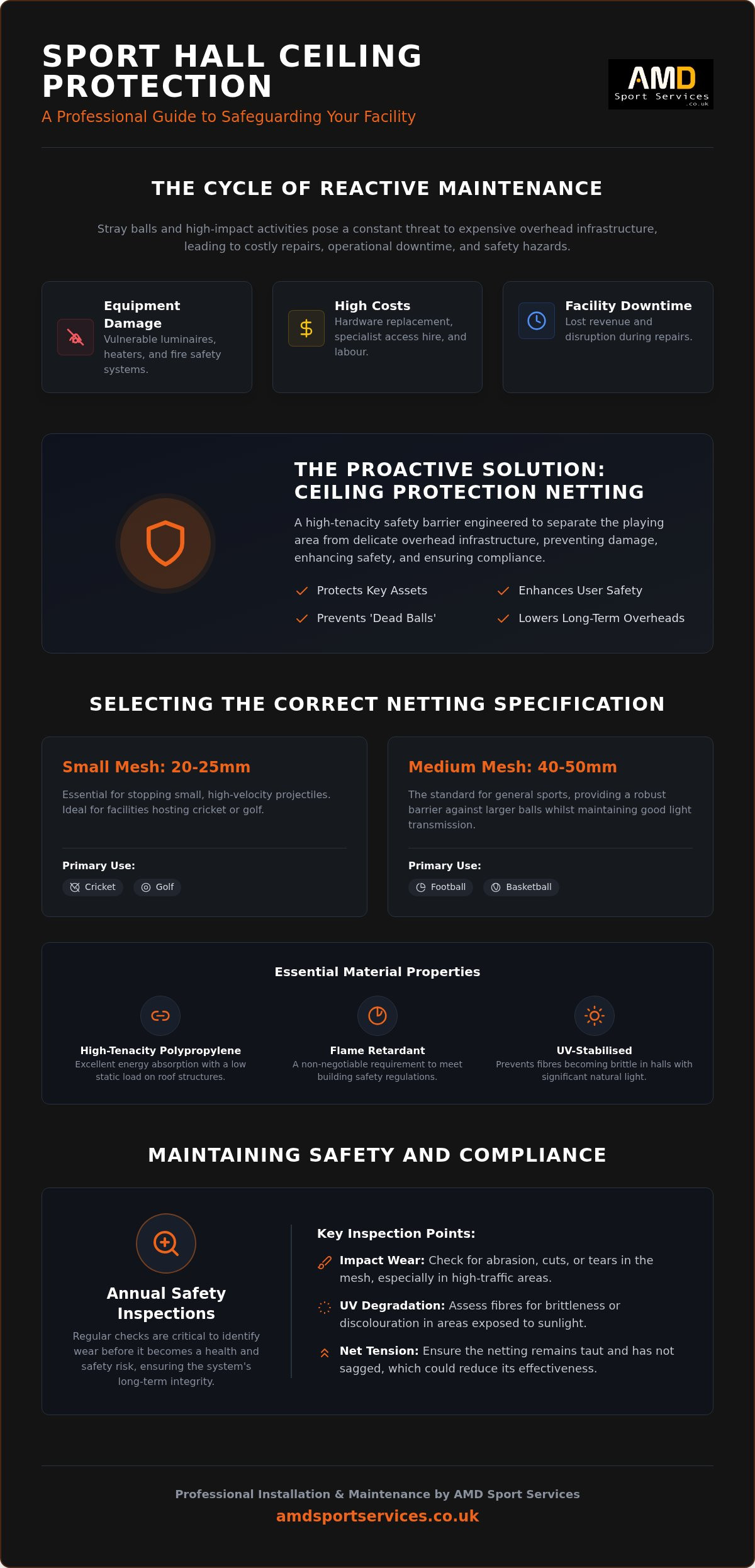
Material choice usually comes down to polypropylene versus nylon. High-tenacity, knotless polypropylene is the industry standard for indoor environments. It's lighter than nylon, which reduces the static load on roof trusses, yet it offers excellent energy absorption. For indoor use, flame retardancy is a non-negotiable requirement to meet building regulations. Additionally, if your hall has significant natural light from skylights, the netting should be UV-stabilised to prevent the fibres from becoming brittle and failing prematurely.
Mesh Sizes and Sport-Specific Requirements
The mesh size determines what the net can stop and how much it affects the hall's lighting and aesthetics. Selecting the wrong size can render the protection useless for certain activities.
Small mesh (20mm - 25mm): These are essential for cricket and golf training. They prevent small, high-velocity balls from passing through or becoming lodged in the mesh, which is a common issue in multi-use centres.
Medium mesh (40mm - 50mm): This is the standard for football, basketball, and general sports. It provides a robust barrier against larger balls whilst remaining almost invisible from the ground, ensuring the hall feels bright and open.
When managing a multi-sport facility, we typically recommend a mesh size that caters to the smallest ball used. This ensures total protection across all booking types without needing to change systems. If you're unsure which material suits your specific roof configuration, our team can provide a bespoke assessment of your facility requirements.
Durability and Material Standards
Longevity is built into the details of the installation. We favour knotless netting because it doesn't have the "peak" stress points found in knotted alternatives. When a ball strikes a knotless net, the force is distributed across the fibres more efficiently, reducing the risk of a tear. Every net should also feature a heavy-duty border cord. This reinforced edge is vital for secure attachment to the tensioned wire systems that hold the net in place.
All materials used in your facility must adhere to relevant British Standards for sports equipment. This ensures the netting can withstand repeated impacts over many years without losing its structural integrity. Properly specified netting doesn't just protect the ceiling; it provides a durable, low-maintenance solution that keeps your facility operational and compliant.
Integration with Overhead Services and Divider Systems
Integrating sport hall ceiling protection netting requires a detailed understanding of the mechanical services already occupying the roof space. It's a technical exercise in coordination rather than a simple installation. A standard system must account for radiant heaters, ventilation ducting, and motorised winches. We design bespoke cut-outs for these services to ensure they continue to function safely. For instance, heaters require specific clearance zones to prevent heat damage to the netting fibres, whilst vents must remain unobstructed to maintain the hall's air quality and temperature control.
The interface between horizontal protection and vertical division curtains is equally critical. If the ceiling net is not correctly aligned with the tracking for division nets, it can create gaps where balls can still bypass the barrier. We ensure that every point of contact is reinforced and securely fastened, creating a seamless envelope that protects the entire overhead infrastructure without hindering the flexibility of the playing space.
Tensioned Cable Systems and Structural Fixings
The foundation of any durable netting system is the framework of galvanised steel straining wires. These wires are tensioned between secure anchor points fixed directly into the building's primary steelwork or masonry. This creates a rigid grid that prevents the net from sagging over time. A sag-free finish is essential for maintaining clear sightlines and ensuring that the net doesn't dip into the path of play or block natural light from high-level windows. We prioritise the use of heavy-duty turnbuckles and wire rope grips. This allows for future adjustments if the building settles or if the system requires re-tensioning after years of heavy use.
Working Around Existing Sports Equipment
The most complex challenge in any sports hall is managing the interface between ceiling nets and moving equipment. We frequently install protection around motorised basketball goals. This requires precise tailoring to allow the goal to retract fully into the roof void without snagging the net or straining the motor. Similarly, the sport hall ceiling protection netting must coordinate with vertical sports hall netting systems used for hall division.
Retrofitting in older facilities often presents unique structural hurdles. Older roof trusses may have irregular spacing or existing cabling that limits fixing options. In these scenarios, we use bespoke bracketry to bypass obstacles. This ensures the sport hall ceiling protection netting remains a continuous, effective barrier. By planning these intersections carefully, we ensure that adding protection doesn't impede the operation of your facility's motorised equipment or partitioning curtains.
Safety Inspections and Maintenance for Overhead Netting
High-level sports equipment is often subject to the "out of sight, out of mind" trap. Because sport hall ceiling protection netting is installed several metres above the playing surface, physical degradation isn't always obvious from the ground. Annual safety inspections are vital to ensure that the system remains a reliable barrier rather than a potential hazard. Over time, the repeated kinetic energy from ball impacts can stress the mesh fibres and the tensioned cable system that supports them. Professional inspections identify these issues before they lead to a mechanical failure or a breach in protection.
UV degradation is a common but subtle sign of wear, particularly in facilities with large skylights or high-level glazing. Natural light causes the polypropylene or nylon fibres to become brittle over time. If the netting feels "dusty" or breaks easily when handled during a high-level check, its structural integrity is compromised. Impact damage is more visible, usually appearing as broken strands or distorted mesh squares. Ignoring these signs increases the risk of a ball passing through the net and striking the very infrastructure you intended to protect.
The Annual Inspection Checklist
A pragmatic maintenance routine focuses on the mechanical components that keep the net taut and secure. Our practitioners follow a structured workflow during every site visit:
Cable tension and wall fixings: We check the galvanised straining wires for signs of stretching and ensure that all wall anchors remain securely seated in the masonry or steelwork.
Mesh integrity: The entire surface area is examined for holes, tears, or thinning of the twine that could indicate localised stress.
Sag assessment: We verify that the net maintains its designed clearance from the playing area and hasn't dipped into the path of play or motorised equipment.
Hardware check: All turnbuckles, wire rope grips, and carabiners are inspected for corrosion or mechanical loosening.
Repairing vs Replacing Ceiling Netting
When damage is identified, the decision to repair or replace depends on the extent of the failure. Patching a net is often a viable, cost-effective solution for small, localised tears caused by a single high-impact event. We use high-tenacity repair twine to "darn" the hole, restoring the barrier's continuity without the expense of a full replacement. However, if the netting shows widespread UV brittleness or if more than 10 percent of the mesh is damaged, a full replacement is usually necessary for safety compliance.
The value of a professional indoor inspection and maintenance programme lies in its ability to extend the lifespan of your assets. By catching tension loss early, we prevent the "whiplash" effect that occurs when a loose net is struck by a ball, which often causes more damage to fixings than the impact itself. If you haven't had your overhead equipment checked in the last twelve months, book a specialist safety inspection today to ensure your facility remains fully compliant.
Bespoke Installation and Professional Maintenance Services
AMD Sport Services approaches every project with the steady confidence of a seasoned practitioner. We don't rely on generic sales pitches; instead, we focus on the technical realities of your building's roof structure. Installing sport hall ceiling protection netting is a specialised task that requires an understanding of structural loads and high-level access logistics. By acting as a single contractor for both the initial installation and long-term servicing, we provide a level of continuity that third-party installers cannot match. This partnership ensures that the team who knows your facility's specific quirks is the same team responsible for its ongoing safety compliance.
Efficiency is a priority for our clients in the education and leisure sectors. We recognise that hall downtime directly impacts revenue and curriculum delivery. Our teams coordinate closely with facility managers to organise work during holiday periods or off-peak hours. We arrive on-site with the correct access equipment and a clear plan, ensuring the project is completed within the agreed timeframe. This methodical approach minimises disruption whilst ensuring the finished installation meets the highest standards of durability and technical proficiency.
Our Approach to Facility Safety
Every project begins with a comprehensive site survey. We don't believe in guesswork. Our technicians identify structural challenges such as irregular truss spacing, existing motorised equipment, or complex lighting layouts. This allows us to provide no-nonsense advice on the most effective protection strategy for your specific hall. We focus on tangible outcomes:
Technical Proficiency: Our installations are engineered to withstand repeated impacts, using high-tenacity materials that meet all relevant British Standards.
Bespoke Design: We tailor every net to fit around your existing infrastructure, ensuring that heaters, vents, and winches remain fully accessible.
Accountability: We take pride in our workmanship; providing clear documentation of the installation and any necessary safety certifications for your records.
Get in Touch for an Expert Assessment
Starting the process is straightforward. Our technical team is available to discuss your specific requirements and help you determine the most appropriate mesh size and material for your sports programme. Whether you are looking for a new installation or need to arrange a comprehensive service and maintenance visit for an existing system, we provide a direct, professional service. We'll guide you through the initial assessment and bespoke design phase to ensure your facility remains safe and compliant. Contact AMD Sport Services today to secure your overhead infrastructure with a professional netting solution.
Securing Your Facility’s Future Infrastructure
Installing professional sport hall ceiling protection netting is a strategic decision that shields your facility from the high costs of reactive maintenance. By selecting the correct mesh specifications and ensuring precise integration with overhead services, you create a durable barrier that protects sensitive lighting and heating systems. Regular maintenance remains the final piece of the puzzle, preventing UV degradation and tension loss from compromising your safety standards.
With over 20 years of technical expertise, AMD Sport Services provides bespoke solutions tailored to the unique requirements of schools and leisure centres. Our team specialises in UK-wide safety inspections and high-level installations that prioritise structural integrity and long-term reliability. Enquire about professional ceiling protection netting from AMD Sport Services to discuss your specific facility needs with a seasoned practitioner. We're ready to help you maintain a safe, compliant, and efficient sporting environment for all users.
Frequently Asked Questions
Does ceiling protection netting reduce the light levels in a sports hall?
Properly specified netting has a negligible effect on light levels within a facility. Using a medium mesh size, such as 40mm or 50mm, allows light from overhead luminaires and skylights to pass through almost entirely unobstructed. The material is designed to be visually minimal from the ground. This ensures that whilst your infrastructure is protected, the playing environment remains bright and compliant with official sports lighting standards.
Can ceiling netting be installed in halls with motorised basketball goals?
Yes, we regularly install sport hall ceiling protection netting in facilities featuring motorised roof-mounted basketball goals. The installation process involves creating bespoke cut-outs and reinforced apertures that allow the goal to retract fully into the roof void. We ensure the netting doesn't interfere with the winch cables or the goal's mechanical operation, preserving the flexibility of your multi-sport space whilst maintaining total overhead protection.
How often should ceiling protection netting be inspected for safety?
You should arrange a professional safety inspection at least once every twelve months. This frequency aligns with standard health and safety requirements for all high-level sports equipment in schools and leisure centres. During these visits, we check for signs of UV degradation, impact damage, and tension loss in the galvanised straining wires. Regular checks ensure the system remains a reliable barrier and doesn't become a hazard itself.
Is it possible to repair holes in ceiling netting without replacing the whole system?
Localised damage can often be repaired using a specialised darning technique. If a single ball strike has caused a small tear, our technicians can restore the net's continuity using high-tenacity repair twine. This is a cost-effective alternative to a full replacement. However, if the net shows widespread thinning or brittleness from age, a full replacement is usually the only way to ensure ongoing safety compliance for the facility.
What is the best mesh size for a multi-use sports hall ceiling net?
For a multi-use hall, the best approach is to select a mesh size that caters to the smallest ball used in the facility. A 20mm or 25mm mesh is essential if the hall hosts indoor cricket or golf, as it prevents these small, high-velocity balls from passing through. If the hall is exclusively for football and basketball, a 50mm mesh is preferred as it offers maximum visibility and minimal weight on the roof trusses.
How long does a typical ceiling netting installation take to complete?
The duration of an installation is determined by the size of the hall and the complexity of the overhead services. Most projects are completed within a few working days. We manage the entire process, from the initial site survey to the final tensioning of the straining wires. To minimise disruption, we often schedule these works during school holidays or off-peak periods when the hall is not in constant use.
Do I need different netting for an indoor cricket centre versus a gym?
The requirements for an indoor cricket centre are much more stringent than a general gym. Cricket netting must have a smaller mesh size, typically 20mm, to stop the ball and withstand significantly higher impact forces. In a general gym or school hall, a 50mm mesh is often sufficient for stopping footballs and basketballs whilst maintaining a lighter load on the building's roof trusses and existing steelwork.
Does the netting need to be flame retardant for UK sports hall regulations?
Yes, all indoor sport hall ceiling protection netting must meet relevant British Standards for flame retardancy. This is a critical requirement for building insurance and fire safety compliance in public spaces. We use high-tenacity, knotless polypropylene that is specifically treated to be flame retardant. This ensures that the netting does not contribute to the spread of fire and remains safe for use in public-sector and educational environments.


Comments