
Folding Basketball Hoop Installation: UK School Guide 2026

When planning a folding basketball hoop installation school leaders must treat the project as a complex structural engineering task rather than a simple equipment purchase. You likely understand the pressure of balancing a multi-purpose sports hall schedule whilst managing the liability risks of overhead retractable systems, especially in older buildings with uncertain load-bearing capacities. It's a persistent challenge to find a solution that provides maximum floor space without compromising the safety of the building's fabric or the well-being of its users.
This professional guide provides a pragmatic roadmap for planning, installing, and maintaining retractable systems that meet BS EN 1270:2005 standards. We promise to clarify the technical requirements that ensure your facility remains both versatile and legally compliant. We will detail the necessity of initial structural assessments, the operational benefits of motorising roof-mounted goals, and the mandatory annual inspection cycles required by the Health and Safety at Work Act 1974. By following this methodical approach, you can achieve a durable, space-saving sports environment that prioritises long-term safety and professional certification.
Table of Contents
Why Folding Basketball Systems are Essential for UK School Halls
Structural and Technical Requirements for School Basketball Goal Fitting
Manual vs. Motorised Retractable Systems: Choosing the Right Mechanism
The Installation Process: Ensuring Compliance with BS EN 1270
Long-Term Safety: Inspections, Maintenance, and Asset Management
Why Folding Basketball Systems are Essential for UK School Halls
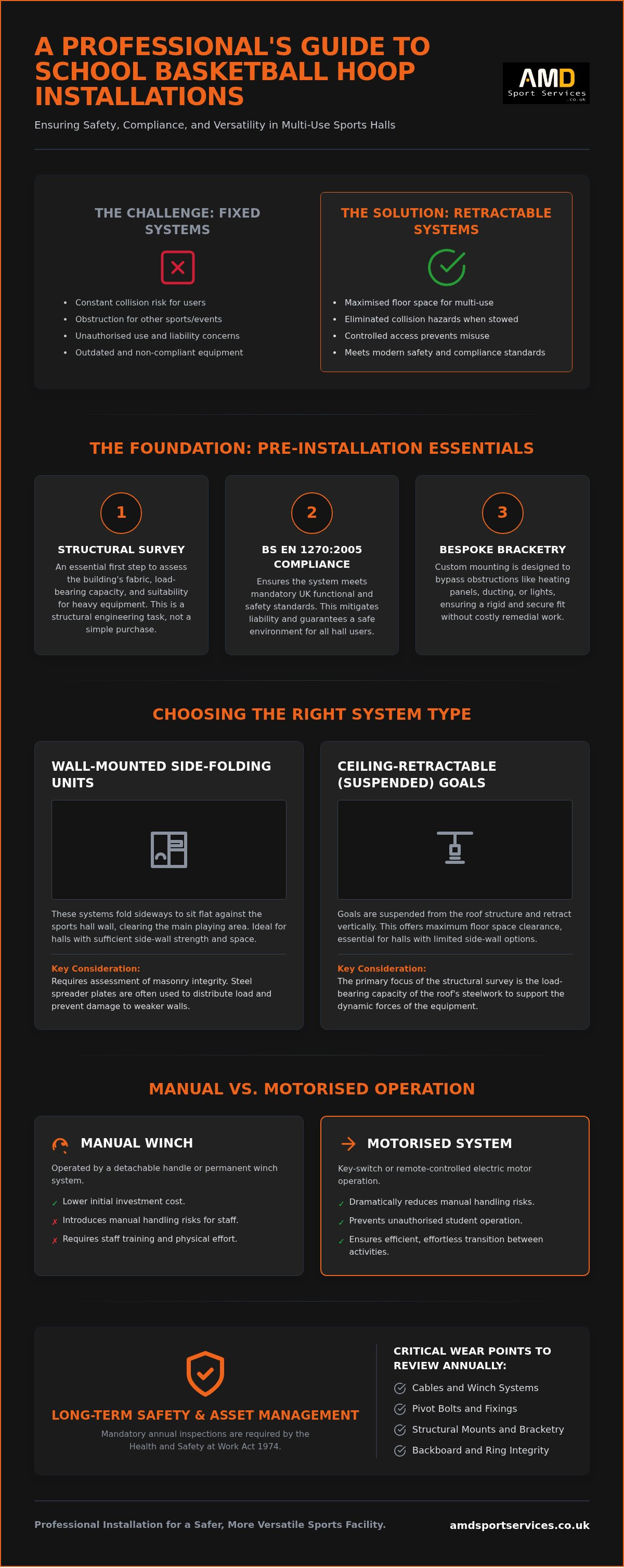
A professional folding basketball hoop installation school project transforms a static hall into a versatile, high-performance environment. These systems generally fall into two categories: wall-mounted side-folding units or ceiling-retractable (suspended) goals. Unlike fixed equipment, these mechanisms allow the hall to serve diverse functions without the constant obstruction of steel frames and boards. It's a pragmatic choice for any institution that needs to balance a heavy PE curriculum with other hall-based requirements.
Space Optimisation in Multi-Sport Environments
UK school halls are high-traffic hubs. One hour the space is a badminton centre, the next it's a formal exam hall or a full-school assembly. Retractable basketball backboard systems ensure that the playing area is completely clear when the sport is not in session. This flexibility is vital for side-court activities where fixed units would otherwise intrude on the safety run-off zones. A clear hall looks professional and functions without the clutter of static equipment, allowing for multiple court layouts within a single sports centre.
Addressing the Safety Risks of Fixed Units
Safety is the primary driver for modern installations. Fixed wall-mounted units present a constant collision risk for pupils during PE or high-speed sports like five-a-side football. By raising or folding the equipment away, you eliminate the danger of impact with rigid steel brackets. It's about reducing the physical footprint of the equipment when it's not needed, ensuring the hall remains a safe environment for all activities.
There's also the issue of unauthorised use. Retractable systems, especially those that are motorised, prevent students from hanging on rings or using equipment during unsupervised times, such as lunch breaks. Choosing a professional basketball goal installation service ensures your school aligns with Sport England facility guidelines. These guidelines favour retractable equipment for multi-use spaces to maintain safety compliance and reduce long-term liability.
Liability is a significant concern for school governors amongst the complexities of modern educational management. Outdated fixed equipment that fails to meet current safety standards represents a major risk. Upgrading to a compliant, retractable system provides peace of mind that the school has met its duty of care whilst future-proofing the facility for years to come. This transition is a key step in professional asset management.
Structural and Technical Requirements for School Basketball Goal Fitting
A successful folding basketball hoop installation school project is, first and foremost, a structural engineering task. You cannot simply bolt heavy equipment to a surface and expect it to withstand the dynamic forces of a competitive match. Every installation begins with a rigorous structural survey to assess the building's fabric. This initial assessment ensures that the chosen system achieves BS EN 1270 compliance, which is the essential standard for functional safety and load-bearing capacity in UK sports facilities.
Bespoke bracketry is often the difference between a system that passes inspection and one that fails within its first year. "One size fits all" solutions frequently interfere with existing hall services such as radiant heating panels, high-level ventilation ducting, or lighting rigs. A seasoned practitioner will design custom mounting plates and supports that bypass these obstructions whilst maintaining the absolute rigidity required for the backboard. This level of technical planning prevents costly remedial work and ensures the equipment integrates seamlessly with the hall's infrastructure.
Wall-Mounted Systems: Assessing Masonry and Steelwork
In many older UK schools, masonry integrity is a significant variable. We evaluate the brickwork to determine its suitability for the significant pull-out forces generated by long-reach retractable arms. If the substrate is found to be weak or inconsistent, we install steel spreader plates. These plates distribute the weight and operational stress across a larger surface area, preventing damage to the wall. For modern buildings featuring timber frames or lightweight cladding, we must identify and fix directly into the primary steelwork to ensure a secure, permanent mount.
Roof-Mounted and Ceiling-Retractable Challenges
Roof-mounted systems offer excellent space-saving benefits but require precise load calculations. Whether we are attaching to steel portal frames or glulam beams, the weight of the motorised winches and backboard assemblies must be factored into the building's structural capacity. Clearance is the primary operational challenge here. The system must retract into the roof void without impacting overhead services or obstructing the field of play for other sports. A professional structural assessment is the only reliable way to verify these technical clearances before any equipment is manufactured or installed on-site.
This methodical approach to technical requirements ensures that the finished result is both durable and safe. By prioritising structural honesty over quick fixes, schools can avoid the liability risks associated with equipment failure. It's about building a foundation of safety that lasts for the lifetime of the sports hall.
Manual vs. Motorised Retractable Systems: Choosing the Right Mechanism
Choosing between manual and motorised mechanisms is a decision that dictates the operational efficiency of your sports hall for the next decade. Manual systems remain a traditional choice for schools with tighter budgets, but the industry is seeing a decisive shift towards motorised solutions. This transition is largely driven by the need to meet school health and safety duties by removing the physical strain associated with manual handling of heavy overhead equipment.
The Case for Motorisation in 2026
When planning a folding basketball hoop installation school teams often prioritise motorised winches for their precision. These systems allow for a rapid transition between sports hall configurations at the touch of a button. Key-switch operation ensures that only authorised staff can deploy the goals, preventing unauthorised use or accidental damage. Because the movement is controlled and consistent, motorised systems experience significantly less mechanical wear than manual units, which are often subject to jerky movements or over-tensioning by well-meaning but untrained staff.
For schools with existing manual systems, retrofitting is a viable and pragmatic upgrade. We specialise in motorising roof-mounted goals that were originally installed as manual units. This process involves installing a high-torque electric winch and control system onto the existing framework, instantly modernising the facility without the cost of a full structural replacement. This specific service is a core part of our service and maintenance offering, helping schools improve safety without a complete overhaul.
Manual Systems: Best Practice for Safe Operation
If a manual system is the only feasible option, safety depends on the quality of the winch and the training of the staff. High-quality pole-operated winches should be geared to allow for smooth, low-effort raising and lowering. Site teams must receive formal instruction on the safe deployment of these heavy goals to prevent injuries. Regular maintenance is non-negotiable; manual mechanisms require frequent lubrication of pivot points and monthly cable checks to ensure the wire hasn't frayed or jumped the pulley.
Whether you choose manual or motorised, the goal remains the same: a reliable, safe system that doesn't hinder the hall's versatility. Motorisation is the gold standard for modern safety, but a well-maintained manual system can still serve a school effectively if managed with technical discipline.
The Installation Process: Ensuring Compliance with BS EN 1270
A professional folding basketball hoop installation school project follows a methodical, four-stage workflow to guarantee structural integrity. The process begins with a formal site survey and a structural feasibility report. This document confirms the building substrate can sustain the intended dynamic loads. Following this, we specify the equipment, manage the physical installation through accredited teams, and conclude with rigorous load testing. This structured approach ensures the finished system achieves full certification to BS EN 1270 standards.
The physical fitting phase is carried out by specialist contractors who hold CHAS and IOSH accreditations. These teams understand the nuances of working within educational environments and prioritise site safety throughout the build. Once the steelwork is secured, the system undergoes a series of controlled tests. We verify that the retractable arms lock into position without vibration and that the fail-safe mechanisms are fully operational. This technical verification is the only way to provide the school with a valid safety certificate.
Selecting the Correct Backboard and Ring Specification
Durability and pupil safety dictate the choice of materials. Perspex backboards are a popular choice for their professional aesthetic and transparency, whilst timber boards offer a robust, cost-effective alternative for high-traffic halls. Pressure-release (breakaway) rings are a mandatory safety feature. These rings are designed to flex when a specific load is applied, protecting the backboard from shattering and reducing the risk of impact injuries to the player. We also ensure that high-density padding is fitted to the lower edge of the backboard to protect pupils during close-range play.
Final Commissioning and Handover
The final stage of the installation is the formal commissioning. Our engineers perform a full cycle test to verify that the winch, whether manual or motorised, operates smoothly and that all cables are correctly seated on their pulleys. During this phase, we provide on-site training for the school's facilities team. This covers the correct operating procedures and the requirements for daily visual inspections to identify early signs of wear.
We conclude the project by handing over a comprehensive Operation and Maintenance (O&M) manual. This file contains all technical drawings, equipment specifications, and the safety certification required for your insurance and health and safety records. If you are ready to upgrade your facility, you can book a professional basketball goal installation survey to begin the process.
Long-Term Safety: Inspections, Maintenance, and Asset Management
The completion of a folding basketball hoop installation school project is only the start of the equipment's lifecycle. To comply with the Health and Safety at Work Act 1974 and the Provision and Use of Work Equipment Regulations 1998 (PUWER), schools must conduct a professional safety inspection at least once a year. Facilities with high community usage often require more frequent checks to manage the accelerated wear on mechanical components. Our role at AMD Sport Services is to provide these comprehensive nationwide safety audits, ensuring every system remains fit for purpose and legally compliant.
Preventative maintenance is the most effective way to avoid facility downtime. We focus on critical wear points that are often overlooked by general site teams. These include the tension and integrity of replacement gym cables, the alignment of pulleys, and the security of pivot bolts. Identifying a frayed cable during a routine check prevents a catastrophic failure during a PE lesson, protecting both the pupils and the school's reputation. A structured maintenance programme extends the life of the asset and ensures the initial investment continues to deliver value.
What Happens During a Professional Safety Inspection?
A thorough inspection is a technical deep-dive into the system's structural and mechanical health. We don't just look at the backboard; we examine the entire assembly to ensure total safety. The process includes:
Structural fixings: Checking for signs of fatigue, metal stress, or movement in the wall or roof mounts.
Safety wires and fall-arrest systems: Testing the integrity of secondary wires that prevent the goal from falling if the primary winch fails.
Motorised units: Verifying that limit switches are correctly calibrated to stop the motor before it over-stresses the cables.
Repairing and Upgrading Existing Equipment
One of the most common questions we face is whether to repair or replace ageing goals. If the primary framework is structurally sound, replacing worn components like pulleys or specialist cables is often the most pragmatic route. However, if a system is discontinued and parts are no longer available, a full upgrade to a modern retractable unit may be necessary to meet current BS EN standards. Upgrading an older folding basketball hoop installation school system to meet 2026 safety standards is a core part of our service and maintenance offering.
We provide a clear action-result report after every indoor safety inspection, detailing exactly what work is required to maintain compliance. This transparent approach allows school business managers to plan their budgets effectively whilst ensuring the sports hall remains a safe environment for every student.
Future-Proofing Your School’s Sports Hall Safety
A successful folding basketball hoop installation school project requires a meticulous balance of structural engineering and operational efficiency. By prioritising a comprehensive initial survey and adhering to BS EN 1270:2005 standards, you ensure that your facility remains a safe environment for both pupils and community users. Transitioning to motorised mechanisms not only streamlines hall setup times but also addresses critical health and safety duties by removing manual handling risks for your site teams.
Long-term reliability depends on technical discipline. Consistent annual inspections and a proactive approach to maintenance prevent equipment failure and extend the life of your sports assets. Our CHAS and IOSH accredited teams provide a specialist UK-wide service, offering particular expertise in motorising roof-mounted goal systems to modernise existing halls and ensure they meet current regulations.
If you are ready to enhance your facility's versatility whilst securing total safety compliance, enquire about our professional basketball goal installation and safety inspections today. We look forward to helping you create a high-performance sports space that serves your school and students for years to come.
Frequently Asked Questions
Do folding basketball hoops require a structural engineer’s report?
Yes, a structural feasibility report is a mandatory first step to ensure the building fabric can sustain the dynamic loads of the equipment. We conduct an initial site survey to evaluate masonry or steelwork integrity before any manufacturing begins. This prevents structural failure and ensures that your chosen system is compatible with the hall's existing infrastructure, such as radiant heating panels or high-level ventilation ducting.
What is the standard height for a school basketball hoop installation?
The standard height for a senior basketball ring is 3.05 metres from the floor. For primary schools or junior play, the height is typically set at 2.6 metres. During a folding basketball hoop installation school teams must ensure these measurements are precise to meet official playing standards. We verify these heights during the commissioning phase to guarantee the equipment is fit for competitive use and physical education.
How often should school basketball goals be professionally inspected?
School basketball goals must receive a professional safety inspection at least once every twelve months to comply with the Health and Safety at Work Act 1974. Facilities with high community usage may require more frequent audits to manage accelerated wear. These inspections identify critical issues like frayed cables or loose pivot bolts, providing the school with the necessary certification for insurance and health and safety records.
Can we motorise our existing manual roof-mounted basketball goals?
Yes, retrofitting electric winches to existing manual systems is a common and pragmatic upgrade for many facilities. This process involves installing a high-torque motor and control system onto the current framework, removing the physical strain of manual handling for site staff. It's a cost-effective way to modernise your sports hall whilst improving operational safety and ensuring the equipment is used only by authorised personnel.
What are the main differences between BS EN 1270 and other standards?
BS EN 1270:2005 is the specific British and European standard that governs the functional and safety requirements for basketball equipment. It focuses on load-bearing capacities, ring safety, and backboard durability, distinguishing it from general playground or multi-sport standards. Compliance with this specific regulation is essential for school halls to mitigate liability and ensure that retractable systems can withstand the stresses of intensive sporting use.
How long does a typical basketball goal installation take in a school?
A typical installation usually takes between two and five days, depending on the complexity of the structural fixings and whether the system is manual or motorised. This timeline includes the physical fitting, the installation of safety wires, and the final load testing. We coordinate these works to minimise disruption to the school timetable, often scheduling projects during half-term or summer holiday periods.
Are there specific padding requirements for wall-mounted folding hoops?
High-density backboard padding is a critical safety requirement to protect pupils from impact injuries during close-range play. This padding must be securely fitted to the lower edge and sides of the backboard as specified in modern safety guidelines. During a professional folding basketball hoop installation school projects also include checking that the padding is durable enough to withstand repeated contact without degrading or becoming detached from the board.
What happens if our school hall walls are not load-bearing?
If the internal walls lack sufficient load-bearing capacity, we look to the primary steelwork or roof portal frames for support. In cases where wall mounting is the only option, we install bespoke steel spreader plates to distribute the weight across a larger surface area. This technical solution allows for safe installation even in older buildings or those with lightweight cladding, ensuring the system remains stable under dynamic load.


Comments