
Indoor Basketball Goal Fitting: A Professional Guide to Sports Hall Standards

A basketball goal is not merely a piece of sports equipment; it is a significant structural load that exerts hundreds of kilograms of force on your building's fabric during every game. If you're managing an older facility, the concern isn't just about the score, but whether your walls can actually withstand the tension of a modern indoor basketball goal fitting. It's a common anxiety for school governors and leisure centre managers who need to balance tight budgets with strict safety obligations.
We understand that navigating BS EN 1270:2005 compliance can feel like a minefield of technical jargon and structural risks. This guide provides a clear, professional roadmap for achieving a safe and durable setup that meets all UK sports hall standards. You'll learn how to choose between wall-mounted and ceiling-suspended systems, the critical role of structural engineer assessments, and the specific maintenance schedules required to ensure your equipment remains fit for purpose for years to come.
Key Takeaways
Adhere to BS EN 1270 to ensure your equipment meets the mandatory European safety and functional requirements for sports facilities.
Prioritise a structural survey to confirm wall integrity and load-bearing capacity before commencing an indoor basketball goal fitting.
Compare wall-mounted and ceiling-suspended systems to determine which configuration best suits your hall's dimensions and competitive requirements.
Follow a methodical installation process that includes site surveys for hidden services and precision marking for exact goal projection.
Implement a proactive maintenance schedule, including essential bolt-tightening during the first year and mandatory annual safety inspections.
Table of Contents
Indoor Basketball Goal Fitting: Understanding UK Safety Standards
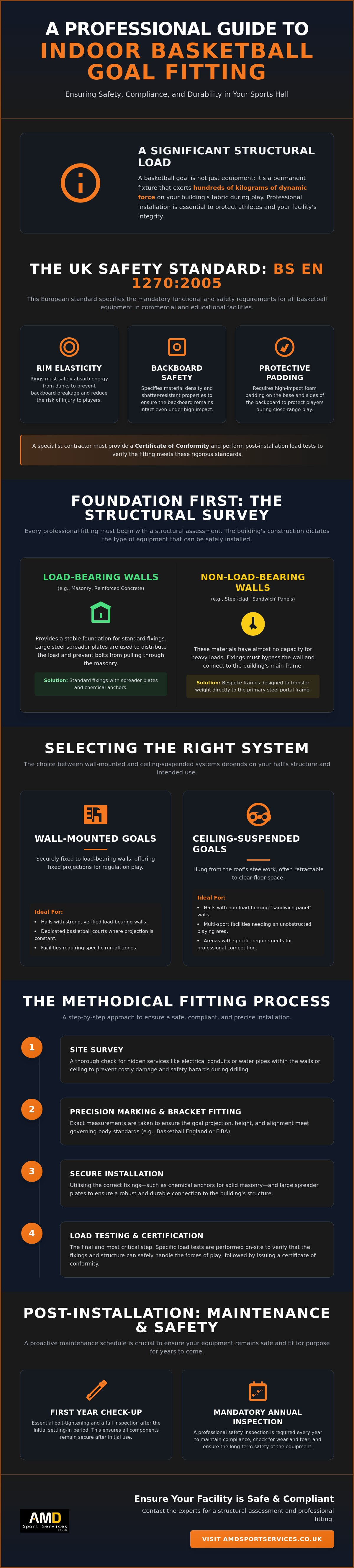
Professional indoor basketball goal fitting is a disciplined engineering task that integrates heavy-duty sports equipment into a building's structural frame. It's far removed from the assembly of retail portable hoops. In commercial leisure centres and educational halls, these systems are permanent fixtures designed to endure high-impact play and constant vibration. A professional fitting ensures the equipment remains secure under the dynamic loads generated by dunking or aggressive rebounding, protecting both the athletes and the facility's structural integrity.
The benchmark for every installation in the UK is BS EN 1270:2005. This European standard specifies the functional and safety requirements for basketball equipment, categorising goals into different classes based on their intended use. "Off-the-shelf" residential solutions are entirely unsuitable for these environments because they lack the material thickness, rim elasticity, and shatter-resistant properties required by law. A specialist contractor's role is to provide a certificate of conformity, proving that the fitting meets these rigorous safety benchmarks and governing body expectations.
Key Requirements of BS EN 1270
This standard focuses on structural stability and the prevention of entrapment. It dictates the load-bearing capacities for both matchplay and practice goals, ensuring they can withstand vertical and horizontal forces without failure. Key technical aspects include:
Rim Elasticity: Rings must absorb energy to prevent backboard breakage and reduce injury risk.
Backboard Safety: Adherence to specific Basketball Backboard Specifications regarding material density and shatter-resistance.
Protective Padding: Requirements for high-impact foam on the base and sides of the boards to protect players during close-range play.
Once the indoor basketball goal fitting is complete, the installer must perform specific load tests. These tests verify that the anchors and brackets haven't compromised the wall or ceiling structure during the process.
Governing Body Compliance: Basketball England vs FIBA
The level of play dictates the specific standard required. Basketball England provides guidance for school and community use, focusing on durability and multi-sport versatility. In contrast, FIBA standards are much stricter, governing professional competition where specific board dimensions and rim tensions are mandatory. The court layout and required run-off zones often determine whether you need a wall-mounted or ceiling-suspended system to keep the playing area clear of obstructions. For primary schools, adjustable height systems are essential to accommodate different age groups whilst remaining compliant with safety height-locking regulations.
Structural Considerations for Sports Hall Installations
Every professional indoor basketball goal fitting must begin with a structural assessment of the building, not a drill. It's a common mistake to assume that any large wall can support the weight and dynamic force of a basketball system. The hall's construction dictates the type of equipment you can safely install. A structural survey identifies whether the substrate can handle the specific leverage and vibration generated during play, ensuring the installation remains secure for its entire lifespan. Skipping this step risks catastrophic failure of the fixing points or damage to the building's fabric.
The distinction between load-bearing and non-load-bearing walls is critical for bracket selection. Traditional masonry or reinforced concrete provides a stable foundation for standard fixings. However, many modern sports halls utilise lightweight "sandwich panel" or steel-clad constructions. These materials have almost no load-bearing capacity for heavy sports equipment. In these environments, we must design bespoke frames that transfer the weight directly to the primary steel portal frame of the building. Adherence to the UK Safety Standard BS EN 1270:2005 requires that the entire assembly, including the wall or roof it's attached to, remains stable under intense pressure.
Wall-Mounted Load Distribution
To manage the forces exerted during "dunking" or when a player hangs on the rim, we use large steel spreader plates. These plates increase the surface area of the connection, preventing the bolts from pulling through the masonry. Fixing methods must be precise. We typically use chemical anchors for solid brickwork or concrete, creating a bond that's stronger than the base material itself. For thinner walls, through-bolting with backing plates on the reverse side is the only way to guarantee maximum security. If you're unsure about your wall's capacity, a specialist review of your basketball goal installation requirements is the safest path forward.
Ceiling-Suspended Structural Requirements
Ceiling-suspended systems are often the preferred choice for main matchplay courts, but they demand rigorous evaluation of the roof steelwork. We must confirm that the trusses can support not only the static weight of the goal but also the dynamic "live" loads. Secondary steelwork is almost always required to create a stable, level mounting platform between the existing roof beams. This framework is essential for managing the sway and vibration inherent in long-drop systems. Without a rigid secondary frame, the goal will move excessively during play, making it difficult for players and eventually fatiguing the metal components.
Selecting the Right System: Wall-Mounted vs Ceiling-Suspended
Deciding on an indoor basketball goal fitting involves more than just picking a model from a catalogue. It's a pragmatic assessment of how your sports hall operates on a daily basis. Whilst budget is always a factor, the primary drivers should be court layout, the age of the players, and whether the hall needs to accommodate other sports like badminton or five-a-side football. You're balancing the need for a rigid, match-quality backboard with the physical constraints of your building's architecture.
Wall-mounted systems are often the most cost-effective solution for practice areas or side-courts. However, they are physically limited by the distance between the wall and the court baseline. If this projection exceeds 3.7 metres, the leverage on the wall brackets becomes excessive, and a ceiling-suspended system usually becomes the only viable engineering choice. For main matchplay, ceiling-suspended units are generally preferred because they keep the floor area clear of heavy-duty wall braces that can interfere with other court markings.
Wall-Mounted Systems: Fixed and Folding
For facilities that prioritise multi-sport flexibility, side-folding wall goals are a standard requirement. These allow the boards to be swung flat against the wall when not in use, clearing the "run-off" zones for other activities. It's a simple mechanical solution that's reliable and easy to operate.
Fixed-height brackets: These are the most stable option, best for dedicated basketball courts where the rim height (3.05m) never needs to change.
Adjustable-height systems: Essential for primary schools or community hubs, allowing the rim to be lowered for junior play whilst maintaining compliance.
Side-folding mechanisms: These must include rigid locking bars to ensure the board doesn't "chatter" or move during high-impact play.
Ceiling-Suspended Systems: Electric and Manual
Ceiling-suspended systems are the gold standard for main matchplay courts. They offer a clean floor area and ensure the goal is perfectly aligned with the court centre-line, regardless of wall positions. They're complex assemblies that require precise calibration during the initial fitting.
Electric winch operation: This allows a single staff member to deploy or retract the goals in under two minutes, which is vital for rapid hall transitions.
Safety locks: Professional fittings include "load-king" or inertia safety locks. These act like a car seatbelt, instantly stopping the goal from falling if a cable or winch fails.
Maintenance access: Because these goals are often 7 to 10 metres above the floor, they require specialist access equipment for annual inspections and motor servicing.
The initial cost of a ceiling-suspended system is higher due to the secondary steelwork and motorised components. However, for a high-use leisure centre, the time saved during hall changeovers often justifies the investment. We find that the long-term reliability of a well-fitted ceiling system often outweighs the lower entry price of complex wall-folding setups in larger halls.
The Fitting Process: Ensuring Safety and Compliance
A successful indoor basketball goal fitting begins long before the first bolt is tightened. It starts with a comprehensive pre-installation site survey to map out the building's hidden infrastructure. We use digital scanners to locate electrical conduits, heating pipes, and structural reinforcements that aren't always visible on original architectural drawings. Identifying these obstructions early prevents costly delays and ensures that the primary anchors are fixed into the most stable parts of the building substrate without compromising essential services.
Once the survey is complete, the "setting out" phase begins. This is a high-precision task where we mark the court centre-line and the exact projection points on the wall or ceiling steelwork. We don't rely on existing wall features, as buildings are rarely perfectly square. Instead, we work from the court's dimensions to ensure the goal is perfectly aligned with the floor markings. This stage is critical for matchplay accuracy; even a few millimetres of misalignment at the mounting point can result in a significant deviation at the rim. If you require a professional assessment of your facility's layout, you can book a basketball goal installation survey to ensure your project starts on a solid technical footing.
Precision Alignment and Levelling
We use industrial-grade laser levels to guarantee that the ring sits exactly 3.05 metres above the finished floor level. This measurement must be taken from the top of the rim, not the bottom. We also calibrate the "projection" to ensure the backboard face is positioned 1.2 metres behind the inner edge of the end line. This distance is a safety requirement that provides players with a necessary run-off zone during high-speed layups. Finally, we verify that the backboard is perfectly vertical. A board that leans even slightly forward or backward will produce "dead" or unpredictable bounces, which is unacceptable for competitive play.
Post-Installation: Maintenance and Safety Inspections
The completion of an indoor basketball goal fitting marks the start of a rigorous lifecycle that demands consistent oversight. During the first 12 months, a new system undergoes a period of settling. The constant vibration from ball impacts and the dynamic forces of play can cause fixings to bed in, which occasionally leads to the minor loosening of bolts. We recommend a thorough check after the first year of use to ensure every component remains as secure as the day it was installed. This initial settling period is the most common time for minor alignment shifts to occur.
In UK schools and leisure centres, annual safety inspections are a legal necessity under health and safety obligations. A poorly executed indoor basketball goal fitting often reveals its flaws during these mandatory reviews. We frequently encounter loose wall anchors or misaligned frames in facilities where the initial installation lacked technical precision. These issues represent a significant liability for facility managers and can lead to equipment failure if left unaddressed. Professional repairs and timely component replacements can often extend the life of your existing infrastructure by several years, deferring the cost of a full system replacement.
The Annual Inspection Checklist
A professional inspection follows a methodical sequence to identify potential failure points before they become dangerous. Our practitioners focus on the following critical areas during a standard site visit:
Pivot Points and Hinges: We check for excessive play or metal-on-metal wear in folding mechanisms that could lead to structural instability.
Wire Ropes and Winches: For ceiling-suspended systems, we inspect cables for fraying and test the winch motors and inertia safety locks for immediate engagement.
Fixing Integrity: We verify that wall spreader plates and chemical anchors remain flush against the substrate with no signs of movement or masonry cracking.
When to Repair vs Replace
Deciding whether to refurbish or replace depends largely on the condition of the primary steel framework. We look for signs of metal fatigue, such as hairline fractures in the welds or distorted brackets that suggest the steel has been overstressed. If the main frame is sound, upgrading outdated timber backboards to modern acrylic or glass alternatives is a cost-effective way to improve the facility's standard without a full reinstall. However, if the structural integrity of the mounting brackets is compromised, a new fitting is the only responsible course of action. To ensure your facility remains compliant and safe for play, you can organise your annual basketball safety inspection with AMD Sport Services.
Securing Your Facility's Sporting Future
A professional indoor basketball goal fitting is an investment in both athlete safety and building longevity. By prioritising structural assessments and adhering to BS EN 1270 standards, you ensure your equipment remains a dependable asset rather than a liability. Whether you've opted for a motorised ceiling-suspended system or a space-folding wall unit, the quality of the initial installation dictates the ease of future maintenance. Precision at the start prevents mechanical fatigue and costly repairs later.
We bring over 20 years of specialist industry experience to every project, providing national coverage across the United Kingdom. As specialists in safety-critical sports infrastructure, we focus on technical proficiency and reliable workmanship to meet the specific needs of schools and leisure centres. Our pragmatic approach ensures that your facility remains compliant with all current safety regulations and governing body requirements.
Contact AMD Sport Services for Professional Basketball Goal Fitting and Inspections to discuss your project requirements or schedule a mandatory safety review. We look forward to helping you maintain a safe and high-performing sports environment for your players.
Frequently Asked Questions
How long does a professional indoor basketball goal fitting take?
A standard installation for a pair of wall-mounted goals typically takes one to two days to complete on-site. More complex ceiling-suspended systems require three to five days, depending on the height of the hall and the amount of secondary steelwork needed. This timeline includes the initial setting out, physical mounting of the framework, and the final safety load testing to ensure compliance with British Standards.
Do I need a structural engineer before fitting wall-mounted goals?
A structural engineer's assessment is a prerequisite for any new installation on an existing wall. The engineer must verify that the masonry or steel frame can withstand the significant dynamic forces and leverage generated during play. We rely on these technical calculations to select the appropriate fixing methods and spreader plates, ensuring the indoor basketball goal fitting does not compromise the building's fabric or safety.
What is the standard height for an indoor basketball ring in the UK?
The official standard height for a senior basketball ring in the UK is 3.05 metres from the finished floor level to the top of the rim. For junior or "mini" basketball, this height is reduced to 2.60 metres. It's vital that these measurements are verified using industrial laser levels during the fitting process to ensure the court meets Basketball England and FIBA competitive regulations.
Can we fit basketball goals to a non-load-bearing wall?
Mounting goals directly to non-load-bearing partitions, such as standard stud walls or modern sandwich panels, is not possible. In these environments, we must install a bespoke steel "goal-post" frame that transfers the weight and dynamic loads directly to the floor or the building's primary portal frame. This approach ensures the goal remains stable without relying on a weak wall surface for structural support.
How often should indoor basketball goals be inspected for safety?
Indoor basketball goals must undergo a professional safety inspection at least once every 12 months. Regular inspections are essential for identifying issues like metal fatigue, frayed cables, or loose wall fixings before they lead to equipment failure or player injury.
Are electric winches safer than manual winches for suspended goals?
Electric winches are generally considered a safer option because they include built-in limit switches and thermal overloads that prevent operator error. They are designed to work in conjunction with inertia safety locks, which act as a fail-safe if a cable fails. Manual winches are reliable but carry a higher risk of strain-related injuries for staff and can be accidentally over-wound if not managed carefully.
What is the difference between practice and matchplay goal fitting?
Matchplay fittings require full-size 1.8m x 1.05m backboards and a 1.2m projection from the wall to provide the necessary player run-off zone. Practice goals are often smaller and may have a shorter projection to save space in side-courts or multi-use areas. Matchplay systems also demand higher specifications for rim elasticity and protective padding to meet the rigorous requirements of BS EN 1270.
Can we upgrade our existing wall-mounted goals to be adjustable?
Most existing wall-mounted systems can be upgraded with a height-adjustment carriage, provided the wall structure is confirmed as sound. This involves replacing the fixed bracket with a telescopic or screw-jack mechanism that allows the board to move between junior and senior heights. It's a practical way to increase a hall's versatility without the expense of a completely new indoor basketball goal fitting.


Comments