
Long Jump Runway Refurbishment UK: The 2026 Facility Manager’s Guide

A worn polymeric surface is more than just a cosmetic issue; it's a technical failure that compromises athlete safety and facility accreditation. Most facility managers feel the constant tension between meeting strict UKA safety standards and managing the tight financial constraints of a school or local authority. You're right to be concerned about injury risks and the potential costs of a full site overhaul. This guide to long jump runway refurbishment UK provides a pragmatic roadmap to restoring your athletics infrastructure to professional levels through targeted, expert-led repairs.
We'll explain how to assess your current surface, navigate the latest 2026 compliance requirements, and choose materials that offer long-term durability. By the end, you'll have a clear understanding of the refurbishment process and the specific technical steps needed to extend the lifespan of your runway whilst keeping your athletes protected. We will cover everything from initial safety inspections to the final application of UKA-compliant surfacing, helping you make informed decisions for your facility and ensure your infrastructure remains fit for purpose for years to come.
Table of Contents
Understanding Long Jump Runway Wear and UKA Compliance Standards
Long jump runway refurbishment UK is the technical process of restoring the traction, elasticity, and level of an athletics surface. It moves beyond basic maintenance; it's a specialist intervention designed to return a facility to its original performance specifications. For schools and local authorities, UK Athletics (UKA) standards serve as the definitive benchmark. These regulations ensure that the surface provides the correct energy return and slip resistance required for competitive use.
Identifying the need for long jump runway refurbishment UK early can prevent the need for a full, costly reconstruction. Recognising signs of failure is critical for effective budget management. Common indicators of degradation include:
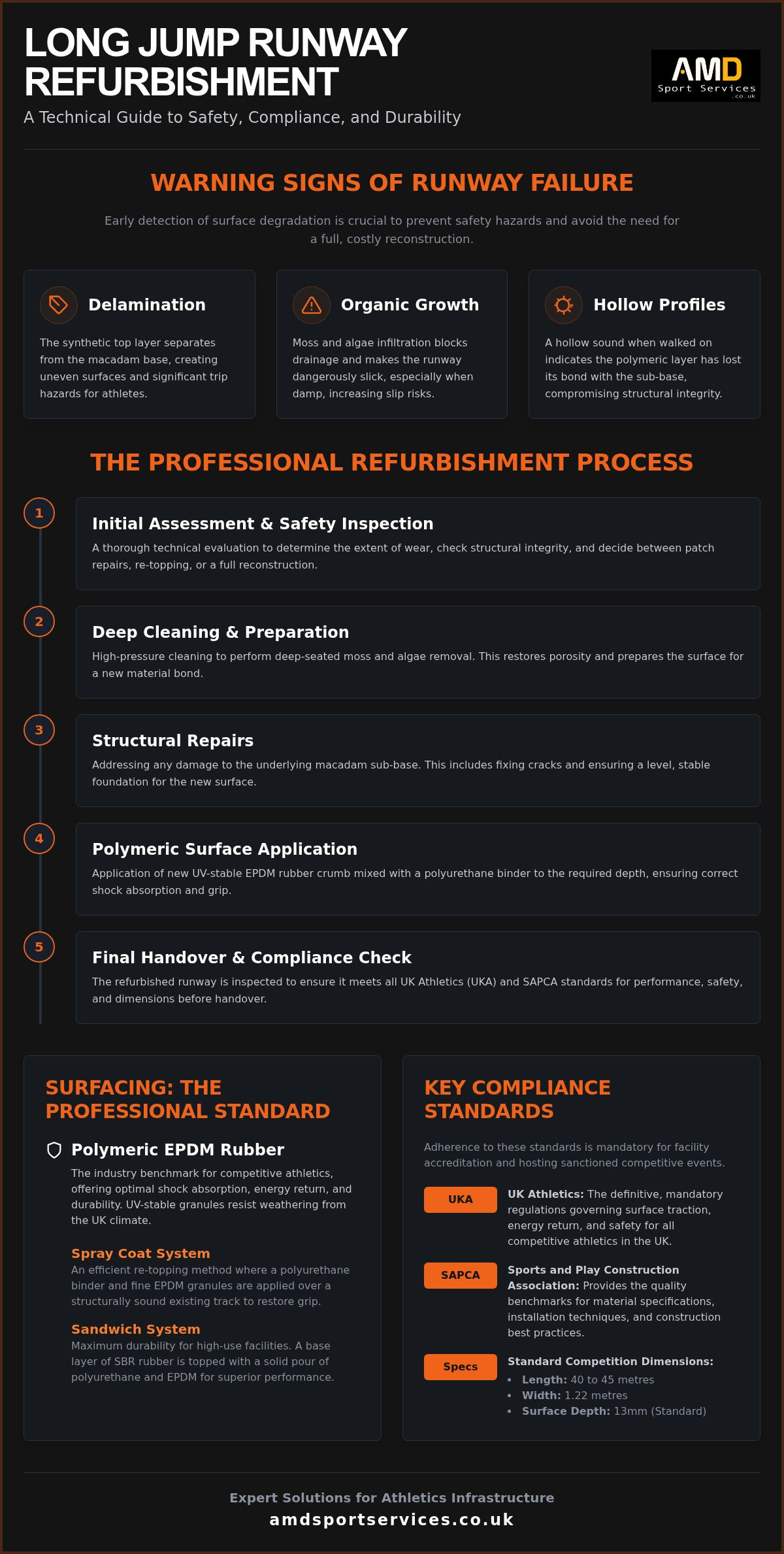
Delamination: The synthetic top layer begins to separate from the macadam base, creating trip hazards.
Organic Growth: Infiltration of moss and algae that makes the surface dangerously slick when damp.
Hollow Profiles: A "hollow" sound when walked upon, indicating the polymeric layer has lost its bond with the sub-base.
Neglecting these issues leads to significant safety risks. A hardened or uneven runway increases the impact on an athlete's joints, whilst a loss of traction leads to slips during the high-velocity approach of a long jump attempt. Addressing these faults promptly ensures the facility remains safe for students and club members alike.
The Impact of the UK Climate on Synthetic Surfaces
The British weather is particularly harsh on polymeric systems. Frequent freeze-thaw cycles during winter cause water trapped within the pores to expand, which leads to surface cracking and accelerated crumbling. In damp, shaded areas, moss and algae colonisation occurs rapidly, blocking the drainage properties of the track. When we perform repairs, we prioritise the use of UV-stable EPDM rubber crumb. This ensures the refurbished sections don't become brittle or discoloured under sunlight, maintaining the runway's elasticity over several seasons.
Regulatory Requirements for Schools and Councils
Compliance isn't optional for facilities hosting official meets. A standard competition runway must typically measure between 40 and 45 metres in length with a width of 1.22 metres. Organisations like SAPCA (Sports and Play Construction Association) provide the quality benchmarks that reputable contractors follow during the installation and repair phases. These standards govern everything from material thickness to drainage rates. UKA compliance is the mandatory standard for any facility intended for use in sanctioned competitive athletics events.
Specialist Surfacing Options for Runway Refurbishment
Selecting the correct material for a long jump runway refurbishment UK project depends on your facility's primary user group and the condition of the existing base. While many providers suggest a generic solution, we evaluate whether your current infrastructure can support a specific system. The two primary choices are polymeric rubber and needle-punch synthetic turf, each offering distinct performance characteristics for different environments.
Polymeric Rubber Crumb: The Professional Standard
Polymeric surfacing is the industry benchmark for competitive athletics and club-level facilities. For a full resurfacing, a 13mm depth is the standard required to ensure proper shock absorption and energy return. Achieving a long-lasting finish requires a precise binder-to-granule ratio; too little binder leads to premature crumbling, whilst too much creates a surface that is too hard for safe use. You can find more detail on these technical specifications in our guide to external sport equipment installation.
If the structural integrity of your track is sound but the grip has faded, the "Spray Coat" method is an efficient long jump runway refurbishment UK option. This involves applying a polyurethane binder mixed with fine EPDM granules directly over the existing track. For high-performance clubs, we often recommend the "Sandwich System." This involves a base layer of black SBR rubber topped with a solid pour of polyurethane and EPDM, providing maximum durability for heavy-use environments. This approach aligns with the Sport England Athletics Design Guidance, which prioritises material quality for facility longevity.
Needle-punch Synthetic Turf for Recreational Use
Needle-punch turf is frequently the preferred choice for primary school facilities. These sand-filled systems are softer on younger joints and require significantly less specialised maintenance than polymeric alternatives. The fibre-bonded carpets are incredibly durable, resisting the "bald" patches often seen in lower-quality synthetic grasses. When performing partial repairs, we take great care in colour-matching to ensure the new sections blend seamlessly with the existing facility, preserving the site's professional appearance.
If you're unsure which surface suits your current budget and usage levels, our team can provide a technical assessment of your current runway to help you decide on the best path forward.
Strategic Decision-Making: Patch Repair vs. Full Surface Resurfacing
Deciding between a localised fix and a total overhaul is a matter of technical assessment, not guesswork. A common misconception is that a worn track always requires a full "dig-out" and replacement of the sub-base. In many cases, if the foundation remains structurally sound, a targeted long jump runway refurbishment UK strategy can deliver professional results at a fraction of the cost. The choice depends entirely on the depth of the degradation and the condition of the underlying layers.
Assessing the Sub-base and Edgings
Before committing to a surface upgrade, we must verify the integrity of the underlying macadam. We look for signs of subsidence or "ponding," where water collects due to poor levels. If the sub-base has shifted, any new surface will eventually mirror these faults. We also inspect the edgings; timber edgings often rot in the damp UK climate, whilst concrete edgings can become displaced by root ingress. For a detailed look at what constitutes a sound foundation, refer to our Long Jump Runway Installation Guide.
Localised Repairs for High-Wear Areas
Damage is rarely uniform across the entire 45-metre length. The take-off area and the first five metres of the runway experience the highest levels of mechanical stress and spike damage. We often employ a "cut and fill" technique here. This involves removing the damaged polymeric section, cleaning the exposed base, and pouring new EPDM rubber to create a seamless, level transition. This targeted approach is a core part of our service and maintenance programmes for schools and clubs.
Re-topping is a viable alternative when the existing surface has lost its texture but remains bonded to the base. It involves applying a new layer of binder and rubber over the cleaned original, which effectively resets the lifespan of the facility. A frequent question we encounter is whether a refurbished runway can match the durability of a new build. When executed correctly, a refurbished surface provides the same UKA-compliant performance and longevity, provided any sub-base issues were addressed during the initial assessment. It's a strategic restoration of safety and performance, ensuring your budget is used where it has the most significant impact on athlete safety.
The Professional Refurbishment Process: From Assessment to Handover
Executing a long jump runway refurbishment UK project requires a methodical, multi-stage approach. We don't simply apply new rubber over an old surface; we follow a technical workflow that ensures the finished runway meets professional standards for grip and energy return. This process begins with a thorough site assessment to identify hidden structural weaknesses that could compromise the final result.
The core refurbishment sequence follows five specific steps:
Step 1: Deep Cleaning. We use high-pressure water systems and specialist chemical treatments to remove deep-seated moss, algae, and silt from the pores of the existing track.
Step 2: Structural Remediation. Any cracks or depressions in the macadam sub-base are repaired using technical mortars to ensure the foundation is perfectly level.
Step 3: Priming. A specialist polyurethane primer is applied to the cleaned surface. This acts as a bonding agent, ensuring the new wearing course adheres permanently to the old substrate.
Step 4: Surface Installation. Depending on the facility's needs, we apply either a structural spray coat or a hand-poured polymeric layer to restore the track's texture.
Step 5: Final Handover. The process concludes with precise line marking and a full refurbishment of the landing pit, including the installation of fresh silica sand.
The Importance of Surface Preparation
Skipping the preparation phase is the most frequent cause of surface failure in the athletics industry. If you apply a new polymeric layer over dirt or organic matter, the binder will fail to bond, leading to rapid delamination. We utilise specialist binders designed to remain flexible amongst the UK's temperature fluctuations, preventing the surface from becoming brittle. Professional refurbishment requires a minimum of 48 hours of dry weather for the binder to cure correctly. This ensures the chemical bond reaches its maximum structural integrity before the runway is returned to use.
Restoring the Landing Pit and Take-off Boards
The landing pit is as vital as the runway itself. We often replace old, rotten timber take-off boards with modern synthetic alternatives that don't warp or decay in wet conditions. For the pit, we only use UKA-approved silica sand; this specific grade prevents compaction and reduces the risk of impact injuries. You can view examples of our completed projects to see how we transform neglected pits into professional-grade facilities. If your facility currently presents a safety risk, you can book a specialist safety inspection to identify the exact repairs required to regain compliance.
Completing a long jump runway refurbishment UK project represents a significant investment in your facility's future. However, the durability of that new surface depends entirely on the care it receives in the following years. Without a proactive maintenance schedule, the UK's damp climate will quickly re-introduce the silt and moss that caused the initial degradation. We recommend a regime that focuses on keeping the surface porous and free from abrasive materials.
Sand management is a critical yet often overlooked aspect of facility care. When athletes exit the pit, sand inevitably "over-spills" onto the polymeric surface. This sand acts as an abrasive, grinding down the grip and elasticity of the runway underfoot. Keeping the area around the take-off board clear of sand is the simplest way to prevent premature wear and maintain the technical properties of the rubber crumb.
Annual Safety Inspections and Compliance Audits
Schools and local authorities have a clear duty of care to provide safe athletics infrastructure. We suggest including your long jump runway in your annual PE equipment safety check to ensure ongoing compliance. Our team takes a "Seasoned Practitioner" approach to these audits, looking beyond surface-level aesthetics to identify early signs of hardening or sub-base movement. For those managing multi-use sites, our expertise extends to indoor inspection and maintenance, providing a comprehensive safety overview for all your sports equipment.
Simple Maintenance Tasks for Ground Staff
Effective maintenance doesn't require specialist equipment, just consistency. Ground staff should regularly brush the runway with a medium-stiff broom to remove organic debris before it can take root in the pores. This is especially important in autumn when leaf mulch can quickly turn into a slippery silt layer that blocks drainage.
When managing the landing pit, the focus should be on keeping the sand level and free from contaminants. Ground staff should avoid using metal rakes on synthetic runways to prevent tearing the polymeric surface. Instead, use plastic or wooden rakes to level the silica sand and ensure it remains at the UKA-mandated depth. AMD Sport Services remains your partner for the long term, providing annual safety audits and minor repairs that keep your refurbished facility in peak condition for years to come.
Securing the Future of Your Athletics Infrastructure
Maintaining a professional-standard athletics facility requires a balance of technical precision and strategic budget management. We have explored how a targeted long jump runway refurbishment UK strategy can restore compliance and performance without the excessive costs of a complete site overhaul. By prioritising deep cleaning, structural remediation, and the application of UV-stable polymeric materials, you can significantly extend the operational lifespan of your existing infrastructure whilst ensuring the safety of every athlete.
Safety remains the non-negotiable benchmark for every school and council project. As specialists in both surfacing and safety inspections, we provide a national service that ensures your runways meet the latest UKA requirements for 2026 and beyond. Our team brings over 20 years of industry experience to every assessment, identifying the bespoke repairs needed to keep your facility accredited and your students protected. Contact AMD Sport Services for a professional long jump runway assessment to begin your facility restoration today. Investing in specialist refurbishment ensures your club members have a safe, high-performance environment for many seasons to come.
Frequently Asked Questions
How much does it cost to refurbish a long jump runway in the UK?
The total cost depends on the current state of your sub-base and the specific surfacing material you choose. A technical assessment determines whether the project requires a simple spray coat or a more intensive structural repair. Factors such as drainage remediation, edge replacement, and the size of the landing pit also influence the final investment required for your facility.
How long does the refurbishment process typically take?
A standard refurbishment project usually takes between three and five working days, provided the weather remains favourable. This timeline includes the deep cleaning phase, primer application, and the installation of the new wearing course. It's vital to allow the site to remain out of use for at least 48 hours after completion so the specialist binders can cure correctly.
Do we need to replace the entire sub-base for a refurbishment?
Replacement of the entire sub-base is only necessary if the foundation has suffered from subsidence or significant structural shifting. If the underlying macadam remains level and drains effectively, a long jump runway refurbishment UK project can be completed by re-topping the existing surface. We always conduct a thorough inspection of the foundation before recommending the most cost-effective repair path.
What is the best type of sand to use for a long jump landing pit?
UKA-approved washed silica sand is the only grade suitable for professional landing pits. This specific sand is rounded and non-abrasive, which prevents it from compacting into a hard surface over time. Using standard builders' sand is a safety risk; it hardens when damp and significantly increases the likelihood of impact injuries for athletes during landing.
Can a refurbished runway meet UKA (UK Athletics) standards for competition?
A professionally refurbished runway can fully comply with UK Athletics standards for competition and training. By restoring the surface thickness, levels, and slip resistance to official specifications, the facility becomes suitable for sanctioned events. This technical restoration ensures that your school or club provides a high-performance environment that is indistinguishable from a completely new installation in terms of athlete safety.
How often should a long jump runway be professionally inspected for safety?
We recommend that all athletics facilities undergo a professional safety inspection at least once every twelve months. Regular audits allow a seasoned practitioner to identify early signs of polymeric hardening or organic growth before they develop into major hazards. For many schools, this annual check is a mandatory part of their broader PE equipment safety and compliance requirements.
What is the difference between polymeric and needle-punch surfacing for refurbishment?
Polymeric is a rubber crumb system designed for high-performance club athletics, whilst needle-punch is a sand-filled synthetic carpet often preferred by primary schools. Polymeric offers superior energy return for competitive jumping. Needle-punch provides a softer, more durable surface for recreational use and is often more budget-friendly for facilities that don't require full UKA competition accreditation.
Is it possible to refurbish a runway during the winter months?
Refurbishment is technically difficult during winter because specialist polyurethane binders require dry conditions and a specific temperature range to cure. Whilst minor emergency repairs can sometimes be managed, we usually schedule full long jump runway refurbishment UK projects between April and October. This ensures the chemical bonds reach their maximum structural integrity, providing a durable finish that lasts for years.


Comments