
Motorising Roof-Mounted Basketball Goals: The Complete UK Facility Upgrade Guide

How many minutes are lost every single week whilst your site team struggles with heavy manual winches to lower basketball goals for the next booking? If you manage a busy UK sports hall, you're likely familiar with the physical strain of manual operation and the anxiety that comes with managing ageing overhead equipment. Motorising roof mounted basketball goals is no longer a luxury; it's a pragmatic mechanical upgrade that addresses these risks directly. It replaces outdated, labour-intensive processes with reliable, push-button efficiency that keeps your facility moving.
We understand that facility managers often feel stuck between the high cost of total replacement and the safety concerns of keeping old gear in service. This guide provides a clear, technical roadmap for transforming your manual systems into motorised units. You'll learn how this upgrade ensures full compliance with PUWER and LOLER regulations, specifically the mandatory 12-month thorough examinations required for lifting equipment. We'll preview the conversion process, explain how to mitigate manual handling risks, and show you why retrofitting is often the most cost-effective way to secure your hall's long-term versatility and safety standards.
Table of Contents
The Shift from Manual to Motorised Systems in Modern Sports Halls
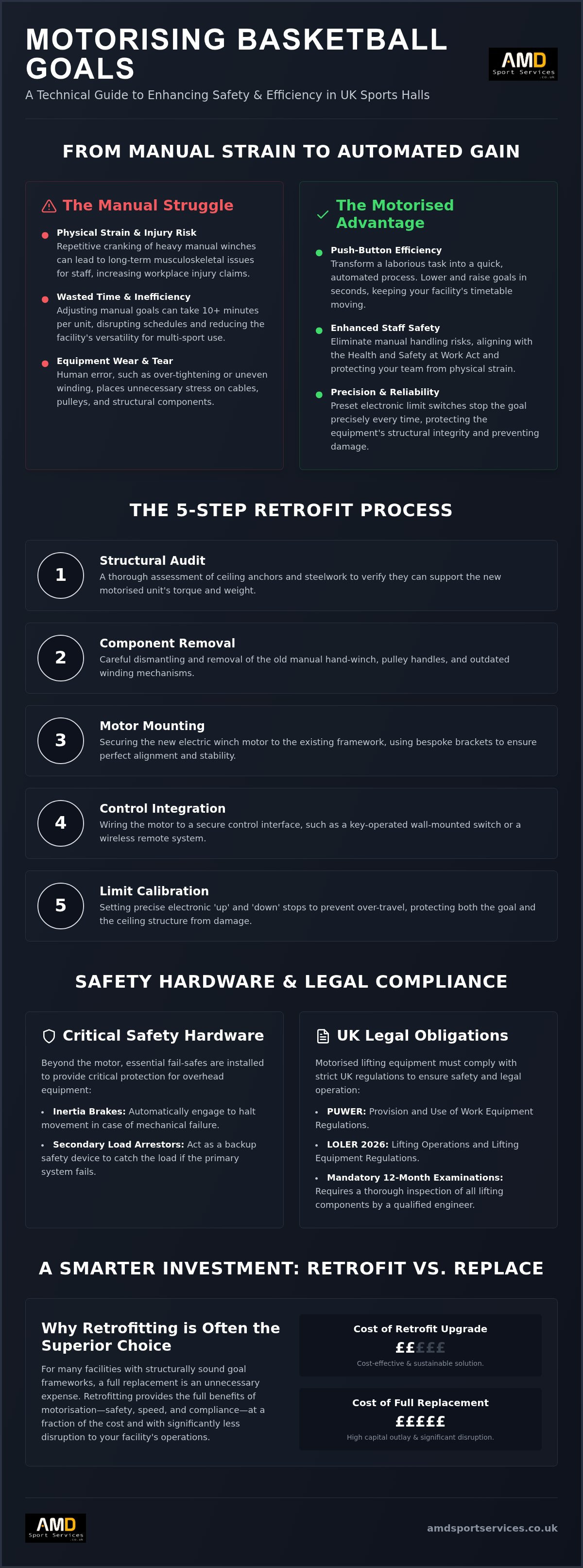
Motorisation in a sports facility context refers to the integration of electric winching systems into existing or new basketball backboard systems. Instead of relying on a staff member to manually crank a handle, a high-torque electric motor handles the heavy lifting. Motorising roof mounted basketball goals transforms a cumbersome chore into a precise, automated task. This isn't just about convenience; it's a mechanical upgrade designed to solve the inherent flaws of manual winching. One of the most significant advantages is the reduction of human error. Manual systems are prone to over-tightening or uneven winding, which puts unnecessary stress on cables and pulleys. Electric motors use preset limit switches to ensure the goal stops exactly where it should, every single time, protecting the structural integrity of your equipment.
Mitigating Manual Handling Risks for Staff
The physical strain of manual winching is a serious concern for facility managers. Repetitive strain from operating heavy, high-resistance winches can lead to long-term musculoskeletal issues for site teams. By automating this process, you align your facility with modern UK workplace safety standards and the Health and Safety at Work Act. It removes the need for awkward postures or the use of ladders to reach manual points. In a busy hall, staff might perform these tasks several times a day. Switching to a motorised system ensures that your team stays healthy whilst reducing the risk of workplace injury claims.
Optimising Sports Hall Versatility
Efficiency is the key to a profitable sports hall. In 2026, facility managers must prioritise multi-use spaces that can transition from a basketball match to a badminton session in minutes. Manual goals can take ten minutes or more to adjust, especially if equipment is stiff or difficult to reach. Investing in motorising roof mounted basketball goals allows for these rapid changes without disrupting the flow of the hall's timetable. This creates a professional-grade environment suitable for competitive play and community use alike. If you are planning a facility upgrade, our Professional Basketball Goal Installation Services ensure your hall remains adaptable to any sporting requirement. We focus on delivering robust mechanical solutions that stand up to the rigours of daily institutional use.
The Retrofit Process: How Manual Roof-Mounted Goals are Motorised
Retrofitting an existing system is a technical challenge that requires precision. We begin by conducting a thorough audit of the current setup. This involves checking the structural integrity of the roof-mounted frame and the condition of all load-bearing cables. If the frame is sound, we can proceed with motorising roof mounted basketball goals rather than recommending a full replacement. Many facilities believe they need to scrap their entire overhead structure to gain automation, but a professional retrofit often provides a more sustainable and cost-effective route.
The process follows a logical sequence to ensure mechanical reliability:
Structural Audit: Verifying that the ceiling anchors and primary steelwork can handle the torque and weight of a motorised unit.
Component Removal: Dismantling the old manual hand-winch, pulley handles, or outdated winding mechanisms.
Motor Mounting: Securing the electric winch motor to the existing framework using bespoke brackets where necessary.
Control Integration: Wiring the motor to a secure control interface, such as a wall-mounted switch or wireless receiver.
Limit Calibration: Setting electronic stops to prevent the goal from over-travelling, which protects the ceiling and the goal frame.
Selecting the Right Electric Winch
Selecting a motor isn't a one-size-fits-all task. Motor torque must be carefully matched to the weight of the backboard and goal assembly. Most standard UK sports halls require 240V single-phase systems, but larger, heavier assemblies may necessitate 415V three-phase power for consistent lifting. In educational settings, we prioritise quiet-running motors to ensure equipment transitions don't disrupt nearby classrooms or exam sessions.
Electrical Requirements and Control Wiring
Safety is the priority when installing electrical components overhead. All wiring must be housed within the ceiling void or high-impact trunking to prevent accidental damage. We strongly recommend key-operated wall switches. These prevent unauthorised use by students or external hirers, ensuring the equipment is only moved by trained staff. This level of control is essential for staying compliant with PUWER regulations, which mandate that work equipment must be safe and properly maintained.
Before any project involving motorising roof mounted basketball goals begins, we recommend booking our Indoor inspection and maintenance services to verify your current equipment's condition. If your facility needs a reliable upgrade, you can consult our technical team for a bespoke assessment of your sports hall.
Critical Safety Hardware: Beyond the Electric Motor
While the electric motor handles the physical labour of lifting and lowering, it represents only one part of a professional installation. When motorising roof mounted basketball goals, the integration of secondary safety hardware is what separates a compliant system from a hazardous one. These components act as silent sentinels, ensuring that mechanical or electrical failures don't lead to catastrophic accidents in a busy hall. High-tensile steel cables are the foundation of this security. Unlike cables used for manual winching, those used in motorised systems must be specifically rated for the constant torque and speed of an electric winch. We also integrate tension sensors into the drive unit. These sensors monitor the load in real-time; if they detect an obstruction or a sudden change in resistance, they immediately cut power to the motor to prevent structural damage or injury.
The Role of Inertia Brakes in Overhead Safety
An inertia brake is a mechanical device that locks the goal in place if it exceeds a set descent speed. It functions similarly to a car seatbelt, engaging only when it detects an uncontrolled drop. If a primary cable were to snap or a winch gear were to fail, the inertia brake engages instantly to halt the falling load before it reaches the ground.
Inertia brakes are non-negotiable for any goals mounted above public areas or student groups. They provide the ultimate peace of mind for facility managers who are responsible for the safety of hundreds of users each week. To maintain their effectiveness, these devices must be tested and documented as part of an annual safety audit to ensure the internal locking mechanism remains responsive and free from debris.
Safety Straps and Load Arrestors
Safety straps, often called load arrestors, provide a separate layer of protection that is independent of the primary lifting cable. Whilst the lifting cable carries the weight during operation, the safety strap remains slack, ready to catch the assembly if the primary winch system fails. This redundancy is a core requirement for LOLER 2026 compliance, which governs all lifting operations in UK workplaces.
Relying solely on a single cable is a risk no modern facility should take. A secondary load arrestor protects your expensive sports hall flooring from impact damage and, more importantly, protects the people below. Ensuring these components are in peak condition requires service and maintenance expertise from practitioners who understand the specific stresses placed on motorised overhead structures. Regular inspections help identify fraying in safety straps or corrosion in high-tensile components before they become a liability. When motorising roof mounted basketball goals, these fail-safes are the most critical investment you can make in your facility's infrastructure.
Compliance and Legal Obligations: PUWER and LOLER 2026
Motorising roof mounted basketball goals changes the regulatory framework governing your sports hall. Once an electric motor is installed, the equipment is no longer classified as a simple static fixture; it becomes a piece of power-operated lifting machinery. This transition brings it under the strict remit of two key UK regulations: PUWER and LOLER. PUWER ensures that the equipment is suitable for its intended use and maintained in a safe condition. LOLER is even more specific. It governs any equipment used for lifting or lowering loads. Because a motorised basketball goal lifts a heavy backboard assembly above people's heads, it must meet these rigorous safety standards to remain in operation.
Statutory Inspections for Motorised Equipment
The primary requirement under LOLER is a "thorough examination" by a competent person at least every 12 months. This is a higher standard than the visual checks performed on manual goals. During these inspections, a technician examines motor wear, checks for cable fraying, and tests the inertia brakes to ensure the internal locking mechanism remains responsive. Failing to maintain these records can have severe legal consequences. For schools and public leisure centres, an incomplete safety logbook is a major liability during insurance claims or Ofsted inspections. It's essential to keep a robust documentation trail that proves the equipment has been professionally serviced and remains safe for use.
Adhering to BS EN 1270 Standards
Adhering to BS EN 1270 is also vital. This European standard specifies the functional and safety requirements for basketball equipment. When you undertake the process of motorising roof mounted basketball goals, the installation won't compromise the unit's stability or the required tolerances for rim height and backboard vibration. A seasoned practitioner ensures that the motor's mounting and the tension of the new cables keep the assembly within these specific safety parameters. If you don't account for these tolerances, the goal may become unstable during competitive play, leading to structural fatigue over time.
If you're managing a full hall refurbishment, you should also consider how other overhead equipment is categorised. Our Sports Hall Netting Systems Guide provides further detail on maintaining safety across all ceiling-mounted installations. Ensuring your facility is fully compliant requires expert oversight from those who understand the nuances of mechanical sports gear.
To book your next statutory inspection or to discuss a technical upgrade, contact AMD Sport Services for a comprehensive safety audit of your motorised equipment.
Professional Implementation: Partnering with a Seasoned Practitioner
Choosing the right partner for motorising roof mounted basketball goals is a decision that impacts the long-term safety and operational efficiency of your facility. At AMD Sport Services, we position ourselves as the seasoned practitioner who understands that every sports hall presents a unique mechanical puzzle. We bring over 20 years of industry experience to every project, moving beyond standard sales pitches to provide grounded, technical solutions. We don't just install motors; we solve the bespoke structural challenges that come with upgrading ageing equipment. Our approach is direct and pragmatic: we assess your current infrastructure, advise on the most viable mechanical path, and deliver workmanship that meets official UK standards.
Bespoke Solutions for Unique Roof Structures
Many UK sports halls, particularly those in the education sector, feature non-standard beam configurations or older architectural designs that don't accommodate modern off-the-shelf equipment. We specialise in these complex environments. Whether your hall has restricted ceiling voids or intricate steelwork, we design and install mounting brackets that ensure total stability. We use high-quality, durable components designed to withstand the rigours of daily school use and heavy community bookings. You can view our latest projects and installations to see how we have successfully adapted motorised systems to various hall designs across the country.
Why Choose AMD Sport Services?
Our commitment to a "no-nonsense" service means we prioritise what your facility actually needs to remain safe and compliant. We work extensively with UK local councils and academy trusts who require transparent, accountable service providers. When we handle the process of motorising roof mounted basketball goals, we provide a comprehensive, end-to-end workflow:
Initial Structural Survey: Assessing the load-bearing capacity of existing roof beams and frames.
Technical Specification: Selecting the correct motor torque and cable strength for your specific backboard assembly.
Precision Installation: Professional mounting and wiring by technicians who understand overhead safety.
Safety Certification: Providing the necessary documentation for your LOLER and PUWER logbooks.
This national service ensures that whether you are managing a single primary school or a large leisure centre, you receive the same level of technical proficiency and reliability. We focus on delivering results that reduce your long-term maintenance labour and ensure the highest safety standards for all users. If you are ready to improve your hall's efficiency, contact AMD Sport Services to discuss motorising your basketball goals and receive a technical assessment of your equipment.
Securing Your Facility’s Future with Automated Upgrades
Transitioning to an automated sports hall is a strategic investment in both staff welfare and operational revenue. By motorising roof mounted basketball goals, you eliminate the physical risks of manual winching whilst ensuring your equipment meets the latest LOLER and PUWER 2026 standards. We've explored how retrofitting existing frames with electric motors and inertia brakes provides a cost-effective alternative to full replacement, provided the structural integrity is verified by a competent person.
AMD Sport Services brings over 20 years of specialist industry experience to these bespoke mechanical challenges. With our national UK coverage, we provide the technical expertise required for high-quality installations and rigorous safety inspections in any facility. You don't have to manage these complex upgrades alone; a partnership with a seasoned practitioner ensures your hall remains versatile, efficient, and fully compliant. Enquire about motorising your basketball goals today to streamline your facility’s operations. Taking this step now protects your site team and provides a professional, high-standard environment for every athlete who uses your space.
Frequently Asked Questions
Can any roof-mounted basketball goal be motorised?
Most existing structures can be converted, but a structural assessment is the first step. We examine the roof anchors and the gauge of the steelwork to ensure they can handle the torque of a new motor. If the frame is compromised by rust or fatigue, repairs are necessary before motorising roof mounted basketball goals. Our technicians provide a pragmatic report on whether your current gear is a viable candidate for a mechanical upgrade.
How long does the motorisation retrofit process take to complete?
A standard installation typically takes between one and two days per pair of goals. This timeframe includes the removal of old manual winches, mounting the electric units, and completing the electrical wiring. We also spend time calibrating the limit switches and testing the inertia brakes to ensure the system is fully operational. We plan our work to minimise disruption to your sports hall's busy booking schedule or school timetable.
Do motorised basketball goals require a special electrical supply?
Most installations require a standard 240V single-phase electrical supply. However, for exceptionally heavy commercial backboards, a 415V three-phase supply might be necessary to provide the required lifting torque. We work alongside your site's qualified electrician to ensure that all power feeds are safely routed through the ceiling void. All control systems, such as key-operated switches, are installed to prevent unauthorised use and ensure total compliance with UK electrical safety standards.
Is it cheaper to motorise old goals or buy new motorised units?
Retrofitting is often significantly more cost-effective than purchasing entirely new units. By motorising roof mounted basketball goals that are already in place, you avoid the high costs of structural steel fabrication and the labour-intensive removal of old frames. We only suggest a full replacement if our initial survey finds that the existing overhead structure has reached the end of its safe working life. Most well-maintained frames are perfectly suitable for a motor upgrade.
How often do motorised basketball goals need to be serviced under UK law?
UK law requires that motorised goals undergo a thorough examination every 12 months. Because these systems are classified as lifting equipment, they fall under the Lifting Operations and Lifting Equipment Regulations 1998 (LOLER). You are also responsible for regular maintenance under PUWER. Keeping a detailed safety logbook is essential for demonstrating compliance during Ofsted inspections or health and safety audits. We provide the necessary certification and documentation following every successful statutory inspection.
What happens if the power fails whilst the goals are lowered?
If the power fails, the mechanical inertia brake acts as a fail-safe to hold the goal securely in place. It won't drop or move unexpectedly. Most professional winch motors also feature a manual override point, allowing a technician to raise or lower the goal using a manual crank if necessary. This ensures that a power cut won't leave your hall unusable for other sports, though we recommend only trained staff perform manual overrides.
Are motorised basketball goals safer than manual ones?
Motorised systems are generally safer because they remove the risk of manual handling injuries and repetitive strain. They also eliminate human error, such as staff over-tightening cables or failing to engage manual locks correctly. Integrated safety hardware, like electronic limit switches and load arrestors, provides multiple layers of protection that manual winches simply cannot offer. This creates a more controlled environment for staff and a safer space for students and community users.
Will motorising my goals affect our sports hall insurance policy?
Upgrading to motorised systems can positively impact your insurance by reducing the likelihood of workplace injury claims. However, your policy likely mandates that all lifting equipment is maintained according to statutory regulations. To keep your coverage valid, you must ensure that your annual LOLER inspections are performed by a competent person and that all records are up to date. Providing proof of professional maintenance demonstrates that you are proactively managing the risks in your facility.


Comments