
Outdoor Netball Post Maintenance: A Practical UK Guide

Updated: Oct 2
An outdoor netball post can look ready for play while corrosion, loose fittings or damage develop. Regular outdoor netball post maintenance helps staff spot visible warning signs early, but a visual check cannot confirm structural integrity.
It is not always obvious which parts need attention or whether a fault means play should stop. A consistent routine helps facility staff record changes, report concerns and decide when to restrict use and arrange a specialist assessment or repair.
This guide explains what to look at on the upright, ring, net, padding and ground socket, how to record what you find, and when to escalate a concern. It also covers simple upkeep, such as clearing debris where equipment guidance allows. The aim is to help schools, councils, leisure centres and sports clubs respond appropriately to equipment issues.
Table of Contents
Why outdoor netball post maintenance matters to your facility
Outdoor netball post maintenance means observing the equipment, cleaning it where appropriate and acting on visible issues. These checks help staff notice changes and pass concerns on for assessment. They are not a substitute for a competent safety inspection: visual observations can flag possible problems but cannot establish structural integrity.
Posts are exposed to rain, damp and changing weather. Regular play and handling can also affect components over time. Corrosion, a fitting that appears loose or damaged padding may need attention, but appearance alone cannot establish the cause or severity. Follow your facility’s procedures and the guidance for the installed equipment. There is no single inspection interval that suits every site.
Which parts make up an outdoor netball post system?
A system may include an upright, ring, net, socket or base, and protective components such as padding. The Netball equipment overview provides general context, but the exact arrangement depends on the equipment installed at your facility. Fixed or socketed posts and portable equipment have different supporting parts, so check the actual setup rather than assuming all posts are the same.
How maintenance supports safe, reliable facility use
Recording what was seen and where gives responsible staff a clear basis for deciding whether cleaning, repair or further assessment is appropriate. It also makes follow-up easier to track and can help with planning court use while a concern is addressed. If an issue could affect stability or safe play, act promptly under site procedures and restrict access where appropriate.
Keep the process straightforward: observe the equipment, record visible changes, report concerns and follow up on the agreed action. This makes maintenance part of routine asset care without treating a visual check as a technical assessment. AMD Sport Services provides sports equipment inspection, maintenance and repair support for facilities across the UK. Find out about our sports equipment service and maintenance.
What to check on outdoor netball posts, rings and sockets
A component-by-component check helps staff describe and report concerns clearly. A visual condition check identifies visible changes; it does not establish whether a post is structurally sound or safe to use. Treat observations as early warnings, not a technical diagnosis. Follow site procedures, and restrict access if a concern could affect safe use.
Use the guidance for your installed equipment to identify its components and expected arrangement. World Netball’s official equipment specifications provide a reference for equipment requirements, but do not replace an assessment of an individual post’s condition.
Inspecting uprights, rings and nets
Look over the upright, ring, net and fitted padding without dismantling or altering anything. Note visible corrosion, cracks, deformation, damaged finishes or parts that appear loose. Check whether the ring appears secure and whether the net is intact and attached. Do not try to diagnose a defect from its appearance alone.
Upright: Record corrosion, cracks, dents, damaged coating or unusual movement.
Ring and fittings: Note visible looseness, deformation, sharp edges or damage where the ring joins the post.
Net and padding: Look for tears, missing sections, loose attachment or visible damage to protective padding.
Record the post’s location and the issue observed. Report unusual movement, sharp edges or other defects promptly under your site procedures. If the concern could affect safe play, restrict access while it is addressed.
Checking sockets, bases and surrounding surfaces
At ground level, look for visible damage to the exposed socket or base, signs of movement and accumulated debris. Check the nearby court surface for obstructions or conditions that could affect access to the post. Do not dismantle components or carry out load tests during a routine visual check. Refer concerns that cannot be resolved by observation for appropriate assessment.
Keep maintenance records consistent: identify the component, describe what you saw, note any immediate action and record who was informed. This gives facility staff a useful basis for follow-up without overstating what a visual check can prove. AMD Sport Services provides sports equipment inspection and maintenance to help facilities assess concerns and plan appropriate work.
How to organise a practical outdoor netball post maintenance routine
A repeatable process makes observations easier to record and act on. Use five steps: observe, record, report, assess and follow up. Set the timing of checks according to your facility’s procedures and the guidance for the equipment in place. Avoid applying one inspection interval to every site, as equipment, use and local procedures differ.
Keep the routine within the limits of a visual check. Staff should record what they can see, not try to establish structural condition. If a concern needs technical judgement, pass it to the responsible person for competent assessment.
A simple visual-check process for facility staff
Start with a clear view of each post and the surrounding area. Look over the visible components in a consistent order, without altering or dismantling equipment. For each post, record its location, the date, what you observed and any action taken. Report concerns to the responsible facility contact so they can be assessed and tracked.
Observe the equipment, record what you see, report concerns, arrange assessment and follow up on the action. This sequence gives staff a clear handover without suggesting that a routine visual check proves a post is safe.
When to report a concern and limit access
Report signs such as unexpected movement, visible damage or sharp edges through your facility’s established procedure. If the concern could affect safe play, follow site procedures to prevent use and make the restriction clear to relevant staff. When the cause or severity is not apparent, arrange a competent assessment rather than relying on repeated visual checks.
Close the loop after reporting. Record who received the concern, what decision was made and whether follow-up remains outstanding. This creates a practical history for repair planning and reduces the chance of an issue being lost between shifts or facility teams. Outdoor netball post maintenance works best as an organised process, not an informal glance with no recorded outcome.
AMD Sport Services provides sports equipment inspection, maintenance and repairs for facilities across the UK. Explore our sports equipment maintenance services for support with equipment concerns and follow-up work.
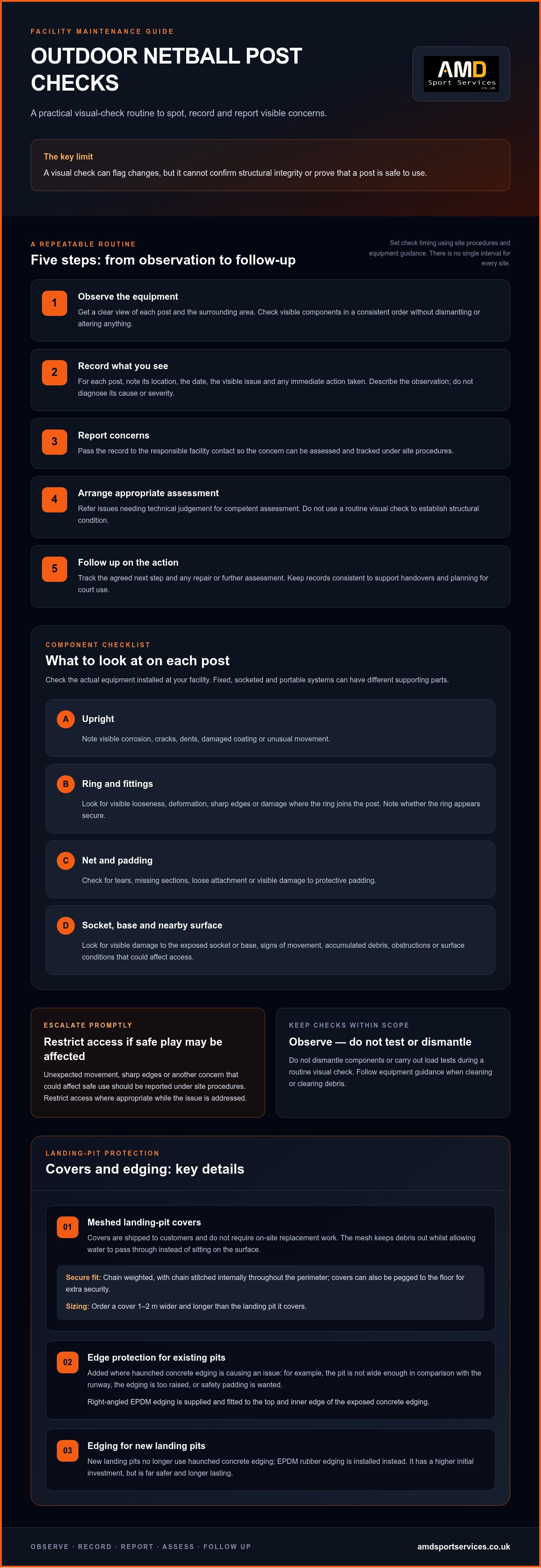
When outdoor netball posts need cleaning, repair or replacement
Not every visible mark calls for repair, but recurring movement, damaged components or deterioration should not be dismissed as routine wear. Use the table to distinguish basic upkeep from issues that need closer assessment. It is a guide to the next step, not a diagnosis of the post’s condition.
Which issues may need professional assessment?
Escalate a concern if a post continues to move, a component is damaged, visible deterioration goes beyond surface soiling or the same fault returns after attention. Take clear photographs from a safe position and add notes identifying the post, its location and what has changed. These details help describe the issue, but photographs and visual observations cannot establish structural integrity.
If the condition could affect stability or safe use, follow your facility’s procedures and keep the equipment out of use where those procedures require it. Do not try to resolve uncertainty by repeatedly using or testing the post. Arrange an appropriate assessment instead.
Repair or replacement: making a condition-led decision
Repair may suit some faults, but the right response depends on the defect, the equipment type and the condition of the wider system. A damaged ring or fitting should not be considered in isolation if there are also concerns about the upright, base or socket. Equally, visible damage does not automatically mean the whole post needs replacing.
Assessment findings, the equipment’s intended use and the facility’s procedures should inform the decision. Outdoor netball post maintenance helps staff identify and report concerns; specialist inspection and repair support can help determine the appropriate next step. Read about AMD Sport Services’ sports equipment maintenance services and arrange support for an equipment concern.
Professional outdoor netball post maintenance with AMD Sport Services
AMD Sport Services provides sports equipment inspections, maintenance and repairs for facilities across the UK. We assess reported equipment concerns and carry out appropriate work, with the outcome recorded for follow-up. For post replacement or installation planning, see our outdoor sports equipment installation service.
What a specialist maintenance visit can address
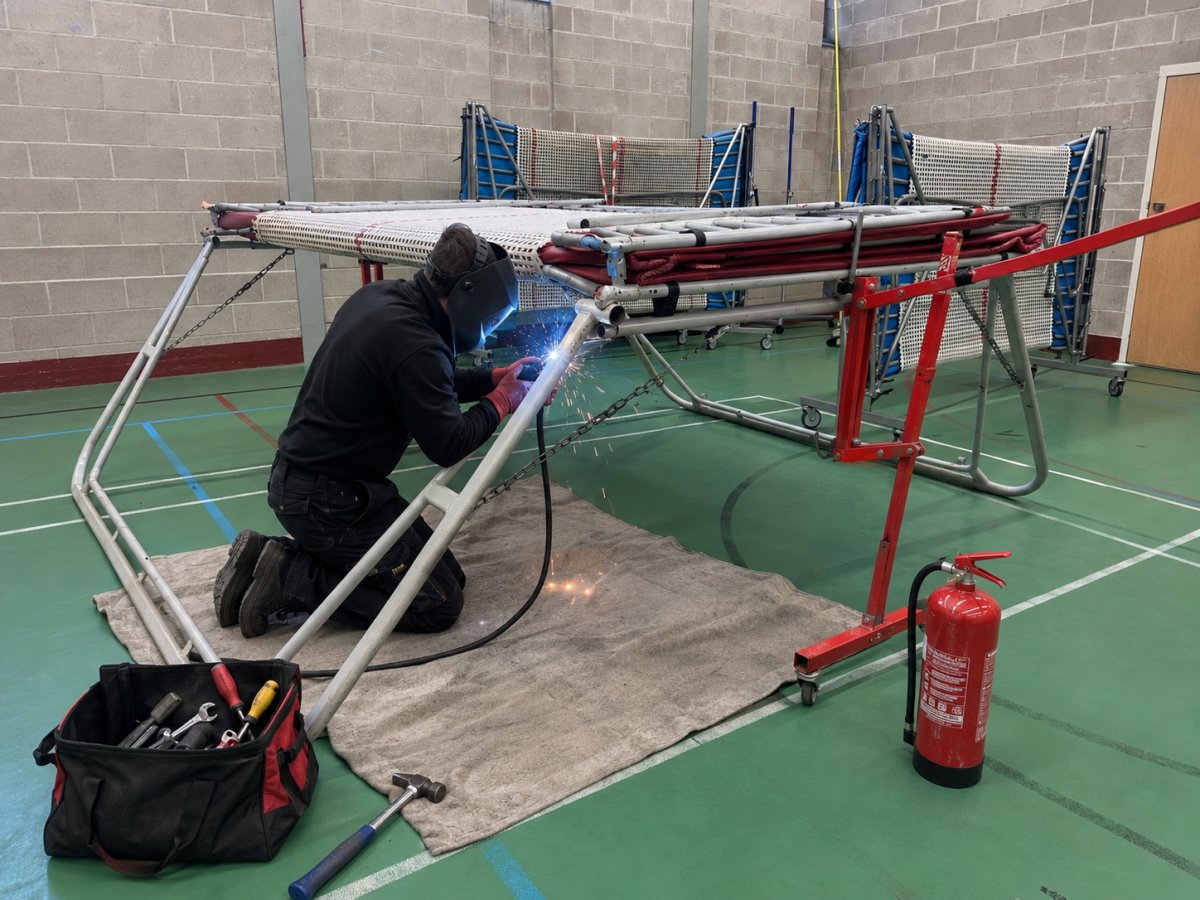
Assessment findings help facility teams understand the condition observed and plan suitable follow-up. The appropriate repair depends on the fault and the solution required. Clear records show what was assessed and what action was completed.
For existing athletics landing pits, we add edge protection when haunched concrete edging causes an issue, such as when the pit is too narrow in relation to the runway, the edging is too raised or safety padding is wanted. We supply and fit right-angled EPDM edging, secured to the top and inner edge of the exposed concrete edging. For new landing pits, we no longer use haunched concrete edging and instead install EPDM rubber edging. It has a higher initial investment but is far safer and longer lasting.
Preparing useful information about your netball posts
When reporting a concern, note the number and location of posts, what you observed, and any relevant access details or maintenance records. Clear photographs can help show the condition. Landing pit covers are shipped to customers and do not require on-site replacement work. They are meshed to keep debris out while allowing water to pass through rather than sit on the surface. Chain is stitched internally throughout the perimeter to weight each cover, which can also be pegged to the floor for extra security. Order a cover 1-2m wider and longer than the landing pit it covers.
For support with outdoor netball post maintenance, discuss your facility’s equipment concerns with AMD Sport Services.
Keep your netball posts ready for confident use
A practical outdoor netball post maintenance routine gives staff a clear way to observe equipment, record changes and report concerns. Check the upright, ring, net, base or socket and protective components, but remember that visual observations do not confirm structural integrity. Follow your facility’s procedures and equipment guidance, and arrange a competent assessment if a fault’s cause or severity is unclear.
Responding promptly to visible damage or possible instability helps your team make informed decisions about access, repair and follow-up. AMD Sport Services provides sports equipment inspection, maintenance and repair support for schools, councils, leisure centres and sports clubs across the UK.
If a post needs specialist attention, discuss outdoor sports equipment maintenance with AMD Sport Services. Share what you have observed so we can help you plan the appropriate next step.
Frequently Asked Questions
How often should outdoor netball posts be checked?
There is no single inspection interval that suits every facility. Set the checking routine according to your site procedures and the guidance for the posts installed. Consider how the equipment is used and exposed to weather when organising observations. Record the date and findings each time, and report visible concerns promptly. Routine visual checks help staff spot changes, but they do not replace a competent safety inspection.
What should I look for when inspecting a netball post?
Look over the upright, ring, net, socket or base, and fitted padding. Note visible corrosion, cracks, deformation, damaged finishes, loose-looking parts, unusual movement, sharp edges or torn netting. Check whether the ring appears secure and the net is attached. Describe what you see rather than trying to diagnose the fault. A visual check can flag a concern, but cannot confirm the post’s structural integrity.
Can outdoor netball posts stay outside all year?
Whether a post can remain outdoors depends on its design and the guidance for that equipment. Follow the manufacturer’s instructions for use, storage and care rather than assuming every post is intended to stay outside year-round. Include outdoor posts in your facility’s observation routine, as exposure can affect visible finishes and components. If you notice deterioration or damage, record it and follow site procedures for assessment.
What should I do if a netball post feels loose?
Stop using the post and follow your facility’s procedure for restricting access if its movement could affect safe play. Report the concern to the responsible facility contact, noting which post is affected and what movement you observed. Do not attempt load tests or dismantle components during a routine check. Arrange a competent assessment to establish the cause and decide whether maintenance or repair is needed.
How do you maintain a netball post socket?
Follow the equipment guidance and your site procedures. During a visual check, look for accumulated debris, visible damage or signs that the socket or post is moving. Where the guidance allows, keep the exposed socket area clear of debris, which can make a post difficult to remove. Do not dismantle the socket or force a stuck post. Report damage or persistent problems for appropriate assessment.
When should a damaged netball post be repaired or replaced?
Arrange an assessment when damage is visible, movement persists or the same fault recurs. Whether repair or replacement is appropriate depends on the defect, the type and wider condition of the post system, and its intended use. Do not assume every damaged part can be repaired or that any visible defect means the whole post needs replacing. Restrict use if the concern could affect safe play, following site procedures.
Can a specialist inspect and maintain outdoor netball posts?
Yes. AMD Sport Services provides sports equipment safety inspections, maintenance and repairs for facilities across the UK, including schools, councils, leisure centres and sports clubs. Our inspections and maintenance help assess reported equipment concerns and identify appropriate follow-up work. Share the post’s location, the issue observed and any relevant records to explain the concern clearly. Visual checks remain useful, but specialist assessment is needed where condition or safety is uncertain.
Comments