
Outdoor Play Equipment Repair: A Guide for UK Facilities

A damaged item of playground equipment doesn’t automatically need replacing. However, continuing to use it while the cause and extent of the damage are unclear may expose children and staff to avoidable risk. For schools, councils, leisure centres and sports clubs, a sound decision starts with the defect and the equipment’s wider condition.
Outdoor play equipment repair may be appropriate, or replacement may be more practical. Until the damage has been assessed, consider restricting access if the defect could pose a risk. Before requesting an assessment, note what is damaged, where it is, when it was noticed and whether you have relevant inspection or repair records. Photos taken from a safe distance can also help explain the issue.
This guide explains how to prepare for an assessment, compare repair and replacement options, and choose a contractor with relevant experience. It also covers how to plan the work and keep users and stakeholders informed, so decisions are clear and the equipment can return to use when appropriate.
Table of Contents
Outdoor play equipment repair: when a defect needs attention
When a defect appears, the facility needs to decide whether the equipment should remain available, be restricted or be taken out of use while it is assessed. Visible damage warrants attention, but it doesn’t automatically mean the equipment needs replacing. The appropriate response depends on the defect, its location and the equipment’s overall condition.
A playground can include many types of equipment and play spaces, as the general overview of a playground explains. When reporting a repair issue, describe what you can observe without trying to diagnose the cause. This gives a contractor a useful starting point, but it cannot confirm whether a repair is feasible or whether the equipment is safe to use.
What information should you record about damaged play equipment?
Record the basic facts before requesting an assessment. Include:
the equipment type and its location within the site
when the concern was first noticed
a plain description of the visible issue, such as a loose part, damaged component, apparent instability or degraded surface
clear photographs from suitable distances, if taking them is safe and permitted
Describe what you can see rather than guessing at the cause or severity. For example, note that a component appears loose, rather than stating that a fixing has failed unless this has been confirmed. If the issue has changed since it was first observed, include that detail. A concise, factual record helps the assessor understand what they are being asked to examine.
Should equipment remain in use while a repair is considered?
There isn’t a universal access decision for every defect. Whether use should continue, be restricted or stop depends on the specific concern, an appropriate risk assessment and competent advice. Follow your organisation’s procedures and applicable professional guidance while an assessment is arranged. If the equipment presents an immediate concern, escalate it through the facility’s established process.
Don’t declare equipment safe or unsafe based only on a short description or photograph. These can help communicate the issue, but may not show the equipment’s full condition or the extent of the defect. A competent assessment can inform the decision and help define suitable next steps.
For information about AMD Sport Services’ service and maintenance, see its website. To start a discussion, provide the equipment details, your observations, site context and any photographs that can be shared safely. The contractor can then advise whether a site assessment is needed.
How a repair assessment determines the right work
Once the concern is documented, the next step is to establish what is affected and what response is practical. Photos and a description help a contractor understand the issue, but they don’t confirm the equipment’s full condition or provide a repair specification. Depending on the concern, the contractor may need to examine the equipment on site and consider whether the proposed work is feasible.
A repair assessment considers the defect, the surrounding condition and the remedial work that can reasonably be carried out. It should lead from initial information to findings and an agreed way forward, rather than assume that every visible defect has the same solution.
What should a contractor assess on site?
The assessment should begin with the reported defect, then consider relevant surrounding components and the equipment’s wider condition. The aim is to distinguish what has been observed from what can be confirmed in person. Site context matters too: the equipment’s position, available working space and access arrangements may affect what can be examined and how the proposed work could be carried out.
Ask the contractor to explain what they have confirmed, what remains uncertain and whether further access or information is needed. An assessment of a specific defect should still address the conditions at your site.
Repair or replacement: what informs the decision?
Repair may be an option when the defect can be addressed and the equipment’s broader condition and function remain suitable. Replacement may warrant consideration if the assessment identifies wider deterioration, limitations that prevent an effective repair or concerns about the equipment’s ongoing suitability. Neither outcome should be assumed from a photograph alone.
For outdoor play equipment repair, ask for the recommendation to set out the proposed work, its scope and the area affected. Check for any limitations or follow-up considerations. This helps decision-makers compare options based on the equipment’s actual condition, rather than treating repair as automatically safer, cheaper or preferable.
Before agreeing next steps, clarify whether the assessment is complete or whether further site access or information is required. AMD Sport Services provides sports equipment assessment and repair services. Sharing the reported issue and site context can help establish what assessment may be appropriate.
Choosing outdoor play equipment repairs that address the cause
An assessment should lead to a defined proposal, not a generic recommendation to “fix the damage”. The work should address the identified defect and any relevant cause that has been established. If the cause remains uncertain, ask the contractor to explain whether further investigation is needed before the scope can be agreed.
Possible outcomes include a focused repair, component replacement or broader remedial work. Clarify what each option covers before deciding how to proceed.
When might a focused repair be appropriate?
A focused repair may be suitable when the assessment identifies a specific defect and confirms that a defined repair is feasible. Ask the contractor to state precisely what the work includes and where it ends. The proposal should also identify related concerns that remain outside its scope. A local repair should not be treated as resolving unrelated wear elsewhere on the equipment.
When should wider remedial work be considered?
Wider damage or a concern about the surrounding surface may change the work required. If the reported condition involves the play surface, ask whether playground safety surfacing is relevant to the assessment and whether it falls within the proposed scope. Don’t assume that equipment repair automatically includes surfacing work, or that a surface issue calls for changes to the equipment.
AMD Sport Services lists playground surfacing alongside outdoor play equipment repair. If the assessment identifies a relevant surface concern, you can review its playground surfacing services when considering the options.
Before authorising work, compare the proposed scope with the assessment findings. Confirm the affected area, access arrangements, exclusions and any recommended follow-up in writing. This gives facility decision-makers a clear basis for agreeing the work and explaining what it is expected to address, without assuming a guaranteed outcome or that one option is always preferable.
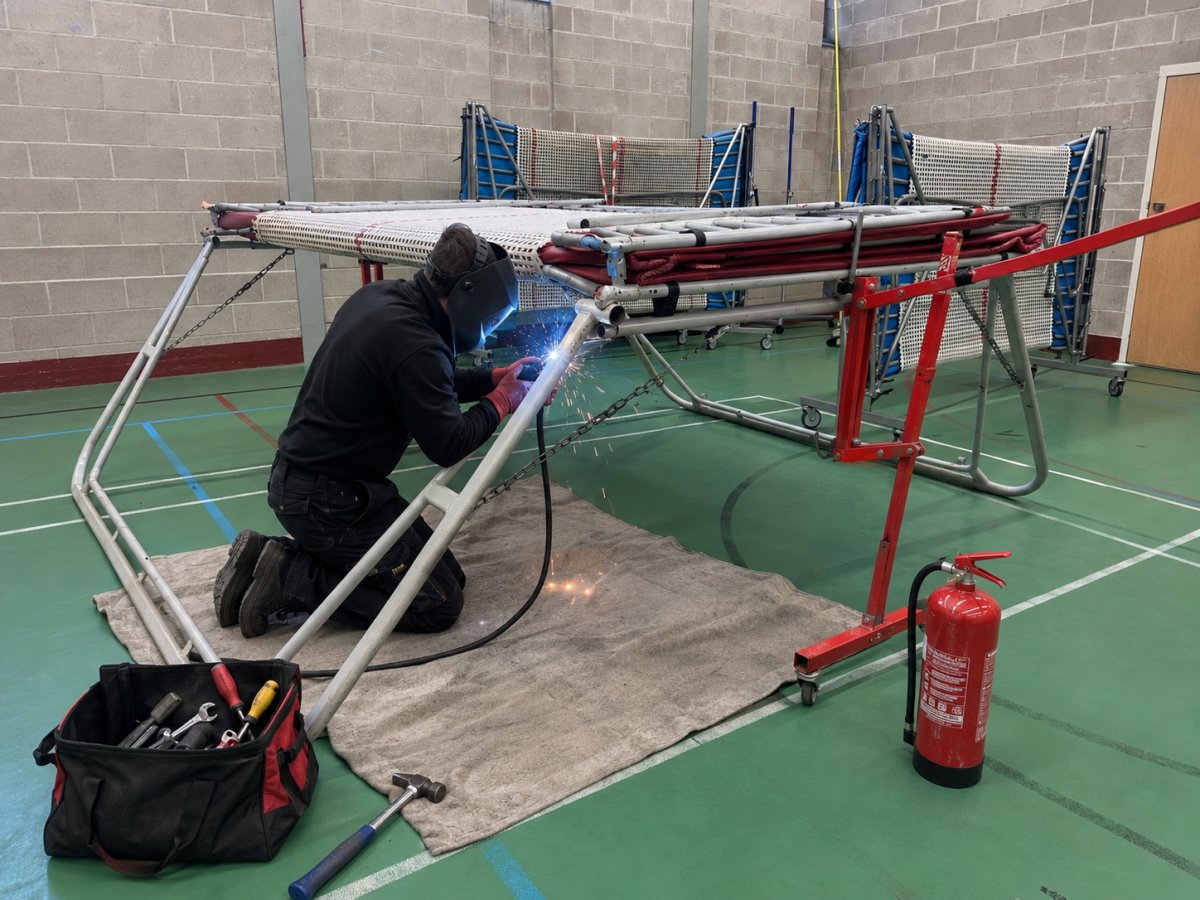
Planning outdoor play equipment repair with minimal disruption
Good coordination starts before work is scheduled. Once the assessment establishes the proposed scope, confirm who will manage the work on site, what access is needed and how the arrangements may affect normal activity. A named contact keeps communication clear if the contractor needs more information or identifies a concern that could change the plan.
What should a facility prepare before requesting a repair?
Share useful site information at the outset so the contractor can understand the issue and advise what is needed for an assessment. Prepare:
the equipment type and its location on site
a plain description of the issue and when it was first observed
photographs, if they can be taken safely and are permitted
relevant previous repair or assessment records available to your facility
site access details and operational constraints that may affect a visit
Be clear about what you have observed and what is not yet known. For example, describe a part as visibly loose rather than assuming why it has moved. Ask whether the contractor needs further details, access to a particular area or other arrangements to assess the equipment. This can help prevent gaps between the initial report and the site visit.
How can a repair project be coordinated responsibly?
Before work begins, agree the scope, access requirements and who will communicate with staff, users and other relevant stakeholders. Depending on the site, this may include explaining which area will be affected and how people will be informed about access arrangements. Keep messages factual and consistent with the agreed plan.
Confirm how the contractor will report a change in scope or a newly identified concern. If findings differ from the original assessment, clarify what has changed, what additional work is proposed and whether the arrangements need updating. This gives facility decision-makers a clear basis for approving revised work and sharing accurate information with users.
A practical sequence is to share your observations and available records, arrange the assessment, agree the written scope, then confirm the site contact, access and communications before scheduling work. These steps help keep the repair process organised without assuming a particular timescale or promising that disruption can be avoided entirely.
AMD Sport Services provides outdoor play equipment repair. Review its service and maintenance support and share the equipment details, observed issue, site context and any photographs when discussing what assessment may be appropriate.
Arrange outdoor play equipment repair with AMD Sport Services
AMD Sport Services works with schools, councils, leisure centres and sports clubs across the UK, with more than 20 years of industry experience. Its listed services include outdoor play equipment repair and playground surfacing. Share the details of the concern to discuss an appropriate assessment and next steps.
What to include in a repair enquiry
Give a clear picture of the facility and issue. Include:
the facility type and equipment affected
the equipment’s location within the site
what you observed and when the concern was noticed
photographs, if taking them is safe and permitted
access arrangements or constraints that may affect a site visit
Include relevant records of previous work or assessments if available. Describe what you can see without guessing at the cause, and ask what further information or site access is needed to assess the issue and define the scope.
What happens after you make contact?
The next step is to clarify the reported issue and determine whether a site assessment is needed. Before work is arranged, confirm the proposed scope, affected area, access requirements and how new findings or changes will be communicated. If the assessment identifies a related surface concern, clarify whether playground surfacing is relevant and included in the proposed work.
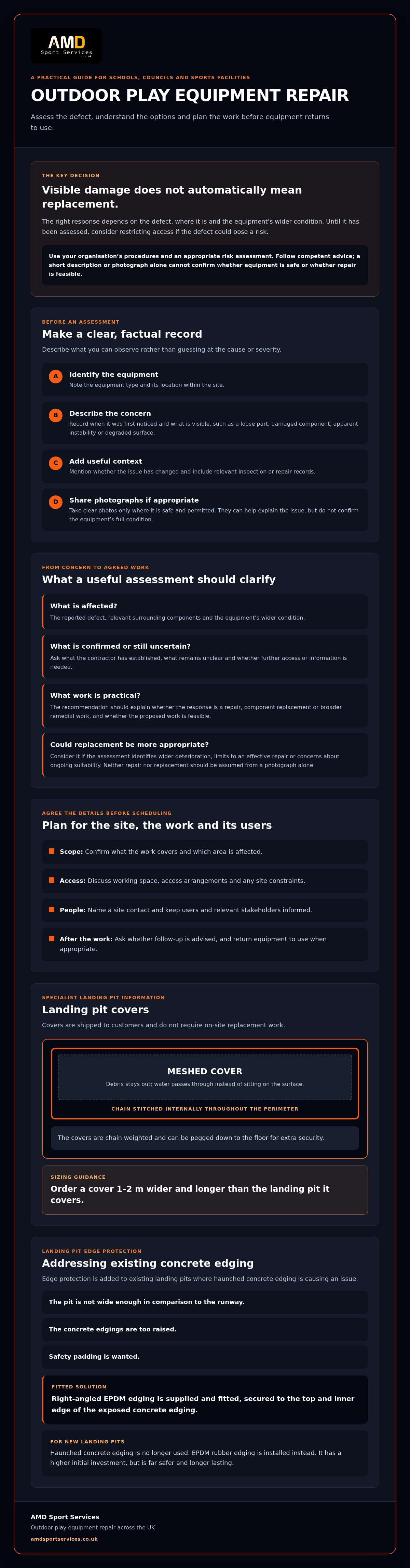
For facilities that also manage an athletics landing pit, AMD supplies mesh covers. The covers keep debris out while allowing water to pass through rather than sit on the surface. They are chain weighted, with chain stitched internally around the perimeter, and can be pegged to the floor for extra security. Order a cover one to two metres wider and longer than the pit.
For existing landing pits where haunched concrete edging causes an issue, such as raised edging, insufficient pit width relative to the runway or a need for safety padding, AMD supplies and fits right-angled EPDM edging to the top and inner edge of exposed concrete. New landing pits use EPDM rubber edging instead of haunched concrete. It requires a higher initial investment and is described as longer lasting.
To discuss the equipment, observed issue and suitable next steps, discuss outdoor play equipment repairs with AMD Sport Services.
Take the next step towards a considered repair
A visible defect calls for a clear response, but it doesn’t determine whether repair or replacement is right. Record what you have observed, arrange a competent assessment and use its findings to agree a defined scope. Before work begins, confirm access, site arrangements and how new concerns will be communicated.
For outdoor play equipment repair, a practical decision starts with the defect and the equipment’s wider condition. Playground surfacing may also be relevant if the assessment identifies a related surface concern.
AMD Sport Services supports schools, councils, leisure centres and sports clubs across the UK. Its listed services include outdoor play equipment repair and playground surfacing, backed by more than 20 years of industry experience. Share the equipment details, site context and photographs to begin a discussion about your requirements.
Discuss your outdoor play equipment repair requirements and take a clear, considered step towards resolving the issue.
Frequently Asked Questions
Can outdoor play equipment be repaired instead of replaced?
Yes, outdoor play equipment may be repairable, but the decision depends on an assessment of the defect and the equipment’s wider condition. A visible fault alone doesn’t establish whether repair is feasible or replacement is more suitable. Ask the contractor to explain the recommended work, its scope and any limitations. This gives your facility a reasoned basis for deciding, without assuming repair is always the safer or more practical choice.
How do I know if outdoor play equipment needs repair?
Visible damage or a change in condition is a reason to seek an assessment. Report what you can observe, such as a loose part, apparent instability, damage to a component or a degraded surface. Don’t try to diagnose the cause or judge the equipment’s overall safety from appearance alone. Record when the concern was noticed and where it is, then share those details with a suitably experienced contractor to discuss next steps.
Who can repair outdoor play equipment at a school or public facility?
Choose a contractor with relevant experience in outdoor play equipment repair and ask how they assess the reported defect and define the work. A site visit may be needed to confirm the equipment’s condition and whether a repair is feasible. AMD Sport Services lists outdoor play equipment repair and serves schools, councils, leisure centres and sports clubs across the UK. Confirm the proposed scope, access needs and any limitations before agreeing to work.
What information should I provide when requesting a playground equipment repair?
Provide the equipment type, its location within the site, a clear description of the visible issue and when it was first noticed. Include photographs if taking them is safe and permitted, along with any relevant records of previous work or assessments. Note access arrangements or operational constraints that could affect a site visit. Describe observations plainly rather than guessing at the cause, and ask the contractor what else they need to assess the issue.
Should damaged outdoor play equipment be closed before it is repaired?
Whether equipment should remain in use, be restricted or be closed depends on the specific defect and competent assessment. There isn’t one access rule that fits every concern. Follow your organisation’s procedures and applicable professional guidance, and escalate an immediate concern through the facility’s established process. A short description or photograph cannot confirm whether equipment is safe or unsafe, so seek appropriate advice before deciding how access should be managed.
Does outdoor play equipment repair include playground safety surfacing?
Not automatically. Outdoor play equipment repair and playground safety surfacing are listed services, but the scope depends on the site findings. If the reported concern involves the surface, ask whether it is relevant to the equipment issue and whether surfacing work is included in the proposal. Clarify the affected area and any separate work required before agreeing the scope, so expectations are clear for your facility and users.
Comments