
Professional Gym Upholstery and Pad Repair: A UK Facility Manager’s Guide

This guide demonstrates how professional refurbishment ensures full compliance with PUWER 1998 and Crib 5 fire safety standards without the capital expense of new equipment. You'll discover the technical process behind bespoke pad repair and how commercial-grade materials extend the operational life of your assets. We'll outline the essential safety benchmarks, the benefits of technical assessments, and the pragmatic steps required to maintain a durable, safe, and compliant fitness environment for your members.
Table of Contents
The Role of Gym Upholstery in Facility Safety and Hygiene
In a commercial fitness environment, gym upholstery serves as the critical protective interface where the human body meets the mechanical structure of a strength machine. It's far more than a decorative finish; it's a functional component designed to distribute weight, provide stability, and protect the user from the rigid steel frames. Understanding the upholstery materials and methods used in these pads is essential for any facility manager tasked with maintaining a safe and professional environment. When this interface fails, the equipment becomes a liability rather than an asset.
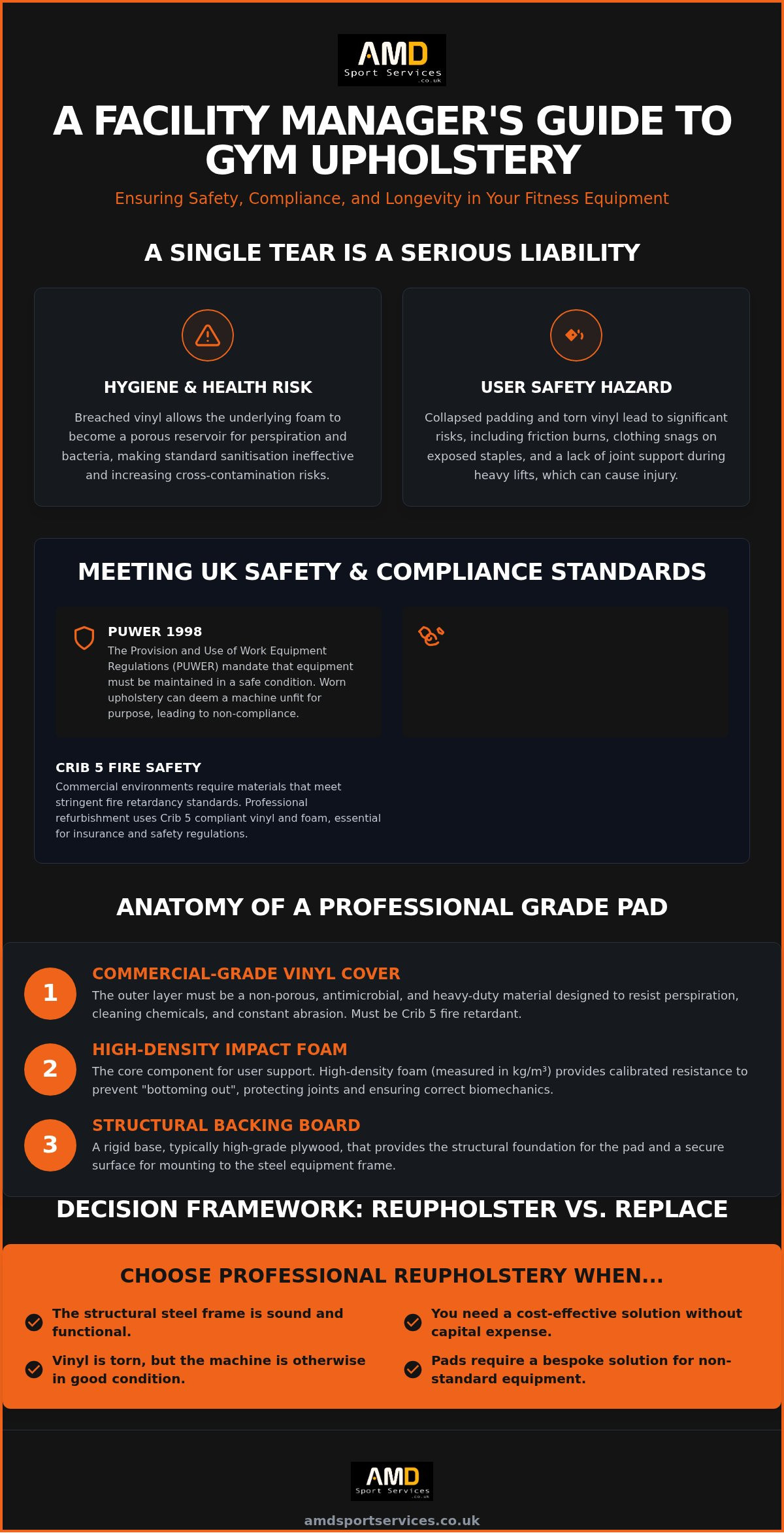
Torn or cracked vinyl is a primary concern for facility hygiene. Once the outer protective layer is breached, the underlying foam becomes a porous reservoir for perspiration, bacteria, and skin cells. Standard sanitisation protocols, which rely on wiping down non-porous surfaces, are ineffective once moisture seeps into the internal padding. This creates an environment where odours persist and cross-contamination becomes a genuine risk for your members. Keeping gym upholstery in top condition is therefore a prerequisite for meeting modern health and safety expectations.
Hygiene Standards in High-Traffic Centres
Leisure centres and school gyms face intense usage cycles that test the limits of standard materials. High-quality fitness equipment upholstery utilises non-porous, antimicrobial vinyl specifically engineered to withstand constant exposure to cleaning chemicals and sweat. If the vinyl is allowed to degrade, perspiration begins to break down the cellular structure of the foam padding from the inside out. This leads to a "soggy" feel and a permanent loss of shape. Incorporating regular pad assessments into your indoor inspection and maintenance schedule ensures that these issues are identified before they compromise your facility's hygiene reputation.
Preventing User Injury Through Proper Padding
The structural integrity of the foam is just as important as the condition of the vinyl cover. Foam density is carefully calibrated to support joints during heavy lifts, providing the necessary resistance to keep the body in the correct biomechanical position. Over time, high-traffic use leads to "bottoming out," where the foam loses its rebound capacity and the user can feel the hard backing board or steel frame beneath. This lack of cushioning is a significant safety hazard during high-impact or heavy resistance training.
Friction Burns: Rough, cracked edges of damaged vinyl can cause painful abrasions during repetitive movements.
Clothing Snags: Exposed staples or jagged tears can catch on member apparel, potentially causing a trip or a sudden loss of balance whilst under load.
Mechanical Interference: Loose pieces of vinyl or foam can migrate into pulleys and weight stacks, causing equipment malfunctions.
Collapsed padding fails to distribute weight evenly, which places direct, unbuffered stress on the user’s joints and skeletal structure during heavy resistance exercises.
Technical Specifications of Quality Fitness Equipment Padding
High-quality gym upholstery is an engineered assembly rather than a simple fabric covering. To withstand the rigours of a commercial environment, a pad must be constructed from three distinct layers: a structural backing board, high-density impact foam, and a heavy-duty vinyl cover. Each component plays a vital role in the pad's longevity and the user's safety. When one layer fails, the entire unit loses its effectiveness. Professional refurbishment focuses on restoring the integrity of all three elements to ensure the equipment remains fit for purpose.
The outer layer requires marine-grade or heavy-duty commercial vinyl. This material is specifically designed to resist the corrosive effects of perspiration and the abrasive nature of constant physical contact. It's essential that these materials meet stringent fire safety codes. Maintaining equipment to these standards is a core part of fulfilling your obligations under the Health and Safety at Work etc. Act 1974. Beyond the surface, foam density is the most critical factor for support. We measure this in kg/m3 rather than simple thickness; a thin, high-density foam will provide better joint support and resist "bottoming out" far longer than a thick, low-quality alternative.
Choosing the Right Vinyl and Stitching
Durability often comes down to the finishing technique used. Wrap-around finishes are common for simpler shapes, but complex pads often require top-stitched seams to maintain their structural profile under load. We use industrial-grade, bonded nylon thread that won't rot or snap when tensioned. For UK facilities, ensuring all materials are fire-retardant (Crib 5) is a non-negotiable building safety requirement. Additionally, precise colour matching allows us to repair individual pads whilst maintaining a consistent brand aesthetic across your entire gym floor. Our team provides detailed technical assessments to identify which components require immediate attention.
The Importance of Structural Backing Boards
The backing board is the foundation of the pad, yet it's often overlooked during basic repairs. We inspect every plywood base for signs of cracking, warping, or rot caused by moisture ingress. A compromised board cannot hold fixings securely, leading to pad wobble or complete detachment during use. We utilise heavy-duty T-nuts and zinc-plated bolts to ensure a vibration-resistant connection to the machine frame. If the wood is damaged, we replace or reinforce the base as part of the reupholstery process, ensuring the finished product is as structurally sound as a factory-new component.
Repair vs. Reupholster vs. Replace: A Decision Framework
Deciding whether to repair a single pad or replace an entire machine requires a pragmatic look at asset management. Most commercial strength equipment is built around a heavy-duty steel frame designed to last decades, whereas the gym upholstery is a wear item with a much shorter lifecycle. Scrapping a structurally sound machine because of damaged padding is an inefficient use of your maintenance budget. A technical refurbishment returns the equipment to a professional standard at a fraction of the cost of a new unit. This approach allows you to reallocate capital towards other facility improvements whilst maintaining a high-standard environment for your members.
The environmental impact of this choice is also significant. Refurbishing existing equipment directly reduces the volume of industrial waste sent to landfill. Scrapping a 200kg leg press creates a substantial carbon footprint compared to the targeted replacement of a few kilograms of vinyl and foam. Logistics also play a role in this framework. Whilst minor on-site repairs might seem convenient, complex or bespoke pads often benefit from factory-grade tools and specialised stitching machinery found in a dedicated workshop. Balancing immediate downtime against the durability of the finished repair is a key consideration for any busy leisure centre.
When a Simple Repair is Sufficient
Proactive maintenance relies on catching damage in its earliest stages. Small nicks or surface abrasions can often be stabilised before perspiration reaches the internal foam, preventing the "soggy" degradation mentioned in previous sections. However, you must recognise the limitations of adhesive patches in high-use commercial areas. These temporary fixes often peel under constant friction, leaving a sticky residue that attracts dirt and compromises hygiene. Proactive inspection allows you to identify these wear patterns early, ensuring that small issues don't escalate into expensive structural failures.
Identifying When Full Reupholstery is Required
Full reupholstery is the only viable option once the internal integrity of the pad is lost. If the foam has permanently collapsed or the backing board feels soft and unstable, surface-level fixes are no longer safe. You should also consider a full refresh if the vinyl has become brittle or shows multiple deep splits. For older facilities, a "fleet-wide" upholstery project is often the most efficient way to bring all equipment up to current safety standards. Incorporating these repairs into a wider service and maintenance schedule ensures that your facility remains fully compliant and visually consistent without the need for significant capital investment.
Compliance with UK Safety Standards and PUWER
Compliance with safety regulations is a legal obligation, not an aesthetic preference. Under the Provision and Use of Work Equipment Regulations 1998 (PUWER), all fitness equipment must be maintained in an efficient state, in efficient working order, and in good repair. This mandate extends directly to gym upholstery. When a pad is torn or the foam has collapsed, the machine is no longer "fit for purpose" as defined by health and safety standards. Professional inspectors frequently flag damaged padding as a failure point because it compromises both user stability and facility hygiene.
Documenting every reupholstery project is vital for maintaining a robust safety audit trail. In the event of an accident or a health inspection, you must be able to prove that your equipment has been regularly assessed and professionally maintained. A simple log of repairs, supported by technical invoices from a specialist provider, demonstrates a proactive approach to risk management. This transparency is particularly crucial for institutional managers who are accountable to local authorities or governing boards.
Annual Inspections and Upholstery Checks
Integrating upholstery checks into your indoor inspection and maintenance routine is the most effective way to ensure ongoing compliance. A professional inspector doesn't just look for surface tears; they evaluate the density of the foam and the security of the backing board fixings. They check for "bottoming out," where the padding no longer provides the necessary buffer between the user and the steel frame. Identifying these issues during a scheduled visit prevents equipment downtime and ensures your facility meets the legal necessity of keeping work equipment in good repair.
School and Local Authority Requirements
Educational institutions face even tighter scrutiny regarding PE equipment and gymnastics apparatus. Meeting the safety criteria set by OFSTED or local council auditors requires a meticulous approach to equipment condition. Damaged gym upholstery on a vaulting horse or a weight bench can lead to immediate closure of the apparatus. We help schools navigate these requirements by providing detailed reports and bespoke repairs that meet commercial-grade standards. For more information on broader compliance, read our guide on Sports Equipment Safety Inspections: A UK Facilities Guide.
If your facility is due for a compliance review, contact us to discuss our professional gym upholstery services today.
Specialist Gym Upholstery Services from AMD Sport Services
Our approach to facility maintenance is built on technical proficiency and direct communication. We don't provide generic, one-size-fits-all solutions; instead, we begin with a pragmatic assessment of your equipment's condition. This process allows us to categorise your assets into those requiring immediate repair and those that remain structurally sound. By identifying specific failure points in your gym upholstery, we help you manage your maintenance budget with precision. Our national service coverage ensures that schools, local authorities, and leisure centres across the UK receive the same high standard of technical expertise, regardless of their location.
Organising a site visit or requesting a quote for a full facility refresh is a straightforward process. We provide itemised assessments that detail the work required for each machine, ensuring total transparency before any physical labour begins. This methodical workflow is designed to minimise equipment downtime, allowing you to return your strength areas to full capacity as quickly as possible whilst ensuring every pad meets the necessary safety benchmarks.
Bespoke Solutions for Unique Equipment
Many facilities operate with specialist apparatus or legacy machines where original manufacturer parts are no longer available. We specialise in custom manufacturing for these unique assets, creating bespoke templates for gymnastics trampolines, treatment couches, and non-standard sports pads. Our team focuses on replicating the original structural profile whilst using modern, heavy-duty materials to improve durability. You can see the results of our technical refurbishments on our installations page. This bespoke capability prevents the unnecessary decommissioning of valuable equipment simply because a pad has worn out.
Why Choose a Seasoned Practitioner?
With over 20 years of experience in the UK sports industry, we've developed a reputation for technical honesty and high-standard craftsmanship. We operate as seasoned practitioners who understand that durability is the most important metric for a busy gym. Our no-nonsense attitude means we prioritise the structural integrity of the backing board and the density of the foam just as much as the finish of the vinyl. We don't use superficial patches that fail under friction; we provide industrial-grade solutions that withstand the rigours of high-traffic use. Contact AMD Sport Services for a professional upholstery quote to discuss your facility's specific requirements and ensure your equipment remains safe and compliant.
Securing Your Facility’s Future Through Professional Refurbishment
Maintaining high standards in a commercial fitness environment requires a pragmatic approach to equipment care. Professional gym upholstery is a critical component of your facility's safety and hygiene strategy. By prioritising the integrity of your padding, you fulfill your legal obligations under PUWER whilst protecting your members from avoidable injury. Refurbishment isn't just about aesthetics; it's a strategic decision that extends the operational life of your assets and avoids the high capital cost of unnecessary replacements.
AMD Sport Services provides national UK coverage for schools and leisure centres, delivering specialist repairs that meet stringent safety compliance benchmarks. We use durable, commercial-grade materials to ensure your equipment withstands the rigours of daily use. Whether you manage a single site or a regional portfolio, our team is ready to assist with technical assessments and bespoke solutions tailored to your specific needs. Take the first step towards a safer, more compliant facility today.
Request a Professional Gym Upholstery Quote
Frequently Asked Questions
How much does it cost to reupholster a gym pad in the UK?
The cost of reupholstering gym pads depends on several technical factors, including the dimensions of the pad, the density of the replacement foam, and the specific vinyl grade required. Whilst industry rates exist, we focus on providing bespoke quotes tailored to the unique requirements of your facility. Factors such as the number of pads and the complexity of the stitching will influence the final investment needed to restore your equipment to a professional standard.
How long does a professional gym upholstery repair take?
Turnaround times for gym upholstery projects are determined by the volume of equipment and the complexity of the repairs. Minor pad replacements can often be completed efficiently to minimise member disruption. For larger facility refreshes or bespoke manufacturing, we provide a clear timeline following an initial assessment. Our goal is to ensure your strength area returns to full capacity as quickly as possible whilst maintaining high standards of workmanship.
Can you match the original colour of my gym equipment pads?
We maintain an extensive inventory of commercial-grade vinyl in a variety of colours and textures. This allows us to closely match the original aesthetic of your strength equipment, ensuring a consistent brand image across your gym floor. If your equipment is from a legacy range where parts are no longer available, we can manufacture replacement pads that seamlessly integrate with your existing machines whilst providing superior durability and safety.
Is it better to repair on-site or send the pads away?
The choice between on-site and off-site repair depends on the technical requirements of the pad. Simple wrap-around pads can often be serviced quickly to reduce equipment downtime. However, complex pads with contoured shapes or heavy-duty top-stitching often require the precision of industrial machinery found in a specialist workshop. We assess each machine individually to recommend the most efficient and durable repair method for your specific facility needs.
What type of vinyl is best for commercial gym equipment?
Commercial fitness environments require heavy-duty, antimicrobial vinyl that is specifically engineered for high-traffic use. The material must be non-porous to prevent perspiration from reaching the internal foam and must meet UK fire safety standards, such as the Crib 5 test. We utilise marine-grade materials that offer high resistance to abrasions and chemical cleaners, ensuring your pads remain hygienic and structurally sound for a significantly longer period.
Does torn upholstery affect my facility’s safety compliance?
Torn or degraded vinyl is a direct violation of the Provision and Use of Work Equipment Regulations 1998 (PUWER). These regulations mandate that all equipment is maintained in an efficient state and in good repair. Damaged gym upholstery can be flagged as a failure during professional safety inspections because it creates hygiene risks and potential snagging hazards. Keeping your padding in top condition is essential for maintaining your facility's safety audit trail.
Can you repair the wooden backing board of a gym bench?
Structural repair is a core part of our upholstery service. We routinely inspect the plywood backing boards for signs of rot, warping, or cracking caused by moisture ingress. If the foundation of the pad is compromised, we replace or reinforce the timber using high-quality materials and secure fixings like T-nuts. This ensures the finished pad is stable and securely attached to the machine frame, preventing wobbles or mechanical failure during use.
Do you provide upholstery services for schools and leisure centres nationwide?
AMD Sport Services provides comprehensive equipment maintenance and upholstery services to facilities across the entire United Kingdom. We specialise in supporting schools, local authorities, and commercial leisure centres with a pragmatic, safety-first approach. Our national coverage ensures that regardless of your location, you have access to over 20 years of industry expertise for your sports equipment repairs, safety inspections, and bespoke refurbishment projects.


Comments