
Professional Long Jump Runway Installation Guide

A compliant long jump runway is a precision-engineered safety system, fundamental to any UK school or athletics club. Its performance and longevity depend not just on the visible surface, but on the synergy between sub-base preparation, surface specification, and ongoing maintenance. For facility managers, school bursars, and council officers, understanding the technical requirements of a professional long jump runway installation is the first step towards creating a safe, durable, and high-performing athletics facility.
This guide provides a no-nonsense, technical overview of the entire process, from groundwork and UK Athletics (UKA) compliance to the specifics of polymeric surfacing and essential safety maintenance. We will detail the professional workflow required to ensure your investment meets the rigorous standards expected in UK athletics, reducing injury risk for students and athletes whilst delivering a facility built to last.
Table of Contents
UKA Standards and Technical Site Preparation
Before any surface is laid, the success of a long jump runway installation is determined by the quality of the groundwork. Adherence to UKA standards is not optional; it is the benchmark for safety, performance, and competition eligibility. This initial phase involves meticulous planning and execution, focusing on dimensions, foundation stability, and water management to prevent premature failure and ensure athlete safety.
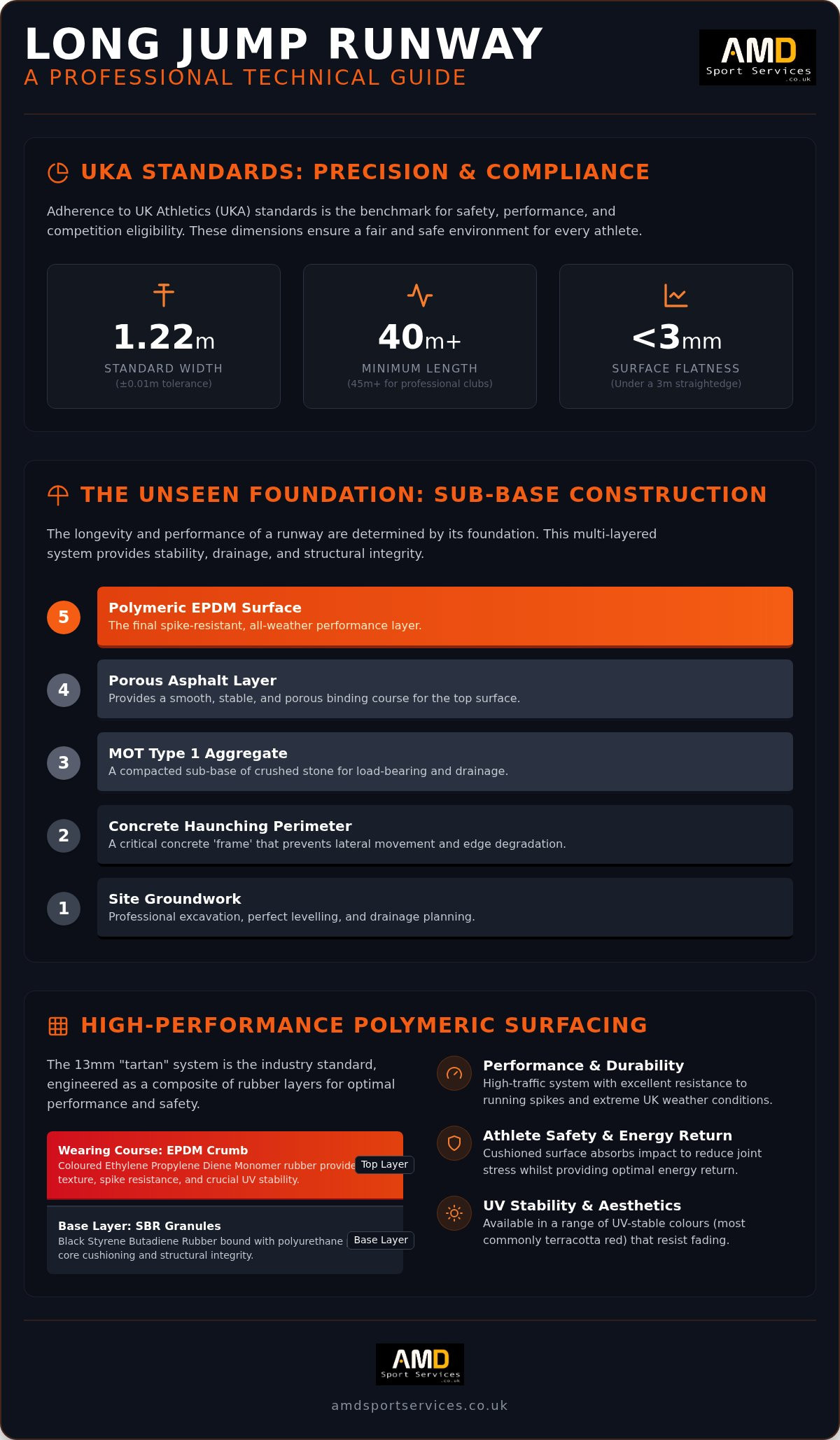
Defining UKA standard dimensions: The competition standard specifies a runway width of 1.22m and a minimum length of 40m, measured from the take-off line.
The critical role of sub-base construction: A stable foundation, typically built from MOT Type 1 aggregate and a porous asphalt layer, is essential for preventing surface movement and ensuring consistent performance.
Why site levelling is the foundation of safety: The ground must be perfectly levelled to create a uniform, flat surface, which is critical for preventing trips and ensuring predictable take-offs and landings.
Identifying drainage requirements: Proper drainage for both the runway and the landing pit must be planned from the outset to prevent water pooling, which can damage the surface and create hazardous conditions.
Official Dimensions and Compliance
For a facility to be used for official competitions, it must strictly adhere to the dimensions and tolerances set by UK Athletics. The standard runway width for competition is 1.22m, with a permitted tolerance of just ±0.01m. Whilst the minimum length is 40m, professional clubs often opt for 45m or longer to accommodate athletes with varying run-up lengths. For primary schools or facilities with space constraints, a shorter runway may be sufficient for training purposes, but it is crucial to understand that this may not be compliant for competitive events. A critical UKA tolerance for the final surface is its flatness, which must not exceed a 3mm deviation under a 3m straightedge, ensuring a perfectly even plane for the athlete.
Groundwork and Foundation Requirements
The unseen groundwork is arguably the most important stage of any long jump runway installation. Excavation depths are determined by local UK soil conditions; poor-draining clay soils, for example, may require a deeper sub-base than well-draining sandy soils. A key structural element is the concrete haunching perimeter. This continuous concrete edge is cast around the runway's foundation to lock the sub-base and surfacing layers in place, preventing lateral movement and edge degradation. Explaining this to a non-expert, haunching acts like a picture frame, holding everything securely together. Improper base preparation, such as inadequate compaction or the wrong materials, is the primary cause of future problems like surface de-lamination, where the top rubber layer peels away from its base.
Specifying Professional Polymeric Surfacing for Long Jump Runways
The choice of surfacing is critical for performance, safety, and long-term durability. For UK athletics facilities, polymeric rubber is the industry standard, offering unparalleled spike resistance, energy return, and all-weather performance. Often referred to as a "tartan" track, this synthetic surface is a composite system engineered to withstand the high-impact forces generated by athletes, providing a consistent and safe environment for both training and competition.
Performance and Durability: Polymeric EPDM rubber crumb systems are designed for high-traffic use, offering excellent resistance to damage from running spikes and extreme weather conditions.
Athlete Safety and Energy Return: The composition of the rubber provides a cushioned yet firm surface that absorbs impact, reducing stress on athletes' joints whilst offering optimal energy return for performance.
UV Stability and Aesthetics: Modern polymeric systems are available in a range of UV-stable colours, most commonly terracotta red, ensuring the facility maintains its professional appearance for years without significant fading.
Maintenance Profile: A well-installed polymeric surface requires routine cleaning to maintain its porosity and slip resistance, but is otherwise a low-maintenance solution designed for longevity in varied UK climates.
Polymeric Rubber Crumb (Tartan) Systems
Polymeric surfacing is the preferred choice for professional athletics clubs, universities, and schools serious about sport. The most common specification is a 13mm system, which can be installed in one of two ways: a "sandwich" system or a spray-coat system. Both begin with a base layer of black SBR (Styrene Butadiene Rubber) granules bound with polyurethane, which provides the core cushioning and structural integrity. For the wearing course—the top layer the athlete runs on—a coating of coloured EPDM (Ethylene Propylene Diene Monomer) rubber crumb is applied. This EPDM layer provides the final texture, colour, and crucial resistance to UV degradation and wear. The meticulous process of applying the SBR base and the EPDM wearing course requires specialist machinery and expertise to achieve the uniform depth and perfect flatness mandated by UKA.
The Professional Installation and Refurbishment Process
A successful long jump runway installation follows a methodical, step-by-step process managed by specialist contractors. Whether constructing a new facility or refurbishing an existing one, the workflow is designed to ensure safety, compliance, and quality at every stage. It begins with a thorough site assessment and ends with the final, precise line marking.
Initial safety inspection and site survey: The project always starts with a detailed assessment to identify potential issues, confirm ground conditions, and define the precise scope of work.
Step-by-step installation workflow: The process moves logically from excavation and base construction to surfacing and the integration of take-off boards.
Refurbishment strategies: For existing runways, an expert assessment determines whether a deep clean and re-topping is sufficient or if a full resurfacing is necessary to restore safety and performance. For more information on this decision, see our detailed guide to long jump runway refurbishment.
Seamless take-off board integration: The foundation troughs for the take-off board system are installed with precision to ensure they sit perfectly flush with the final surface.
New Runway Installation Workflow
A new installation is a multi-stage construction project that demands precision. The typical workflow is as follows:
Excavation and Ground Preparation: The site is excavated to the required depth, and prepared for the sub-base layers.
Sub-Base and Haunching Construction: A geotextile membrane is laid, followed by compacted MOT Type 1 aggregate and a porous asphalt (tarmac) base course. The concrete haunching is then cast around the perimeter.
Foundation Trough Installation: The galvanised steel troughs for the take-off board and blanking board are set into a concrete base at the correct distance from the landing pit, ensuring they are perfectly level.
Application of Polymeric Surfacing: The SBR rubber base mat is installed, followed by the application of the EPDM rubber wearing course. This is a highly technical process to ensure a seamless, uniform finish that is flush with the surrounding track and take-off board trough.
Final Line Marking: Once the surface has fully cured, professional-grade, anti-slip athletics paint is used to mark the runway lines according to UKA specifications.
Refurbishing Existing Runways
Over time, even the best-installed runways will show signs of wear, particularly in the high-impact area around the take-off board. Refurbishment can restore a facility to a safe and usable condition. This may involve patching holes or "ruts" with new polymeric material, ensuring a seamless repair. For surfaces that have become clogged with moss and algae, a professional deep-cleaning process can restore porosity and slip resistance. In cases of extensive damage or de-lamination, a full resurface—where the old EPDM wearing course is removed and a new one is applied—may be the most cost-effective long-term solution. You can see examples of our refurbishment projects to understand the transformations possible.
Essential Maintenance: Sand Pits, Take-off Boards, and Safety
The installation is only the beginning. A structured maintenance programme is essential for maximising the lifespan of the facility and, most importantly, ensuring the ongoing safety of its users. This involves regular attention to the landing pit, the take-off board system, and the runway surface itself.
UKA-approved silica sand: Using the correct grade of washed, sub-angular silica sand is vital. It is designed to be non-compacting, providing a safe landing medium that absorbs impact effectively.
Take-off and blanking boards: These components are subject to immense force and must be inspected regularly for wear, rot, or damage. Worn boards compromise safety and must be replaced.
Sand pit drainage management: A blocked or inefficient drainage system can lead to a water-logged pit, promoting algae growth and turning the sand into a hard, unsafe landing surface.
Routine safety checks: A comprehensive maintenance plan should include checks of all components, from the runway surface to the pit retaining edge. For a deeper dive, explore our guide on maintaining long jump sand pits for safety.
Take-off Board and Trough Maintenance
The take-off board requires constant vigilance. Any signs of splitting, cracking, or significant surface wear are indicators that a board requires immediate replacement. The no-jump indicator, typically a plasticine tray, must be kept clean and the plasticine fresh for competitions. A critical safety check is to ensure the blanking board or trough lid is always perfectly flush with the surrounding surface when the take-off board is not in use, eliminating a serious trip hazard.
Landing Pit Care and Silica Sand Top-ups
The sand in the landing pit is a piece of safety equipment. Regular raking and turning of the sand is essential to keep it loose and aerated, ensuring it provides a soft landing. Over time, sand will be lost from the pit and can become contaminated with leaves, litter, and other environmental debris, which can affect its quality and block drainage. Regular top-ups with fresh, UKA-approved silica sand are necessary to maintain the correct depth. For school facilities, a securely fitted sand pit cover is a crucial investment, protecting the sand from contamination and preventing the pit from being used inappropriately when unsupervised.
Partnering with Specialist Long Jump Runway Contractors
The technical precision required for a long jump runway installation places it far beyond the scope of general builders or landscapers. Partnering with a specialist athletics facility contractor is the only way to guarantee compliance, safety, and a durable final product. Specialists bring an in-depth understanding of the materials, UKA regulations, and construction techniques necessary for a successful project.
Specialist expertise: Contractors with a proven track record in athletics infrastructure understand the unique challenges of building to fine tolerances.
Integrated safety and maintenance: A reputable specialist will offer integrated safety inspections and ongoing maintenance contracts to protect your investment.
National compliance: AMD Sport Services has the expertise to ensure your facility meets all national standards, whether it's for a local primary school or a regional competition venue.
Complete service: We invite you to explore our athletics surfacing services to see the full scope of our capabilities.
Long-term Maintenance and Support
A specialist partner will not consider the job finished upon completion of the installation. The best contractors provide long-term support, helping you develop a bespoke maintenance plan designed to extend the runway’s lifespan and ensure it remains safe year after year. Regular safety audits of all your indoor and outdoor sports equipment are a vital part of facility management, identifying potential hazards before they can cause an incident. A proactive approach to maintenance is always more cost-effective than reactive repairs. We offer a range of service and maintenance options to help you keep your athletics facilities in peak condition.


Comments