
Professional Outdoor Sports Cage Repairs: A UK Facility Manager’s Guide

A single hairline fracture in a structural post or a frayed section of netting isn't just a minor maintenance issue; it's a significant liability risk that could compromise your entire facility's safety standing. You likely oversee sites where the British weather and constant use take a heavy toll on infrastructure. Worrying about whether a net will hold during a high-velocity impact or if a corroded post can withstand the next gale is a stress no manager needs. Professional outdoor sports cage repairs are about more than just fixing visible damage; they're about ensuring your equipment meets the rigorous standards required for modern competition and school use.
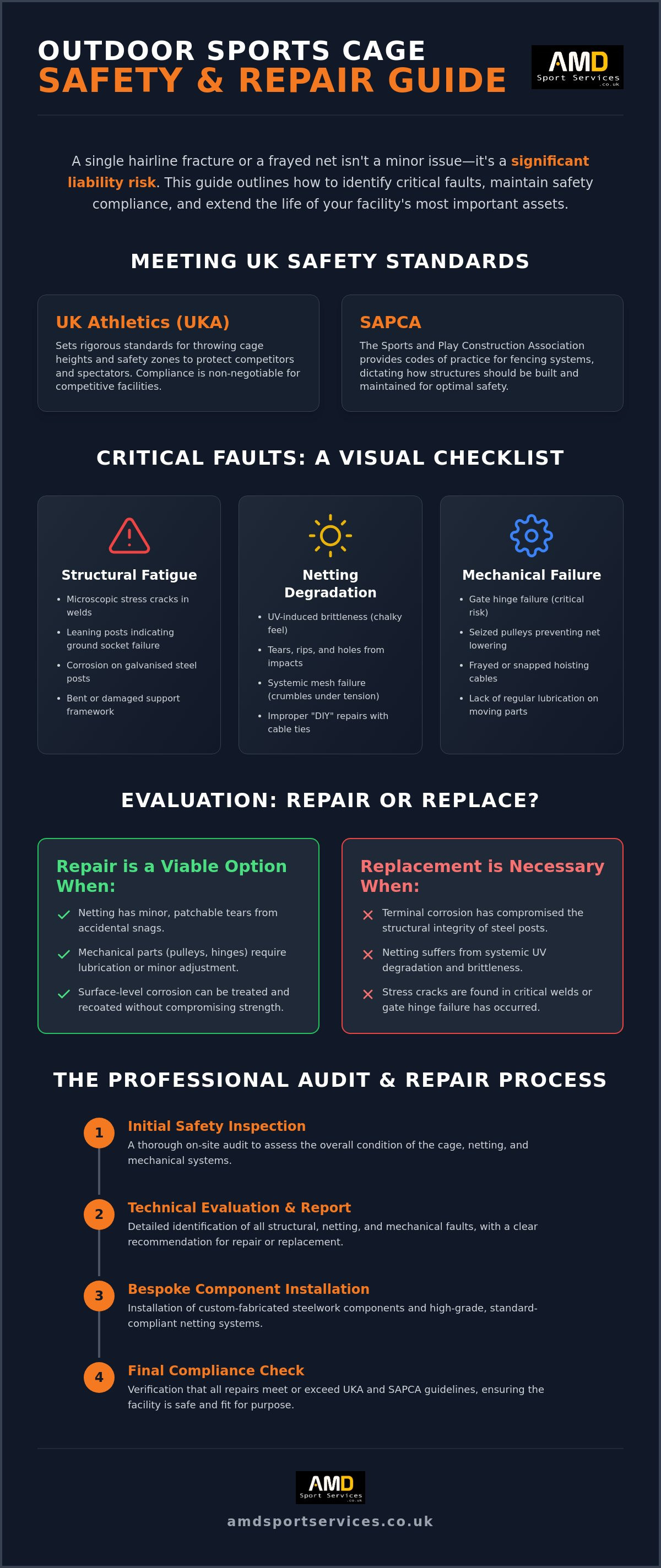
We understand that budget constraints often clash with the necessity of total safety compliance. This guide helps you navigate that balance. You'll discover how to identify structural faults before they become critical, maintain compliance with UK Athletics (UKA) and SAPCA standards, and decide when a targeted repair is more sensible than an expensive replacement. We'll provide a clear look at technical assessments and professional maintenance workflows that extend the life of your facility's most important assets whilst keeping your users safe.
Table of Contents
Understanding Outdoor Sports Cage Maintenance and Safety Standards
Outdoor sports cages serve as the primary line of defence between high-velocity projectiles and the public. Whether you manage hammer and discus throwing cages, cricket lanes, or multi-use games areas (MUGAs), these structures function as large-scale protective sports equipment. Unlike indoor netting systems that remain shielded from the elements, outdoor cages must withstand constant environmental stress whilst maintaining strict safety tolerances. Failure to maintain these assets doesn't just lead to equipment downtime; it creates significant liability risks for schools and local authorities.
The regulatory landscape for these facilities is governed by specific industry bodies. UK Athletics (UKA) sets rigorous standards for throwing cage heights and safety zones to protect competitors and spectators. Similarly, the Sports and Play Construction Association (SAPCA) publishes codes of practice, such as the 2022 standards for fencing systems, which dictate how these structures should be built and maintained. Adhering to these guidelines is essential for any facility manager overseeing outdoor sports cage repairs or routine maintenance schedules.
The Role of Compliance in Facility Management
Facility managers have a clear legal duty of care under the Health and Safety at Work Act 1974. This responsibility extends to ensuring that all sports equipment is fit for purpose and safe for use. Professional safety inspections are the only reliable way to identify "hidden" structural fatigue. Whilst a net might look intact from a distance, impact stress can weaken the mesh over time. Regular service and maintenance visits help catch stress cracks in welds or ground socket failures before they result in an accident. For high-use school or council sites, an annual professional audit is the minimum requirement to maintain insurance validity and safety compliance.
Weather Factors and Material Durability
The British climate is particularly harsh on outdoor sports infrastructure. UV degradation is a constant threat to polyethylene and nylon netting, eventually making the fibres brittle and prone to snapping upon impact. Wind loading is another critical concern. In high winds, a fixed net acts like a sail, putting immense pressure on support posts. This is why many professional systems are designed to be lowerable; failing to drop the nets during a storm can lead to bent or snapped galvanised steel posts. Corrosion is the final major factor. Even galvanised steel can succumb to rust if the coating is scratched or if the posts sit in poorly drained ground sockets. Effective outdoor sports cage repairs must address these environmental impacts to prevent long-term structural failure.
Identifying Common Faults in Outdoor Sports Cages
Early detection is the difference between a minor maintenance task and a full structural condemnation. Whilst some damage is obvious, such as a gaping hole in a cricket net, other faults are insidious. Structural fatigue often begins as microscopic stress cracks in welds or a slight lean in a support post that indicates a failure in the ground socket. Identifying these issues early is a core part of outdoor sports cage repairs, preventing minor flaws from escalating into dangerous mechanical failures.
Netting Degradation: When to Patch vs. Replace
Sunlight and high-velocity impacts are the primary enemies of sports netting. UV-induced brittleness is often invisible until the mesh begins to crumble under tension. You can perform a basic "thumb test" by applying firm pressure to a mesh strand; if it snaps or feels chalky, the net has likely reached the end of its safe operational life. Minor tears from accidental snags can often be patched, but systemic failure requires a full replacement. Avoid using cable ties or non-rated twine for "DIY" fixes. These materials lack the breaking strength required by safety standards and can create false confidence in a compromised structure.
Mechanical and Gate System Failures
For throwing cages, the gate system is often the most complex and vulnerable component. Gate hinge failure represents a critical safety risk, as a detached gate can weigh several hundred kilograms. Seized pulleys and frayed hoisting cables are equally problematic, leading to net jams that often occur when you need to lower the system quickly during a storm. Regular lubrication of moving parts amongst your outdoor apparatus is a simple but frequently overlooked preventative measure. The Sports Grounds Safety Authority (SGSA) emphasises the importance of rigorous maintenance for any equipment that could impact public safety.
Beyond the structure itself, ground-level hazards like damaged concrete sockets or protruding metalwork create significant tripping risks. If you notice standing water around a socket or cracked concrete at the base, the internal stability of the post is likely compromised. A professional safety inspection can help you categorise these faults by severity, ensuring your budget is allocated to the most critical outdoor sports cage repairs first. Identifying these mechanical and ground-level issues before the start of the season is essential for maintaining a compliant facility.
Structural vs. Netting Repairs: Evaluation Framework
Deciding between targeted outdoor sports cage repairs and a complete system overhaul is a common challenge for facility managers. This choice is often dictated by your obligations under the Health and Safety at Work Act, which requires all sports equipment to be maintained in a safe, operational condition. If a cage structure shows signs of terminal rust or ground socket failure, it's effectively "condemned." Terminal rust isn't just surface discolouration; it's deep-seated corrosion that flakes away at the structural steel, significantly reducing the wall thickness of the posts. This level of decay usually occurs at the point where the post meets the ground, where moisture sits amongst the debris and accelerates oxidation.
The "Systemic Failure" rule is a pragmatic benchmark for netting. When you reach the point where over 30% of the mesh is covered in patches, the net has lost its uniform tension. This creates "soft spots" that might not contain a high-velocity impact as effectively as a new, continuous net. At this stage, a full replacement is more economical and safer than continuous minor repairs. Professional outdoor sports cage repairs must ensure that any work performed does not void existing safety certifications or manufacturer warranties.
Repair vs. Replace Decision Matrix
Evaluating the age of your facility against modern safety requirements is vital. Older throwing cages often feature non-standard designs that don't match today's off-the-shelf products. In such cases, bespoke structural welding is often the favourite choice. It allows you to bring the existing infrastructure up to standard without the massive capital expenditure of a full new installation. However, if the technical assessment reveals that the cost of these bespoke repairs exceeds 50% of the price of a new system, we generally recommend a full refurbishment. This resets the facility's lifespan and ensures full compliance with current UK Athletics safety zone requirements.
Upgrading Whilst Repairing
A repair project provides an ideal opportunity to improve the original specification of your facility. By integrating superior components during the maintenance process, you can reduce the frequency of future interventions. Consider these common upgrades:
Marine-Grade Hardware: Replace standard pulleys and carabiners with marine-grade stainless steel alternatives to prevent seizing and salt-air corrosion.
High-Density Netting: Upgrade to 2.5mm HDPE netting with enhanced UV resistance for better longevity in exposed areas.
Ground-Level Protection: Install heavy-duty buffers at the cage base to prevent mower damage, which is a leading cause of net fraying in school and council fields.
Following a service and maintenance audit, you'll receive a clear roadmap for these improvements. This ensures your budget is spent on tangible safety outcomes rather than temporary fixes.
The Professional Repair Process and Compliance Requirements
The professional repair process follows a logical, evidence-based sequence designed to restore full safety compliance without compromising the original design intent. Unlike generic fencing work, outdoor sports cage repairs require a specialised understanding of dynamic loads and projectile containment. We follow a methodical five-step workflow to ensure every component meets institutional standards:
Step 1: On-site Safety Audit: A comprehensive physical examination of the entire structure, including a structural integrity assessment of the steelwork and ground sockets.
Step 2: Technical Specification: Defining the exact requirements for bespoke netting or replacement steel components, ensuring they match the original system's tolerances.
Step 3: Site Preparation: The safe removal of damaged netting, frayed cables, or corroded posts, followed by the clearing of ground sockets to ensure a clean fit for new elements.
Step 4: Installation and Tensioning: Precise fitting of new systems, including the calibration of hoisting mechanisms and the tensioning of netting to eliminate "dead spots" or sagging.
Step 5: Post-Repair Certification: A final sign-off confirming the equipment is safe for use, with all work documented for inclusion in the facility’s permanent maintenance log.
Why Professional Installation Matters
Precision is paramount when dealing with heavy-duty throwing cages. Hoisting systems must be perfectly aligned to prevent cable fraying, whilst gate hinges require exact levelling to ensure they operate smoothly for officials and athletes. Poorly installed gates are a significant hazard; if they don't swing correctly, they can't be positioned to protect spectators during competition. AMD’s approach to external sport equipment installation prioritises these mechanical nuances, ensuring that every bolt and pulley functions as part of a cohesive safety system.
Maintaining the Repair Log
Accountability doesn't end once the physical work is complete. Documenting repairs is a vital part of your health and safety compliance, providing an audit trail for insurance purposes. This log should also inform your preventative maintenance schedule, helping you move away from reactive "emergency" fixes. As part of our service, we help train on-site staff on the correct behaviour for lowering nets in high winds. This simple operational step, when performed correctly, significantly reduces the need for future outdoor sports cage repairs caused by storm damage.
If you are concerned about the current safety status of your facility, you can request a structural integrity audit to identify necessary remedial works.
Maintaining Compliance with AMD Sport Services
AMD Sport Services provides national UK coverage for comprehensive outdoor sports cage repairs, ensuring that your facility remains safe for use and fully insured. Our team specialises in the technical nuances of hammer cage repairs and throwing cage netting, addressing the unique structural challenges that generic fencing contractors often overlook. By combining targeted remedial work with regular sports equipment safety inspections, we provide a complete safety solution that protects both your budget and your athletes.
We don't believe in temporary fixes that fail after a single season. Instead, we focus on the long-term durability of your infrastructure. This involves using industry-specific materials, such as high-tensile steel for gate repairs and UV-stabilised netting that can withstand the British climate. Our goal is to return your facility to a state of total compliance, ensuring every component meets the rigorous standards set by UK Athletics and SAPCA.
National Expertise in Outdoor Sports Infrastructure
We adopt a "Seasoned Practitioner" approach, prioritising technical honesty and durability. Our experience spans diverse environments, from local primary schools to elite athletics centres and council-managed public parks. We understand the specific wear patterns associated with different sports and can recommend bespoke netting grades to suit your site's usage levels. You can read about our technical approach and workflow in our recent guide on throwing cage netting replacement.
Booking Your Facility Audit
Organising a site visit is the first step toward a safer facility. Our structural assessments provide a clear, itemised report on the condition of your posts, sockets, gates, and netting. This proactive approach ensures you aren't caught off guard by equipment failure during the peak competitive season. We work around your schedule to minimise facility downtime, providing efficient outdoor sports cage repairs that extend the life of your infrastructure. Our reports are transparent and direct, giving you the evidence needed to make informed maintenance decisions.
Don't leave your facility's safety to chance. Request a professional cage inspection from AMD Sport Services to ensure your equipment meets all current safety requirements and is ready for use.
Securing Your Facility’s Future Compliance
Maintaining safe and functional athletic facilities is a continuous process of technical assessment and proactive maintenance. By understanding the specific failure points of your infrastructure, from UV-damaged mesh to corroded ground sockets, you can make informed decisions that protect both your budget and your users. Professional outdoor sports cage repairs ensure that your equipment doesn't just look functional but meets the exact technical requirements set by UK Athletics and SAPCA standards. Relying on expert assessments prevents minor faults from escalating into significant liability risks.
With over 20 years of technical expertise, AMD Sport Services provides national UK coverage for all facility types, delivering UKA compliant repair standards that stand up to the rigours of the British climate. We provide the technical honesty needed to determine whether a bespoke repair or a full refurbishment is your most cost-effective path forward. Taking action now ensures your site remains operational and safe for every athlete.
Ensure your infrastructure is ready for the upcoming season by taking the guesswork out of safety. Book a Professional Sports Cage Inspection today to receive a comprehensive structural audit of your site. We're ready to help you maintain a safe, high-performing sports environment for years to come.
Frequently Asked Questions
How often should outdoor sports cages be inspected for safety?
Professional safety inspections should be carried out at least once a year to ensure compliance with the Health and Safety at Work Act 1974. High-use facilities at schools or council sites benefit from additional monthly visual checks by on-site staff. These routine audits help identify minor fraying or loose bolts before they escalate into significant liability risks or equipment failure.
Can I repair a hammer cage net myself or do I need a specialist?
You should always engage a specialist for hammer cage repairs to ensure the system meets UK Athletics safety standards. DIY fixes using non-rated twine or cable ties don't have the breaking strength required to contain high-velocity impacts. A specialist provides bespoke netting and professional tensioning that maintains the structural integrity of the entire safety system whilst protecting spectators.
What are the main causes of structural failure in outdoor sports cages?
Internal corrosion at the ground-socket interface and extreme wind loading are the leading causes of structural failure. Moisture trapped in poorly drained sockets accelerates rust in galvanised steel posts, whilst failing to lower nets during storms puts immense pressure on the frame. Fatigue in welds and seized pulleys also contribute to mechanical breakdowns that compromise the facility's safety over time.
How long does a professional outdoor sports cage repair typically take?
Most outdoor sports cage repairs are completed on-site within one to three days, depending on the scope of work. Simple netting replacements are relatively quick, whilst structural welding or ground socket refurbishment requires more intensive labour. We prioritise efficient workflows to minimise facility downtime, ensuring all bespoke components are fitted and tested to professional safety specifications before sign-off.
Is it possible to replace just the netting if the steel frame is still in good condition?
Yes, replacing only the netting is a common and cost-effective solution if the steel frame passes a structural integrity audit. If your posts are vertical and the ground sockets show no signs of terminal rust, fitting a new high-density net can reset the facility's lifespan. This approach ensures the cage remains safe for use without the capital expenditure of a full new installation.
What safety standards must a throwing cage meet in the UK?
Throwing cages must comply with UK Athletics (UKA) height and safety zone requirements and the relevant SAPCA codes of practice. These standards dictate mesh strength, gate functionality, and structural stability to ensure the safety of athletes and officials. Professional outdoor sports cage repairs must be documented in your facility maintenance log to prove the equipment meets these rigorous national standards.
Does AMD Sport Services provide national coverage for cage repairs?
AMD Sport Services provides comprehensive national coverage across the UK for all sports equipment safety inspections and repairs. Our team travels to schools, local authorities, and elite athletics centres to perform on-site assessments and bespoke remedial work. This ensures that facility managers nationwide can access seasoned practitioners who understand the specific technical requirements of specialist sports infrastructure and compliance.
What is the typical lifespan of outdoor sports netting in the UK climate?
High-quality outdoor netting typically lasts between five and eight years before UV degradation makes the fibres brittle. The British weather eventually breaks down the elasticity of polyethylene and nylon mesh, increasing the risk of failure upon impact. Once a net shows systemic fraying or snaps easily during a tension test, it's reached the end of its safe operational life and requires replacement.


Comments