
Roof Mounted Basketball Goal Load Arrester Installation

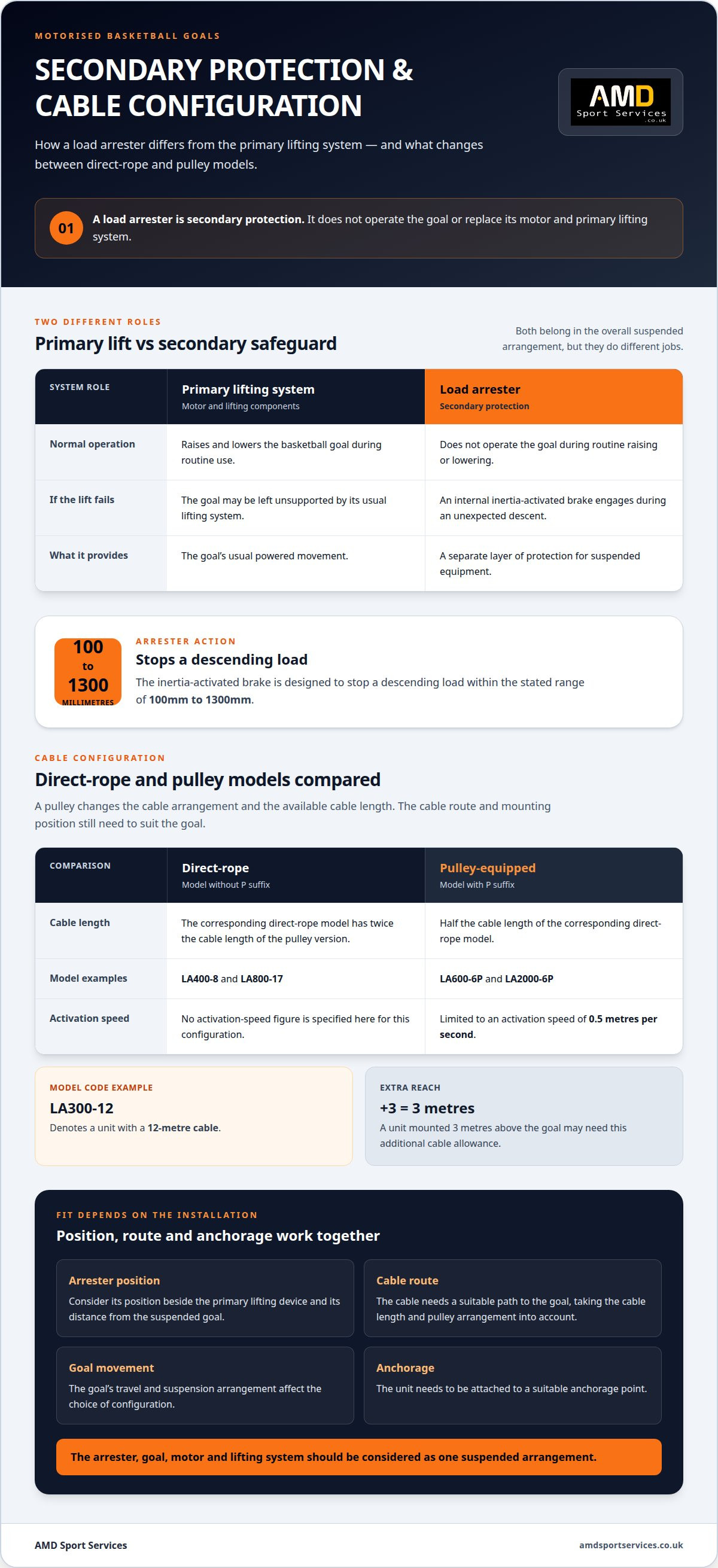
A motorised or manual winched fold down basketball goal needs secondary protection in case its primary lifting system fails. Not all free-fall safety devices are the same: we are seeing a trend of companies installing cheap fall arrest blocks designed for humans, instead of the correct load arresters. A correctly specified motorised basketball goal load arrester is engineered for this application, using an inertia-activated brake to stop a descending load within 100mm to 1300mm. It is a practical safeguard for suspended equipment in schools, leisure centres and sports halls.
Choosing the right arrangement depends on the load arrester model, cable length and cable route. A pulley affects both capacity and cable length, while pulley-equipped units also have a specific activation-speed limit. This article explains how these details influence installation, and why a load arrester should complement, not replace, the goal’s primary lifting system. It also covers key considerations when fitting secondary protection to a motorised basketball goal.
Load arrest devices as secondary protection for suspended equipment
An AMD-specified load arrest device provides secondary protection for suspended equipment if its primary lifting system fails. Its position, cable arrangement and anchorage all affect how it operates.
UK Requirements and Applicable Standards
EN 17206:2020 is an entertainment safety standard relevant to secondary safeguarding in stage and entertainment environments. That does not establish it as the applicable standard for powered basketball goals in UK sports halls.
For a sports hall, the relevant standards depend on the equipment and installation. The goal, motor, lifting system and secondary safeguard should be considered as one suspended arrangement, rather than assuming a standard for entertainment equipment automatically applies.
Load arrester function and professional installation
A free-fall device uses an internal inertia-activated brake to stop a descending load within 100mm to 1300mm. Installation places the arrester beside the primary lifting device, with the cable routed to the load and the unit attached to a suitable anchorage point.
The cable route and device configuration matter. Pulley-equipped units, for example, are limited to an activation speed of 0.5 metres per second. The installer considers how the goal is suspended and moves when specifying the arrangement.
Retrofitting Existing Motorised Goals
A load arrester can be retrofitted by using to any manual, or motorised ceiling mounted, fold down basketball goal.
Suppliers and Installation Services
In the UK, specialist sports equipment installers such as AMD Sport Services can work on motorised basketball goals and integrate secondary protection with the existing suspension arrangement. Installation involves more than supplying a device: the position, the weight and size of the goal, cable route and anchorage all need careful consideration.
For related sports equipment installation work, the same practical focus applies. The safeguard must suit the equipment and its setting, with the goal arrangement considered as a whole.
What is a load arrester or free-fall device on a motorised basketball goal?
A load arrester is a secondary safety device for suspended equipment, such as a roof-mounted basketball goal. The electric motor and primary lifting system raise and lower the goal during normal use. The arrester provides separate protection if that system fails; it does not operate the goal or replace its motor. Think of it as a seat belt for your goal.
Load arresters use an internal inertia-activated brake. If a suspended goal begins to descend unexpectedly, the device detects the movement and engages to arrest the fall. This is different from the motor’s normal, controlled operation. The arrester is designed to act during an abnormal descent, not whenever staff raise or lower the goal.
Primary lifting system failures can have several causes, including mechanical wear, incorrect installation, overloading, component fatigue, environmental conditions or corrosion. In a sports hall, a fault in the motor or lifting components could leave the goal unsupported by its usual system. A separately installed arrester adds another layer of protection to the suspended arrangement.
How well the device works depends on its integration with the goal. Its cable must follow a suitable route, and the arrester needs an appropriate anchorage point beside the primary lifting device. The goal’s travel, mounting arrangement and cable path are all part of the system. A unit selected without considering these details may not suit the installation.
This distinction matters in schools and leisure centres, where roof-mounted goals move between stored and playing positions. The motor handles routine movement; the load arrester is there to address an unintended descent. Installing one on a motorised basketball goal means treating both components as parts of a single suspended system, with the secondary device positioned and connected to provide protection if the primary lifting arrangement fails.
Why a fall arrest block is not a load arrester
A fall arrest block and a load arrester are different types of free-fall safety device. A fall arrest block is generally designed to arrest a person falling from height using a retractable lifeline and energy-absorbing system. Its activation, braking characteristics, cable, anchorage and rated load are intended for that type of fall and mass. A load arrester uses an inertia-activated brake and a load-rated cable arrangement engineered to arrest suspended equipment when its primary lifting system fails. They are also designed to work with much larger masses than that of a single person.
Using a fall arrest block on a swinging basketball goal weighing 250–400 kg is unsafe. The goal’s mass, swinging movement, pendulum effect and the shock generated during an unintended descent create forces and operating conditions that a personnel fall arrest block is not designed to manage. The block’s cable, brake, energy absorber and anchorage can be subjected to loads beyond their intended duty, making failure likely when the device deploys.
Load arresters are significantly more expensive than fall arrest blocks, but they are specifically engineered for motorised basketball goals and similar suspended loads. The arrester, cable route, anchorage and goal movement must be specified as one arrangement so the secondary protection can operate as intended.
When is a load arrester required for a motorised basketball goal in the UK?
There is no blanket rule in the available information stating that every motorised basketball goal must have a load arrester. The decision depends on the suspended goal and its lifting arrangement. However, we strongly advise that all roof mounted fold down basketball goals should have one fitted. For example, a school sports hall with a roof-mounted goal needs to consider what could happen if the primary lifting system failed.
The key point is that the arrester provides secondary protection; it does not replace the motor or primary lifting system. It is relevant where a goal is suspended and an unintended descent could put people or property below at risk. Assess the complete arrangement rather than treating the arrester as an accessory chosen in isolation.
For an existing goal, an assessment considers its suspension, lifting mechanism, movement and available anchorage. A retrofit may be suitable if the arrester can sit beside the primary lifting device, connect along an appropriate cable route and attach to a suitable anchorage point. The arrangement may need to differ if the roof structure, goal travel or cable path makes those positions unsuitable.
Operating conditions matter, too. A goal used frequently in a busy leisure centre may face different demands from one moved occasionally in a school hall. Mechanical wear, component fatigue and corrosion are possible causes of lifting-system failure, so the equipment’s condition and setting should inform the decision. Harsh or high-use environments may also call for more frequent servicing of load arrest devices.
In practice, the questions are whether the suspended goal needs a separate safeguard and whether that safeguard can be integrated correctly. A professional assessment can identify the arrangement, anchorage and model requirements, then determine whether a load arrester is suitable for that particular motorised basketball goal.
AMD Sport Services: Motorising roof mounted basketball goals
AMD Sport Services motorises roof-mounted basketball goals and can help facilities plan work around the existing goal and lifting arrangement. This service is relevant when a school or leisure centre is converting a manually operated goal, upgrading equipment or considering secondary protection as part of an installation.
The work can be considered alongside basketball goal installation and sports equipment safety inspections, helping facility managers address the goal’s operation and condition together. The appropriate scope depends on the existing equipment and the sports hall’s requirements.
For advice on motorising a roof-mounted goal or discussing related installation work, contact AMD Sport Services.
Plan the next step for your sports hall
For facility managers, the next step is to consider the goal as part of the wider sports hall, not as an isolated mechanism. Work may involve planning a motorised basketball goal load arrester or free-fall device installation alongside changes to the goal itself. This keeps the discussion focused on the existing equipment, how it operates and what the facility needs.
AMD Sport Services also provides sports equipment safety inspections and basketball goal installation, helping schools and leisure centres address equipment condition and installation requirements. Safety surfacing is another service for facilities needing wider site improvements. The right service depends on the issue, so planning can start with the goal and the intended project.
Discuss your basketball goal project with AMD Sport Services. A clear starting point can help shape the right practical next step for your hall.
Frequently Asked Questions
Why are secondary load protection systems important?
Load arresters add another protective measure for equipment suspended above an occupied sports hall. If the main lifting arrangement fails, the potential consequences extend beyond the goal: people on court and nearby equipment may be affected. Secondary protection is therefore relevant to facility risk management, particularly when a roof-mounted goal is used for lessons, training sessions or public bookings.
What load rating and device type are suitable for a motorised basketball goal?
No single device type suits every goal, and the goal’s name alone is not enough to select a load rating. The installer needs to understand the equipment layout and intended rope arrangement to identify a suitable load arrester model. Direct-rope and pulley configurations are distinct options, so matching the device to the goal’s setup is more useful than choosing by a code in isolation.
Who is qualified to install and inspect a basketball goal load arrester in the UK?
Choose a specialist installer familiar with motorised basketball goals and suspended sports equipment such as AMD Sport Services.
Ask to see the specifications of the unit they are looking to install at your facility, so that you can be sure you are getting a load arrester installed, and not a cheaper fall arrest blocks. The work requires knowledge of the goal’s operation and secondary safeguard, not simply general building maintenance. For ongoing oversight, a sports equipment inspection can include basketball goals and their supporting equipment. AMD Sport Services provides sports equipment safety inspections and basketball goal installation for facilities managing this equipment.
What maintenance, testing and inspection intervals are recommended for a basketball goal fall-arrest device?
There is no single maintenance interval suitable for every site.
However, we would advise any site with high level equipment should have a high level inspection carried out at least every 2 years, as opposed to the yearly ground level inspections of standard. Plan maintenance around how often the goal moves and the conditions around the device, and keep servicing records with the facility’s wider equipment records. A school hall with occasional use may have different needs from a busy leisure centre. Inspection findings can help inform the schedule for future servicing.
What are the risks of installing or operating a motorised basketball goal without a load arrester?
The main risk is that a failure in the primary lifting arrangement leaves no separate arrest device to limit a descent. The suspended goal could then drop from its stored position causing irreversible damage to the goal itself, and putting users at risk of injury and potentially damaging the floor or other equipment. A failure may also disrupt lessons, club sessions or leisure-centre bookings while the goal is taken out of use and assessed.
Comments