
Sport Hall Perimeter Netting: Essential Safety Guide

How much would a shattered electronic scoreboard or a cracked viewing gallery window actually cost your facility in repairs and downtime? It's a question many site managers only ask after a high-velocity impact occurs. You already know that keeping a multi-use space functional requires more than just floor markings; it demands a robust physical barrier that can handle the rigours of daily school sports and club competitions. Investing in high-quality sport hall perimeter netting is often the difference between a safe, professional environment and a liability-prone hall plagued by unsightly, saggy nets.
We understand that your priority is a durable, compliant setup that stands up to heavy use without constant adjustment. This guide explains how to specify, install, and maintain a professional system to protect your infrastructure and ensure user safety. We'll detail the technical standards defined in BS EN 1263-1, explore bespoke installation workflows, and provide a clear framework for ongoing maintenance. By the end, you'll have the technical insight needed to pass health and safety audits with total peace of mind regarding your facility's long-term protection.
Table of Contents
The Essential Role of Sport Hall Perimeter Netting
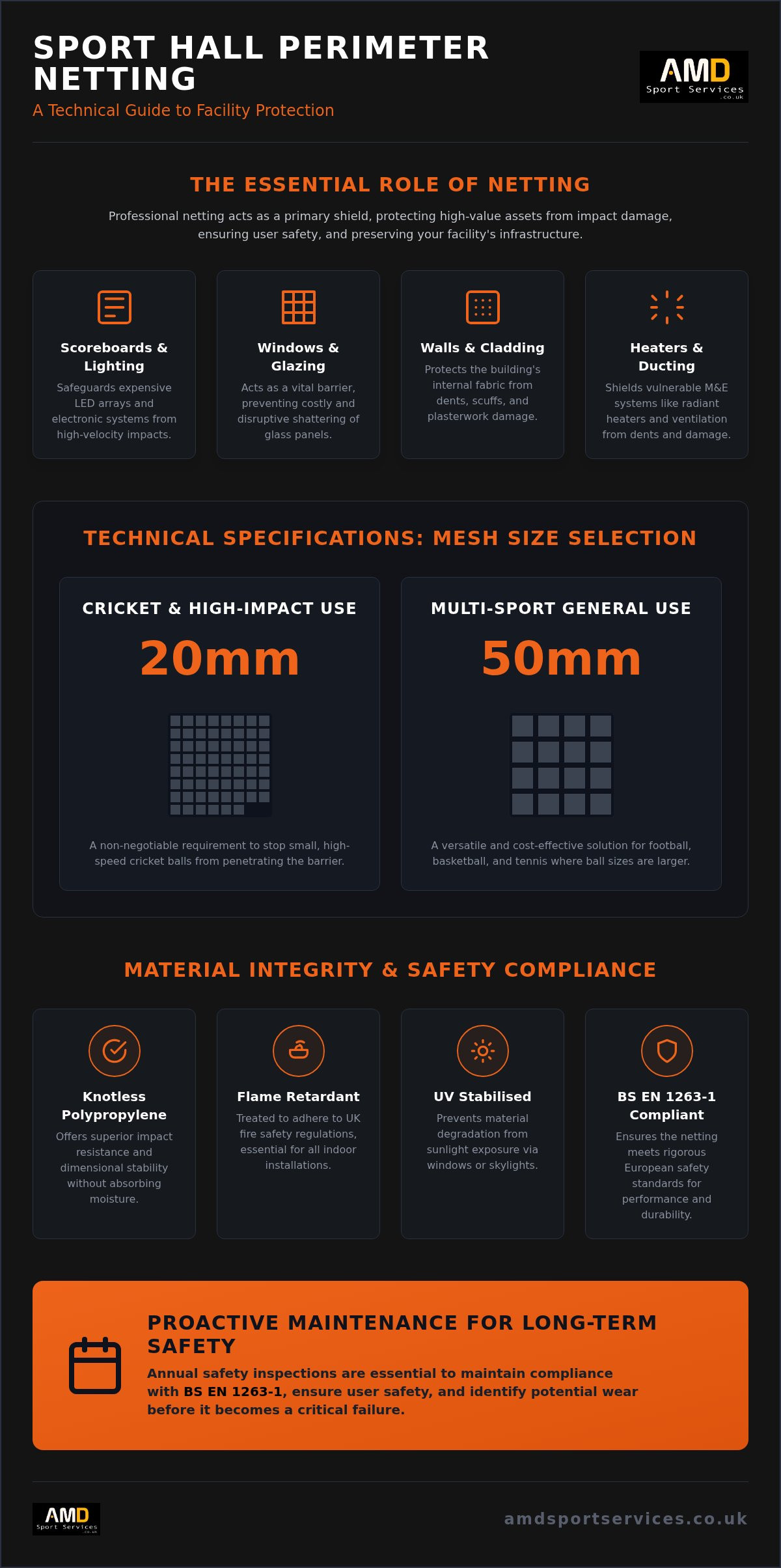
In a busy multi-use facility, the walls and ceiling are under constant threat from high-velocity impacts. Professional sport hall perimeter netting isn't just a boundary for gameplay; it's a critical structural shield designed to protect the building's internal fabric. Without it, the daily rigours of five-a-side football or cricket practice would quickly lead to mounting repair bills for plasterwork, cladding, and fixtures.
Beyond the walls themselves, netting safeguards high-value technological assets. Modern halls often feature expensive LED lighting arrays and sensitive electronic scoreboards that are vulnerable to stray balls. A correctly tensioned net absorbs the kinetic energy of an impact, preventing direct contact with these systems. This proactive approach to protection preserves the hall's capital value and ensures that technical equipment remains operational for scheduled matches and community events.
User safety is equally paramount. By installing a robust perimeter system, you create a clear buffer zone between the field of play and spectator areas. This physical separation prevents injuries whilst allowing observers to view the action safely. Additionally, heavy-duty netting provides subtle acoustic benefits. The large surface area of the mesh helps to break up sound waves, dampening the echoes that often plague large sports halls and improving the overall environment for coaches and players.
Protecting Windows and Glazing
Replacing shattered windows or viewing gallery glazing is both expensive and disruptive. High-impact mesh acts as a vital barrier, but its effectiveness depends heavily on the stand-off distance. This is the gap between the netting and the glass, which must be sufficient to allow the net to deflect without the ball making contact with the surface behind. Impact resistance in the context of 50mm mesh describes the material's capacity to absorb and dissipate the kinetic energy of a ball before it reaches the surface behind it.
Safeguarding Mechanical and Electrical Systems
Sports halls are packed with essential infrastructure that sits in the "firing line" of play. Perimeter systems shield the following:
Radiant heaters and ventilation ducting that are easily dented or damaged.
Fire exit routes, where netting must be designed to allow rapid egress whilst maintaining full coverage during play.
Roof-mounted equipment, such as basketball goals, where the netting must integrate seamlessly with the mechanical supports.
Proper integration ensures that your safety measures don't hinder the functionality of the hall's mechanical systems or compromise emergency protocols. Regular indoor inspections are necessary to ensure these barriers remain secure and correctly positioned to protect your facility's infrastructure.
Technical Specifications: Mesh Sizes and Material Selection
Specifying the correct sport hall perimeter netting involves balancing physical protection with the specific requirements of your facility's curriculum. It isn't merely about hanging a net; it's about selecting a mesh that performs under the high-frequency impact seen in school and leisure centre environments. Choosing the wrong specification often leads to balls passing through the barrier or the material failing prematurely under tension.
Cricket vs. Multi-Sport Mesh
A 20mm mesh is a non-negotiable requirement for halls used for cricket practice, as larger holes allow high-speed balls to penetrate the barrier and damage the building's fabric. Conversely, a 50mm mesh provides a cost-effective and versatile solution for football, tennis, and basketball. For facilities hosting a diverse range of activities, a dual-mesh system offers a bespoke approach, layering different specifications to ensure total coverage across the entire hall perimeter.
Material Integrity and Fire Retardancy
All indoor netting must adhere to UK fire safety regulations, typically requiring a flame-retardant treatment that is either inherent to the fibre or applied during manufacture. If your hall features large windows or skylights, UV stabilisation is essential to prevent the fibres from becoming brittle and snapping over time. Polypropylene is the preferred material for institutional use because it offers superior impact resistance and maintains its tension over time without absorbing moisture. Ensuring your installation follows the Sport England design guidance helps align your facility with national standards for safety and inclusive play.
The weight of the netting, measured in grammes per square metre (gsm), is a direct indicator of its longevity and resistance to abrasion. Heavier gsm netting withstands the repeated friction of being drawn across tracks and the force of impact better than lighter, budget alternatives. In high-use environments, investing in a higher gsm material reduces the frequency of repairs and extends the replacement cycle significantly.
Standard colour options usually include white, black, or green. Whilst white is traditional, black often provides better visibility for spectators and players by reducing glare from overhead lighting. To ensure your hall meets these technical requirements, consider our indoor inspection and maintenance services to assess your current netting's condition and determine if a technical upgrade is necessary.
Installation Frameworks: Trackway vs. Fixed Systems
Determining the best mounting method for sport hall perimeter netting depends entirely on your building's structural layout and how the space is utilised. It isn't just a matter of hanging mesh; it's an engineering task that must account for roof beam height, wall materials, and the presence of mechanical obstructions. If your hall hosts a rotation of diverse sports, a flexible mounting system is mandatory to keep the floor area adaptable.
Trackway systems provide the most versatility for multi-use centres. They allow staff to retract the netting when it isn't required, opening up the full hall for assemblies or large-scale events. Designing these systems requires a precise understanding of Safety Standards and Maintenance Requirements regarding edge rope strength and impact resistance. Unlike basic wire setups, a professional trackway provides a stable, rigid path that ensures the net moves smoothly without snagging or dragging on the floor.
Professional Trackway Engineering
Heavy-duty aluminium tracks are the industry standard, offering significant advantages over traditional steel wire tension systems. Aluminium doesn't rust and maintains its profile under the weight of high-gsm netting. To ensure long-term reliability, we use precision-engineered runners and trolleys that facilitate effortless operation. Proper storage is also a key consideration; bagging the nets at the end of the track prevents them from becoming trip hazards or gathering dust whilst stored against the wall.
Fixed Netting and Wall Protection
Fixed perimeter netting is a robust solution for dedicated zones, such as permanent cricket lanes or spectator buffer areas. These systems use high-tension fixings mounted directly to the wall or structural steelwork to prevent the mesh from sagging over time. A common installation error is failing to consider how these nets interact with other fixed equipment. We specialise in integrating these systems with indoor basketball goal fitting to ensure the netting doesn't obstruct the goal's mechanical operation or the players' line of sight.
Installation challenges frequently arise from uneven roof beams or existing obstructions like radiant heaters and ventilation ducts. A seasoned practitioner doesn't simply work around these; they design bespoke brackets and offset mounts to ensure the track remains level and the protection is continuous. This integrated approach ensures your safety systems work in harmony with the building's infrastructure rather than creating new maintenance headaches.
Safety Standards and Maintenance Requirements
Maintaining sport hall perimeter netting is a statutory obligation rather than a recommendation. Under the Health and Safety at Work etc. Act 1974, facility managers have a clear duty of care to ensure all equipment is fit for purpose and safe for public use. Failure to demonstrate a proactive maintenance regime can invalidate insurance policies and lead to significant liability during a health and safety audit. British Standards BS EN 1263-1:2014 and BS EN 1263-2:2014 provide the technical framework for these systems; adherence to these is the benchmark for institutional safety.
Annual safety inspections are critical for long-term facility management. They provide a documented trail of compliance that insurers specifically look for following an incident. We frequently see facilities where netting has been neglected, resulting in brittle fibres that snap under the slightest pressure. Identifying these issues early prevents the catastrophic failure of a tensioned system, which could otherwise cause injury to players or damage to the hall's infrastructure. Attempting DIY repairs on high-level tensioned systems is a significant risk; the mechanical forces involved require specialist tools and training to manage safely.
Early detection of material fatigue is the most effective way to manage maintenance budgets. Signs of wear to look for include fraying along the bottom edge where the net meets the floor, visible thinning of the mesh fibres, and 'chalking' on the surface of the netting, which indicates advanced UV degradation. Mechanical failure often manifests as bent track profiles or runners that stick, requiring excessive force to operate. Addressing these minor issues during an annual visit prevents them from escalating into expensive structural repairs.
The Inspection Process
A thorough inspection involves a systematic review of the entire installation. We start with visual checks of the mesh integrity, looking for signs of abrasion or UV degradation, whilst simultaneously examining every attachment point for security. The mechanical operation of trackways, winches, and pulley systems is then tested to ensure they move freely without excessive force. You can learn more about our indoor inspection and maintenance services to understand how we document these technical findings for your facility records.
Repair vs. Replacement: A Pragmatic Approach
Our philosophy is to repair wherever safe and cost-effective. If damage is localised, such as a small tear caused by a sharp object, we can often perform a high-strength patch repair to extend the net's service life. However, if the material has reached its safety threshold due to widespread UV brittleness or mechanical failure of the support structure, a full replacement is the only responsible course of action. Every repair or adjustment must be recorded in your facility's safety logbook to ensure a complete audit trail.
If you are unsure about the current condition of your equipment, book a comprehensive safety inspection to ensure your facility remains compliant and safe for all users.
Bespoke Perimeter Solutions from AMD Sport Services
Every facility presents a unique set of structural challenges, from low-hanging ventilation ducts to non-standard roof pitches. Our approach to sport hall perimeter netting begins with a detailed site-specific assessment. We don't believe in one-size-fits-all solutions; instead, we engineer systems that respect the architectural constraints of your building whilst providing maximum protection for your assets. This pragmatic methodology ensures that even the most complex halls can achieve full compliance with safety standards.
We provide national UK coverage, supporting schools, leisure centres, and private sports clubs with a comprehensive service that spans from initial design to long-term maintenance. Our expertise is particularly valued in environments where standard products fail to meet the rigours of daily use. By focusing on durable materials and technically precise mounting, we deliver systems that remain tensioned and professional-looking for years, rather than months.
Our Installation Process
Efficiency is a core component of our project management. We understand that sports halls are high-demand spaces, so we organise our workflows to minimise facility downtime. Our veteran installation teams follow a logical sequence to ensure safety and workmanship:
Conducting a final structural verification of all mounting points.
Installing heavy-duty tracks or fixed tensioning systems with millimetre precision.
Hanging and testing the mesh to ensure correct stand-off distances and smooth mechanical operation.
Performing a final safety sign-off to document compliance for your records.
You can view our previous installations across the UK to see the standards we maintain in diverse sports environments.
Why Experience Matters in Sport Netting
Leveraging over 20 years of industry knowledge allows us to anticipate problems before they occur. We've encountered almost every possible structural obstacle, from historic timber beams to modern lightweight cladding, and we've developed custom brackets and mounting solutions for each. This depth of experience means we can offer honest, technical advice on whether a system requires a full technical upgrade or if a pragmatic repair can safely extend its service life.
Our commitment to high standards of workmanship is matched by our dedication to transparency. We provide clear, matter-of-fact assessments that help institutional decision-makers manage their budgets effectively whilst prioritising user safety. Contact AMD Sport Services for a professional safety inspection or a bespoke installation quote to secure your facility's future.
Securing Your Facility's Long-Term Protection
Professional protection is about more than just containing a ball; it's a strategic investment in your building's longevity. Selecting the correct specification for your sport hall perimeter netting ensures that high-value assets like scoreboards and glazing remain shielded from daily impact. When you combine precise material selection with a robust installation framework and a documented maintenance regime, you create a facility that is both safe for users and fully compliant with national safety standards. This proactive approach prevents the disruption of shattered glass or broken fixtures whilst keeping your insurance profile secure.
We leverage over 20 years of technical expertise to solve the complex structural challenges that standard products simply cannot address. Our national UK service provides schools and leisure centres with the peace of mind that their equipment meets every regulatory requirement for institutional compliance. Don't wait for a costly impact to occur before assessing your site's specific needs. Request a Professional Site Survey and Quote from our specialist team to ensure your hall remains a high-performing, safe environment for every player and spectator.
Frequently Asked Questions
What is the standard mesh size for sport hall perimeter netting?
The standard mesh size for sport hall perimeter netting depends on the activities hosted. For multi-sport environments including football and basketball, a 50mm mesh is the industry norm. However, cricket practice requires a 20mm mesh to prevent ball through-flow. Selecting the wrong size compromises safety and building protection. We assess your curriculum to ensure the mesh specification provides adequate resistance against high-velocity impacts while maintaining visibility for spectators.
How often should my sports hall netting be inspected for safety?
Your sports hall netting should undergo a professional safety inspection at least once every twelve months. Annual checks are vital for insurance compliance and to meet the duty of care requirements under the Health and Safety at Work etc. Act 1974. These inspections identify material fatigue, UV degradation, and mechanical wear in trackway systems. Regular documentation in your facility’s safety logbook ensures a clear audit trail and helps prevent catastrophic equipment failure.
Can perimeter netting be repaired if it is torn?
Localised tears in sport hall perimeter netting can often be repaired using high-strength patch techniques to extend the system's service life. We perform these repairs by securing new mesh sections to the existing net using industrial-grade twine. However, if the tear is a result of widespread UV brittleness or material fatigue, a full replacement is safer and more cost-effective. We evaluate the net’s overall integrity before recommending a pragmatic repair or a complete technical upgrade.
Does sports hall netting need to be fire retardant?
Yes, all indoor sports netting must be fire retardant to comply with UK building regulations and fire safety standards. This is typically achieved through an inherent flame-retardant treatment applied during the manufacturing process of the polypropylene or nylon fibres. Using non-compliant materials poses a significant risk to facility users and can lead to failed health and safety audits. We ensure all our installations meet the necessary fire performance criteria for institutional and public-sector buildings.
How long does a professional netting installation typically take?
A professional netting installation typically takes between two and four days, depending on the hall's dimensions and the complexity of the mounting system. We prioritise efficient project management to minimise facility downtime, often scheduling work during school holidays or off-peak periods. Our teams handle every stage, from structural verification of roof beams to the final tensioning of the mesh. A bespoke assessment allows us to provide a precise timeline based on your specific hall layout.
Is it possible to motorise perimeter netting systems?
It is possible to motorise specific types of netting systems, particularly roof-mounted division nets or complex trackway setups. Motorisation reduces the manual labour required to deploy large nets and ensures they are retracted correctly every time, which prevents accidental damage during high-impact sports. We specialise in motorising roof-mounted equipment and can integrate these mechanical systems into your hall’s infrastructure. This upgrade is particularly beneficial for large multi-use spaces where nets are moved frequently throughout the day.
What is the difference between partition netting and perimeter netting?
Partition netting is designed to divide a large hall into smaller, independent playing areas, allowing multiple activities to take place simultaneously. In contrast, perimeter netting is installed around the room's edges to protect the building’s internal fabric, such as windows, heaters, and scoreboards. Whilst both systems use similar mesh materials, their mounting frameworks differ significantly. Perimeter systems often require bespoke stand-off brackets to create a buffer zone between the netting and the walls they protect.
Can you install netting in a hall with low ceilings or obstructions?
We can install netting in halls with low ceilings, uneven roof beams, or mechanical obstructions like ventilation ducts. Our approach involves designing bespoke brackets and offset mounts to ensure the trackway remains level and the protection is continuous. We don't use a one-size-fits-all method; instead, we engineer a solution that works around your facility's unique structural challenges. This ensures that safety systems don't hinder the operation of radiant heaters or fire exit routes while providing full perimeter coverage.


Comments