
The Essential Sports Facility Safety Audit Checklist for UK Managers 2026

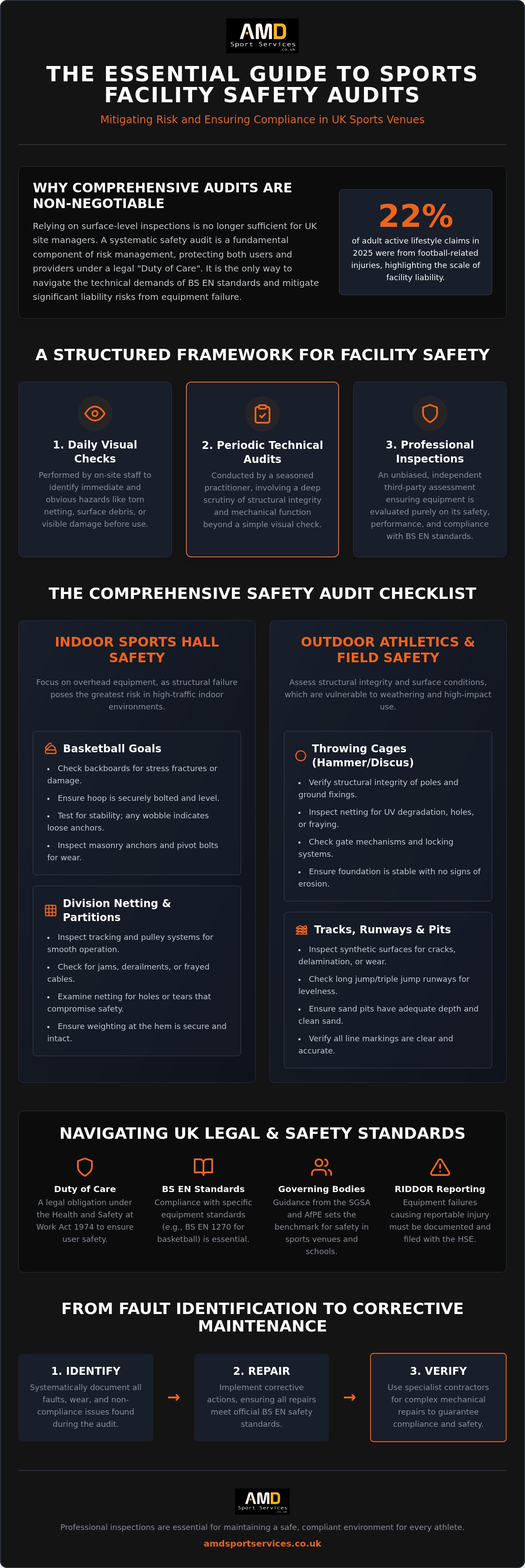
Football-related injuries accounted for 22% of all adult active lifestyle claims in 2025, a figure that underscores the significant liability risks facing UK site managers today. Relying on a surface-level inspection is no longer sufficient; you need a comprehensive sports facility safety audit checklist to navigate the technical demands of BS EN 913:2018+A1:2021 and the new security mandates of Martyn’s Law. We know the pressure of managing aging equipment on a restricted budget whilst worrying about the legal fallout if a structural failure occurs during a match or session.
This guide offers a grounded, expert-led framework for conducting robust safety audits across both indoor and outdoor facilities. You’ll gain a clear understanding of the mechanical checks required for high-stress apparatus and learn exactly how to document your findings for insurance and governing bodies. We’ll also clarify the specific scenarios where a specialist contractor is required to ensure your repairs meet official standards. From inspecting basketball goals to refurbishing long jump runways, this article provides the technical clarity you need to maintain a safe, compliant environment for every athlete in 2026.
Table of Contents
Understanding the Framework of Sports Facility Safety Audits in the UK
Indoor Sports Hall Safety: From Basketball Goals to Division Netting
Outdoor Athletics and Field Safety: Inspecting Tracks, Pits, and Cages
The Essential Sports Facility Safety Audit Checklist: A Comprehensive Breakdown
Beyond the Checklist: Implementing Corrective Maintenance and Professional Inspections
Understanding the Framework of Sports Facility Safety Audits in the UK
A sports facility safety audit is a systematic, methodical evaluation of both physical assets and operational protocols. It ensures that every piece of equipment, from a wall-mounted basketball goal to a long jump runway, remains fit for purpose and safe for use. In the UK, this process is not merely a recommendation; it's a fundamental component of risk management that protects both the user and the provider. It moves beyond a simple visual check, requiring a technical scrutiny of how equipment performs under stress.
Under the Health and Safety at Work Act 1974, facility managers hold a legal "Duty of Care" to ensure the safety of employees and the public. This responsibility is often guided by the Sports Grounds Safety Authority (SGSA), which provides the framework for maintaining safe environments. Adhering to specific standards, such as BS EN 1270 for basketball equipment and BS EN 1176 for playground apparatus, is essential for demonstrating compliance. In educational settings, the Association for Physical Education (AfPE) sets the benchmark for sports hall safety, offering the definitive guidance that schools and colleges must follow to maintain safe learning environments.
Legal Compliance and Liability Mitigation
Maintaining a documented sports facility safety audit checklist serves as a vital legal shield. If an accident occurs, this audit trail proves that the organisation took all reasonable steps to prevent harm, which is critical for defending against negligence claims. Managers must also be aware of their obligations under RIDDOR (Reporting of Injuries, Diseases and Dangerous Occurrences Regulations). Any equipment failure that results in a reportable injury must be officially documented and reported to the Health and Safety Executive. Combining annual professional inspections with regular in-house visual checks ensures that minor mechanical wear is identified before it's allowed to cause a serious incident.
Who Should Conduct the Audit?
Effective safety management requires a tiered approach to inspections. Site staff should perform daily walk-through checks to identify immediate hazards like torn netting or surface debris. Whilst these checks are useful, they can't replace the periodic technical audit conducted by a seasoned practitioner. A professional assessment involves a deep scrutiny of structural integrity and mechanical function that goes beyond what a non-expert can see. Independent third-party assessments offer an unbiased perspective, ensuring that equipment is evaluated purely on its safety and performance. Using a standardised sports facility safety audit checklist ensures consistency amongst different staff members and guarantees that no component is overlooked during the assessment process.
Indoor Sports Hall Safety: From Basketball Goals to Division Netting
Indoor sports halls are high-traffic environments where overhead equipment poses the greatest risk. When conducting a sports facility safety audit checklist, you must prioritise the structural integrity of wall-mounted and ceiling-suspended apparatus. These units are subject to constant vibration and mechanical stress. Failure here isn't just an equipment issue; it's a major safety hazard. According to guidance from the UK Government's Sports Grounds Safety Authority, maintaining these assets requires technical precision and regular scrutiny.
Basketball goals are primary audit targets. You should examine the backboard for stress fractures and ensure the hoop is securely bolted. Stability is paramount; even a slight wobble in the bracketry can indicate loose masonry anchors or worn pivot bolts. Similarly, sports hall division netting and partition curtains require inspection. These systems often rely on complex tracking and pulleys that can jam or derail if not properly maintained. Ensuring the netting is free from holes and the weighting at the hem is secure prevents balls from passing through and protects players in adjacent courts.
Inspecting Ceiling-Mounted and Motorised Apparatus
Roof-mounted basketball goals rely on safety winches and secondary safety chains to prevent catastrophic failure. During your audit, look for signs of oil leaks from winches or corrosion on the safety links. For motorised netting systems, pay close attention to the gym cables. Frayed strands or "bird-caging" in the wire rope are immediate red flags. Worn pulleys can cause uneven lifting, putting unnecessary strain on the motor and tracking. If you identify these mechanical issues, professional indoor inspection and maintenance services are essential to rectify the faults safely.
Gymnastics and Portable Equipment Checks
Gymnastics equipment undergoes intense physical stress. Your sports facility safety audit checklist should include a detailed review of trampoline beds, checking for thinning fabric or failing stitching. Springs must be inspected for uniform tension; any "gapping" suggests the metal has reached its elastic limit. Frame padding must be thick enough to absorb impact and securely tied down.
Portable equipment, such as netball posts or freestanding hoops, requires a different approach. Check that the ballast weights are sufficient and that the base hasn't developed sharp edges or cracks. Floor sockets and anchor points are also critical. Ensure the caps sit flush with the floor to prevent tripping hazards whilst ensuring the internal threads remain clear of debris. For complex mechanical issues, such as specialist gymnastics trampoline repairs, always consult a practitioner who understands the structural requirements of the apparatus.
Outdoor Athletics and Field Safety: Inspecting Tracks, Pits, and Cages
Outdoor sports facilities face a unique set of challenges that indoor halls don't encounter, primarily driven by the unpredictable UK climate. Constant exposure to frost, rain, and UV radiation accelerates the degradation of structural components and synthetic surfaces. When you're working through your sports facility safety audit checklist, you must shift your focus toward weather-related wear and high-impact structural integrity. Meeting the Health and Safety Executive (HSE) legal requirements for outdoor areas means ensuring that every piece of infrastructure, from a pole vault trough to a hammer cage, can withstand both the elements and the rigours of competition.
Outdoor cricket netting and football goal systems are also prone to hidden risks. Ground anchors can work loose in soft, waterlogged soil, whilst netting often becomes brittle after several seasons of sun exposure. A failure in a throwing cage or a collapsing goal post carries severe liability consequences, making these high-priority items for any seasonal audit. Identifying these faults early is the only way to maintain a safe environment for athletes and spectators alike.
Athletics Infrastructure and Throwing Cage Integrity
Throwing cages for hammer and discus are high-risk structures that require meticulous mechanical scrutiny. You should inspect the netting for UV degradation; if the mesh feels dry or "crunchy" to the touch, it's likely lost its energy-absorption capacity and needs replacement. The structural gate hinges and ground anchors must be checked for corrosion and movement. These gates are heavy and subject to high-velocity impacts; any failure in the hinge mechanism could lead to a catastrophic collapse. Additionally, ensure that landing pits are filled with UKA approved silica sand for landing pits to provide the necessary cushioning and prevent athlete injury during descent.
Surfacing and Runway Maintenance
Synthetic surfaces like tartan tracks and polyurethane runways are prone to delamination, often appearing as "bubbling" where the top layer has separated from the base. This isn't just an aesthetic issue; it's a significant trip hazard that can cause serious falls. Your sports facility safety audit checklist should include a walk-over of all runways to check for these soft spots. Long jump take-off boards are another critical area. Wood rot or instability in the housing can cause the board to shift under a jumper's foot, leading to acute ankle or knee injuries. Finally, assess the slip resistance of any safety surfacing, such as rubber crumb or mulch in MUGAs. Over time, moss and algae growth can turn these surfaces into ice-like hazards, requiring professional deep cleaning or resurfacing to restore grip. If your audit reveals significant structural or surface failings, seeking a specialist for external sport equipment installation and repair is the most reliable way to restore compliance.
The Essential Sports Facility Safety Audit Checklist: A Comprehensive Breakdown
A safety audit is only as good as the documentation it produces. To ensure your sports facility safety audit checklist holds up under legal scrutiny, every entry must be supported by photographic evidence and a dated signature. This creates a transparent record of the facility's condition at a specific point in time. We recommend a tiered approach that separates structural integrity from administrative records, allowing for a more streamlined inspection process. By organising the audit by facility zone, you can systematically move through the site without missing isolated equipment in storage rooms or external corners.
We advocate for a "Traffic Light" system to prioritise repairs effectively. This method allows managers to allocate limited budgets to the most critical risks first:
Red: Immediate hazard identified. Equipment must be decommissioned and cordoned off until a professional repair is completed.
Amber: Wear or minor fault detected. The item is currently safe but requires monitoring or scheduled maintenance within a defined timeframe.
Green: Equipment is fit for purpose and meets all relevant BS EN safety standards.
Structural and Mechanical Checklist Items
The mechanical scrutiny of your apparatus is the most technical part of the audit. You must check all fixings, bolts, and welds on basketball goals and wall-mounted frames for signs of metal fatigue or stress fractures. These components are under constant load and vibration. For motorised systems, verify that all netting operates smoothly without snagging or creating undue tension on the winch. In gymnastics areas, inspect the tensioning of trampoline springs and ensure safety padding remains thick enough to absorb impact without "bottoming out" against the frame.
Surface and Environmental Checklist Items
Surfaces are the primary cause of slips and trips. Examine court markings for visibility and grip, particularly in high-traffic zones like the "D" in basketball or netball. In outdoor areas, check for trip hazards such as loose rubber mulch or uneven safety surfacing. Environmental safety also extends to how equipment is stored. Audit the storage of portable goals and mats to ensure they don't obstruct fire exits or walkways. If your internal audit identifies complex mechanical failures or surface degradation, you can book a specialist sports equipment safety inspection to ensure every fault is rectified to official standards.
Beyond the Checklist: Implementing Corrective Maintenance and Professional Inspections
Identifying a fault via your sports facility safety audit checklist is only the first half of the process. The second, more critical stage is the execution of certified repairs. A documented fault that remains unaddressed is a significant legal liability; it's evidence that a risk was known but ignored. To protect your organisation, you must maintain a "Safety Log Book" that records every inspection, identified fault, and subsequent repair. This log book is your primary evidence of compliance when dealing with insurers or governing bodies, proving that you have met your duty of care through consistent, recorded action.
Relying on general handymen for sports equipment maintenance is a common mistake. Sports apparatus, such as motorised basketball goals or gymnastics trampolines, are complex mechanical systems. They require the technical proficiency of a seasoned practitioner who understands the load-bearing requirements and official standards. AMD Sport Services provides the specialist expertise needed to transition from audit findings to a fully compliant facility, ensuring that every repair is durable and safe for high-intensity use.
When to Call a Specialist Contractor
Any "Red Level" fault identified during an audit requires immediate equipment decommissioning. You should cordon off the area and contact a specialist. These faults often involve structural fatigue in wall-mounted frames or frayed cables in motorised systems. Tasks like motorising roof-mounted basketball goals or replacing heavy-duty netting systems are not standard maintenance jobs. Older facilities often present unique challenges where standard parts are no longer available. In these cases, bespoke engineering solutions are required to restore safety without the expense of replacing the entire installation.
Planning for Long-Term Facility Refurbishment
Use your audit data as a strategic tool. It provides the evidence needed to build a business case for capital investment, such as a long jump runway refurbishment or a full track renewal. Proactive maintenance doesn't just ensure safety; it significantly extends the operational lifespan of expensive assets. By viewing safety as a continuous improvement cycle rather than a yearly hurdle, you move from reactive repairs to a methodical management style. This approach ensures your facility remains a high-quality environment for athletes whilst protecting the long-term budget of the sports centre or school.
Securing Your Facility’s Future Through Technical Scrutiny
Maintaining a safe environment requires more than a casual walk-through. By implementing a structured sports facility safety audit checklist, you've taken the first step toward meeting your legal duty of care and mitigating liability. The true value of an audit lies in the precision of the corrective maintenance that follows. Whether you’re managing motorised basketball goals or outdoor athletics infrastructure, ensuring every repair meets current BS EN standards is essential for long-term athlete safety and insurance compliance.
AMD Sport Services provides UK-wide national coverage and specialist knowledge to help you manage these complex mechanical and structural requirements. We deliver comprehensive reports with actionable repair advice, allowing you to focus on facility operations with absolute confidence. Book Your Professional Sports Equipment Safety Inspection Today and ensure your site remains a benchmark for safety and performance. Taking a proactive approach today protects your equipment, your budget, and most importantly, your users.
Frequently Asked Questions
How often should a sports facility safety audit be conducted in the UK?
Professional technical audits should be conducted at least once every 12 months. This ensures that structural and mechanical components, which are subject to high stress, remain compliant with BS EN safety standards. Whilst annual inspections are the industry standard for insurance and regulatory purposes, managers should supplement these with weekly or daily visual inspections. This tiered approach allows for early identification of wear and tear before it develops into a reportable safety hazard.
Is a sports facility safety audit a legal requirement for schools?
Yes, schools have a legal duty of care under the Health and Safety at Work Act 1974. They must ensure that all sports equipment is safe for use by pupils and staff. Adhering to a robust sports facility safety audit checklist helps schools meet these obligations. The Association for Physical Education (AfPE) also provides clear guidance that mandates regular, documented inspections of indoor and outdoor apparatus to maintain a safe learning environment.
What is the difference between a visual inspection and a professional safety audit?
A visual inspection is a frequent, surface-level check carried out by on-site staff to spot obvious hazards like debris or torn netting. In contrast, a professional safety audit is a deep technical assessment. It involves testing the structural integrity of anchors, the tension of springs, and the mechanical function of winches. Specialists use industry-specific tools and knowledge of BS EN standards to identify hidden fatigue that a non-expert would likely overlook.
Can our own staff carry out the annual sports equipment safety inspection?
Whilst staff can perform routine daily or weekly checks, the annual inspection must be carried out by a competent specialist. Professional audits require a level of technical knowledge and liability insurance that standard facility staff don't possess. A specialist has the expertise to certify that equipment meets current safety regulations. Relying on an independent expert also ensures an unbiased report, which is essential for demonstrating compliance to insurers and local authorities.
What are the most common safety hazards found in UK sports halls?
Common hazards include loosening wall-mounted basketball goal brackets and frayed cables in motorised division netting. Floor sockets that don't sit flush create persistent tripping risks, whilst worn upholstery on fitness equipment can lead to hygiene issues or structural failure. We also frequently find that portable equipment is stored in a way that obstructs fire exits. Identifying these issues through a methodical audit prevents minor mechanical wear from escalating into a serious accident.
How long should we keep records of our sports facility safety audits?
You should keep all audit records for a minimum of three years, as this aligns with the typical statute of limitations for personal injury claims in the UK. However, many organisations choose to retain these documents for up to seven years to ensure a comprehensive history of maintenance. Maintaining a consistent safety log book demonstrates a long-term commitment to duty of care. These records are vital for defending against negligence claims and verifying compliance during insurance renewals.
What happens if our facility fails a safety audit?
If a piece of equipment fails, it must be decommissioned and cordoned off immediately to prevent use. You should then follow the "Traffic Light" system to prioritise the necessary repairs. A failure isn't a permanent closure; it's a critical signal that professional intervention is required. Once a specialist contractor has completed the corrective maintenance, the equipment can be re-inspected and returned to service, ensuring it once again meets all relevant BS EN safety standards.
Do we need separate audits for indoor and outdoor sports equipment?
Yes, because the risks and regulatory standards differ significantly between environments. Indoor audits focus on ceiling-mounted mechanical systems and floor-mounted apparatus. Outdoor audits must account for weather-related degradation, UV damage to netting, and the structural integrity of throwing cages or goal posts anchored in the ground. Using a tailored sports facility safety audit checklist for each zone ensures that environment-specific hazards, such as moss growth on safety surfacing or rust on athletics gates, are thoroughly assessed.


Comments